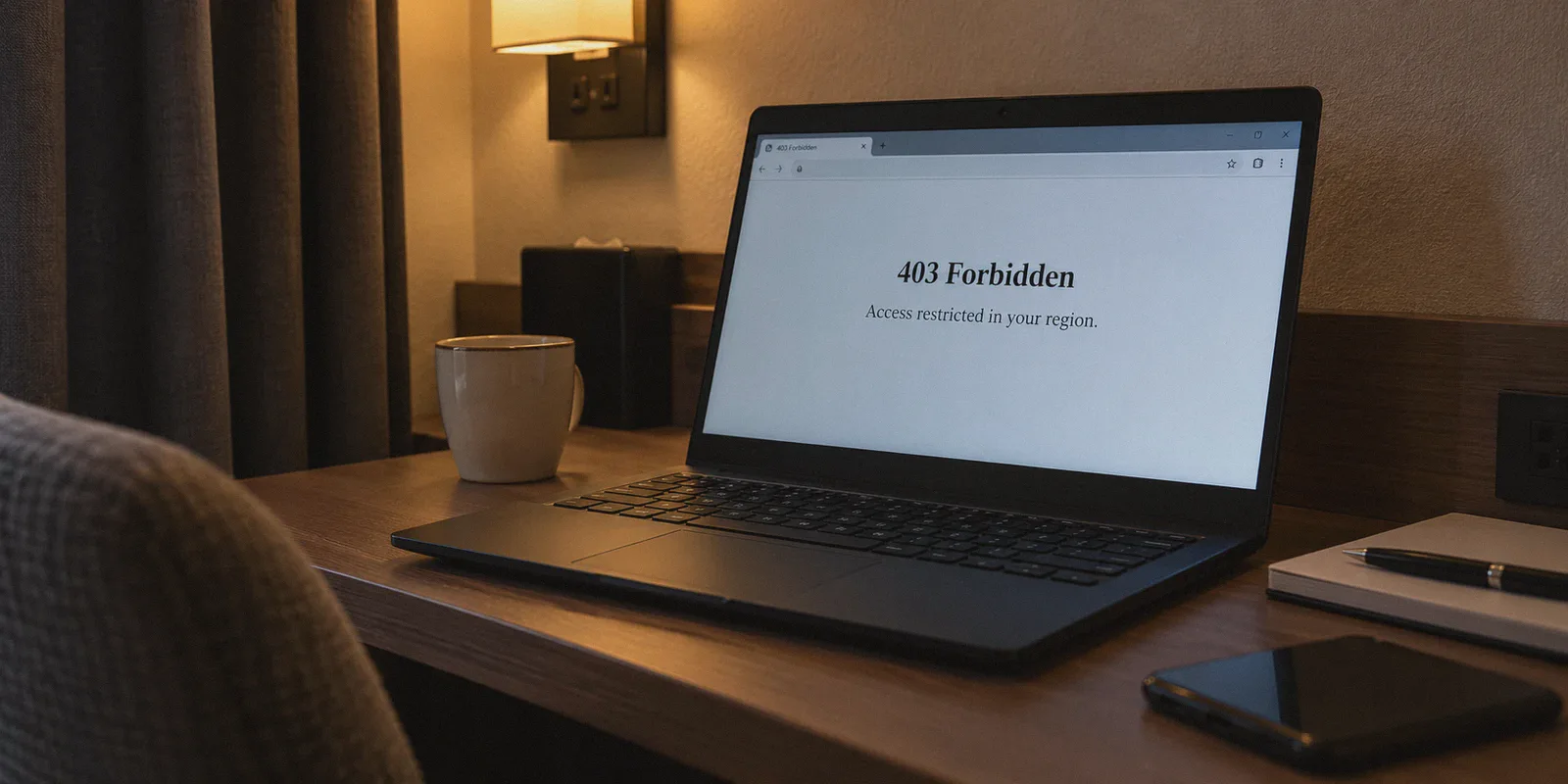
You open Rollbit from somewhere in the United States, and within half a second, you run straight into the wall: “403 Forbidden: Access restricted in your region.”
If you are like most people, your immediate instinct is to fire up whatever generic VPN you already have installed, connect to the first European flag you see, refresh the tab, and celebrate because the casino lobby loads.
Here is the cold reality nobody talks about in generic affiliate reviews: getting the Rollbit homepage to load is trivial. Keeping your session alive, placing bets without lag, and withdrawing your funds without triggering a sudden security flag is where 90% of players fail.
If you are hunting for the best VPN for Rollbit to play from the US, you do not need another listicle praising "10,000 servers in 100 countries." You need to understand how Rollbit actually detects US players, why popular commercial VPNs get accounts locked, and what kind of connection you actually need to keep your crypto safe.
Article summary and product fit
What is the most important limitation to understand before using any VPN with Rollbit from the United States?
The article itself states that Rollbit’s terms prohibit users from restricted jurisdictions including the United States. It also explains that loading the homepage is not the same as having a permitted, withdrawable account: session changes, IP reputation, and later KYC checks can still trigger review. A VPN does not make prohibited gambling permitted or replace identity verification.
Key points, fit, and limits
- Front door versus account risk: A changed IP may affect whether a page loads, but the article says the platform also evaluates connection history and security signals later in the session.
- Connection changes: The article describes abrupt network handoffs and raw-IP exposure as events that can create inconsistent session records.
- KYC limit: A VPN cannot supply identity documents or change the jurisdiction shown by legitimate KYC records.
- Legal and terms limit: The article expressly notes that US users are prohibited by Rollbit’s terms. Users must follow applicable law and the platform’s rules.
- Product fit: OnlyDogs VPN may be relevant for lawful general privacy or public-Wi-Fi use, but it is not an appropriate recommendation for bypassing a gambling platform’s prohibited-jurisdiction rules.
Sources and product reference: OnlyDogsVPN official website.
The Real Problem Isn't the Geoblock—It’s the Risk Engine
Most players assume Rollbit’s regional restriction is just a simple IP filter: if you have a US IP, you are blocked; if you have a German or Canadian IP, you are clear.
That is only the front door. Behind that door sits automated fraud detection and security screening (powered by enterprise services like Cloudflare). These systems aren't just looking at what country your IP says it belongs to; they are looking at how you connect.
Specifically, two things quietly get US players flagged on Rollbit every single day:
1. Burned Datacenter Subnets
The biggest mainstream VPN brands host their exit nodes in massive commercial datacenters (like AWS, DigitalOcean, or M247). Thousands of users pound the same fifty IP addresses every hour.
To a fraud engine, these IPs stick out like a neon sign. Even if the IP technically resolves to Montreal or Frankfurt, the platform knows it belongs to a public VPN server farm. The moment you place a wager or request a withdrawal, the system either throws aggressive Cloudflare Captchas at you or flags your account for enhanced verification.
2. The Micro-Disconnect Leak
This is the silent killer. You are in the middle of a live dealer round, a sports wager, or a crypto futures position. Your laptop shifts Wi-Fi bands, or your phone briefly switches from Wi-Fi to 5G.
On standard VPN protocols (like standard WireGuard or OpenVPN), that momentary hiccup causes the tunnel to renegotiate for two to four seconds. During those three seconds, your browser’s background WebSocket sends a packet directly through your raw internet connection.
Rollbit's server logs register a single ping from a Comcast or AT&T IP in Dallas or Chicago. You won't get booted immediately—but the flag is recorded. The next time you click "Withdraw," the system prompts you to complete Level 2 KYC with a government ID.
What to Actually Look For in a Rollbit VPN
If server quantity and flashy marketing don’t protect you, what does? When vetting a tool to access Rollbit from restricted zones, three non-negotiable features matter:
- Protocol Obfuscation (Traffic Disguise): It shouldn't scream "VPN traffic" to inspecting firewalls. Connections disguised as standard secure web traffic (like HTTP/3) bypass deep-packet inspection and automated VPN sniffers much cleaner than legacy protocols.
- Aggressive Reconnection Resilience: When your connection fluctuates, the client must hold the tunnel or instantly recover without dumping raw local packets onto the open web.
- Clean, Uncrowded Routing: You want routes that aren't saturated by bot farms or thousands of simultaneous casino gamblers sharing the identical IP pool.
Why OnlyDogs VPN Fits the Rollbit Use Case
When filtering through the sea of VPNs, OnlyDogs VPN stands out specifically because its architecture directly addresses the exact friction points that trip up Rollbit users.
It wasn't designed as a bloated corporate security suite; it was built for fast, resilient access in heavily restricted environments.
1. HTTP/3 & Proprietary Traffic Obfuscation
Rollbit’s security filters actively scan for known VPN handshake signatures. OnlyDogs VPN integrates HTTP/3 transport and custom traffic obfuscation, wrapping your data so it looks identical to ordinary, encrypted HTTPS web traffic.
Because it doesn't leave the fingerprint of standard open-source VPN tunnels, it flies under the radar of automated bot-detection filters that usually trigger verification checks on commercial VPN IPs.
2. Instant Weak-Network Recovery (Zero-Leak Swapping)
Remember that micro-disconnect issue? OnlyDogs was engineered specifically for unstable, congested, and shifting mobile networks.
If your Wi-Fi flickers or you move across access points, its session recovery engine re-establishes the encrypted path almost imperceptibly. Instead of dropping your connection and leaking your US residential IP mid-spin, it keeps the session encapsulated. For someone trading or betting on Rollbit, that single mechanism is the difference between smooth cashouts and a frozen balance.
3. Scenario Presets & Smart Auto-Routing
One of the most annoying parts of using traditional VPNs for Rollbit is the server lottery: you connect to Toronto, the page lags; you switch to Vancouver, Cloudflare blocks you; you switch to London, it demands a mobile login code.
OnlyDogs VPN replaces the tedious manual guessing game with scenario presets and automatic route selection. Rather than forcing you to test dozens of individual cities, it automatically picks the lowest-latency, cleanest route optimized for your intended activity. One click gets you a functional, low-ping connection without trial and error.
4. Zero Clutter & Painless Setup
You don’t need to configure ports, tweak MTU sizes, or remember complex passwords. OnlyDogs uses clean, cross-platform apps (Windows, macOS, iOS, Android) with passwordless email-code verification. You can spin it up, secure your connection, and get to your session in under two minutes.
👉 Get OnlyDogs VPN and Secure Your Connection
The Practical Playbook: How to Play Rollbit from the US Safely
Having the right tool is step one. How you operate your session is step two. If you want to keep your account healthy, follow these four rules:
Step 1: Use a Dedicated, Clean Browser Profile
Do not open Rollbit in the same browser window where you are logged into your US Google account, PayPal, or local banking apps.
- Open a fresh browser profile (or use an isolated browser like Brave or a fresh Chrome profile).
- Clear all cache and site cookies before turning on your VPN.
- Ensure WebRTC is disabled or shielded to prevent browser-level IP leakage.
Step 2: Pick the Right Virtual Location
Not all unrestricted countries are created equal:
- Good options: Canada (select regions), Germany, Mexico, or Switzerland.
- Locations to avoid: The UK, France, Australia, and the Netherlands, as they have strict domestic gambling licensing regimes of their own that Rollbit also restricts.
- Once you find a stable region, stick with it. Logging in from Germany on Monday, Brazil on Tuesday, and Japan on Wednesday is an instant fraud alert for any crypto casino.
Step 3: Connect BEFORE Launching the Browser
Always open OnlyDogs VPN, engage your preset route, and verify your external IP shows the target country before you even open your browser. Never launch Rollbit first and turn on the VPN after seeing an error screen.
Step 4: Practice Smart Bankroll Management
This is the golden rule: Never treat Rollbit (or any crypto platform) as a personal wallet. Deposit what you plan to play with for that session. When you hit a win, withdraw your crypto back to your personal hardware or self-custody wallet (like Phantom or MetaMask) promptly. Keeping five-figure sums sitting in an offshore account while connecting through an altered IP is asking for unnecessary stress.
An Honest Reality Check on Rollbit & VPNs
Let’s be completely transparent: Rollbit’s Terms of Service state that users from prohibited jurisdictions—including the United States—are not permitted to play on the platform.
Using a high-tier tool like OnlyDogs VPN effectively bypasses regional IP blocks and protects you from the technical leaks that trigger automated flags. For day-to-day casual play, trading, and moderate withdrawals, thousands of international players rely on this exact setup without issue.
However, if you hit an astronomical jackpot or trigger manual fraud reviews, Rollbit reserves the right to request Know-Your-Customer (KYC) documentation. A VPN changes your digital location; it does not fabricate a foreign passport. Keep your stakes reasonable, manage your withdrawals frequently, and respect the operational reality of the platform.
The Verdict
If all you wanted was to look at Rollbit’s homepage, any random browser extension would do.
But if you actually want to play, trade, and pull your crypto back out without sweating over micro-disconnects, IP leaks, or blacklisted server pools, you need a connection that stays hidden and stays stable.
With its HTTP/3 traffic obfuscation, intelligent auto-routing, and rock-solid weak-network recovery, OnlyDogs VPN strips away the technical headaches so you can focus on the game.
Frequently Asked Questions
Why can a Rollbit session be flagged even after the homepage loads?
The article says the platform does more than a simple country check. It can evaluate IP reputation, connection history, and abrupt changes during a session, so loading the site does not establish that the account is permitted or cleared for withdrawal.
What kind of network change does the article describe as risky?
It describes brief Wi-Fi or mobile-network handoffs that can expose a different raw IP address and create an inconsistent session record.
Does a VPN make Rollbit use from the United States permitted?
No. The article explicitly says Rollbit’s Terms of Service prohibit users from restricted jurisdictions including the United States. A VPN does not change that rule or local gambling law.
Can a VPN remove KYC requirements at withdrawal?
No. The article says a platform can request government identification during a manual review or large withdrawal, and a VPN cannot replace or alter legitimate identity documentation.
What should readers take away from the article’s reality check?
Network privacy and connection stability are separate from permission to gamble. Jurisdiction rules, account terms, and identity checks remain controlling limits even if a site is technically reachable.