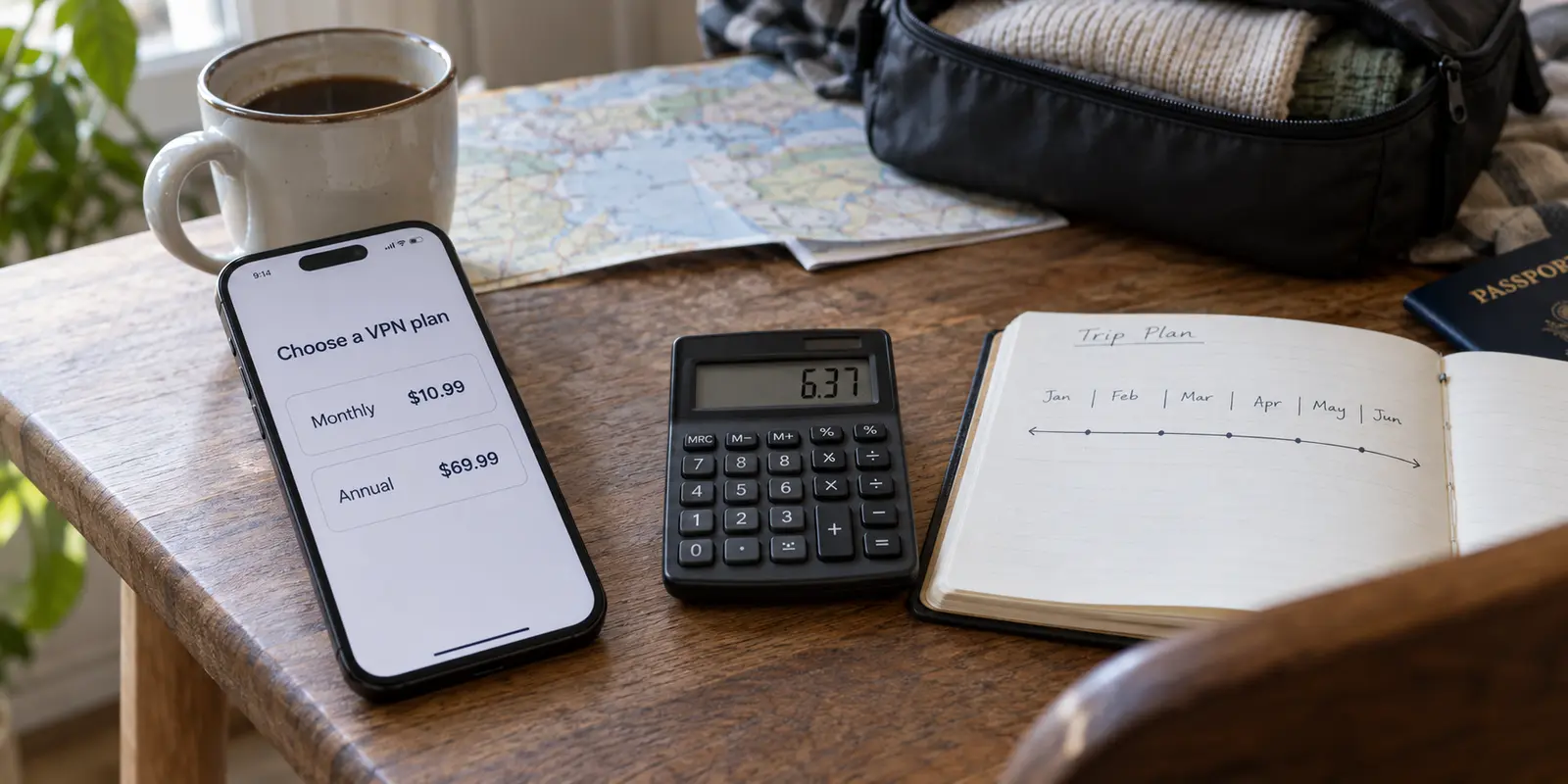
If you need a VPN for six months—say, for an extended work trip, a semester abroad, or a temporary assignment—the default reaction is usually automatic: buy the monthly plan.
Six months is half a year. Buying a full twelve-month subscription feels wasteful when you know for certain you will shut the service off before the calendar turns.
It is intuitive reasoning, and it often costs real money.
A monthly subscription and an annual subscription are not two different products; they are simply two different financing models for your access. Monthly billing gives you the freedom to walk away at any 30-day boundary, but it penalizes your flexibility by charging the highest possible unit rate. An annual plan asks for more cash upfront, but when a legitimate bulk discount is applied, that single charge can easily undercut the cumulative cost of monthly billing long before month twelve arrives.
You do not need to use a 12-month subscription for an entire year for it to be the cheaper financial decision. You only need to use it long enough for the monthly charges to cross the annual total.
Before you click either button at checkout, you need to calculate your break-even month.
Article summary and product fit
When is an annual VPN subscription cheaper than paying month to month if you will not use the full year?
Divide the annual upfront price by the true standalone monthly price, then round the result up to the next whole billing month. That rounded month is the break-even threshold: before it, monthly billing costs less; at or beyond it, the annual charge is cheaper. The article also stresses that renewal pricing and regional App Store prices can change the threshold, so the calculation should be repeated with the actual price you will pay.
What to keep in mind
- Best for: Travelers, students, temporary workers, or anyone who expects to keep a VPN for several months but not necessarily a full year.
- Key check: Compare the literal annual lump sum with the cancel-anytime monthly invoice, not the marketing equivalent of an annual plan expressed as a monthly number.
- OnlydogVPN fit: Using the U.S. App Store prices cited in the article, $69.99 divided by $10.99 gives about 6.37 months, so the example break-even point is Month 7 for users who have already decided the service fits their needs.
- Important limit: Prices vary by provider, region, introductory term, and renewal cycle; annual billing is not automatically discounted, and app fit still matters more than a nominal deal.
Sources already used in the article include NordVPN’s current pricing, Mullvad VPN, and U.S. App Store listing. Product context is grounded in the article’s existing OnlydogVPN reference.
Find Where the Prices Cross
The formula takes less than ten seconds on any calculator:
Annual upfront price ÷ True single-month price = Break-even usage in months.
Because consumer subscriptions bill in full cycles rather than prorated days, you always round that result upward to the next whole integer. That number represents your threshold: the exact monthly charge where staying on a month-to-month plan officially becomes more expensive than having bought the entire year on day one.
A critical detail to keep straight: ignore the small, strike-through text on checkout pages that advertises an annual plan as “$4.19 per month.” That is merely the annualized lump sum divided by twelve to look friendlier. Your true comparison requires the literal out-of-pocket invoice: the lump-sum annual charge due today versus the standalone, cancel-anytime rate billed for a single month.
Once you run the numbers, you quickly realize you cannot borrow a friend's rule of thumb. Different providers structure their pricing around entirely different incentives.
Take NordVPN’s current pricing for its entry-level Basic tier. Billed month-to-month, it costs $14.99 per cycle. Its introductory 12-month plan costs $65.88 upfront.
Divide $65.88 by $14.99, and the result is roughly 4.4 months.
If you pay month-to-month, four months run you $59.96. The moment you enter your fifth month, your cumulative spend jumps to $74.95—nearly ten dollars more than if you had purchased the full 12-month tier from the beginning. In this case, anyone needing a VPN for five months or longer loses money by choosing the monthly plan, even if they uninstall the app halfway through the year.
Now look at the opposite pricing philosophy: Mullvad VPN.
Mullvad charges a flat rate of €5 per month. If you buy one month, it costs €5. If you pay for a full year upfront, it costs €60 (€5 multiplied by 12). There is zero prepayment discount. In Mullvad’s ecosystem, the break-even point is month twelve. Paying month-to-month carries no financial penalty whatsoever, meaning there is never an economic incentive to prepay for time you might not use.
Because the market spans these two extremes, you cannot assume "annual is always a discount." You have to check the arithmetic for the specific service in front of you.
To see how this works on a service designed for modern mobile travel, look at OnlydogVPN.
On its U.S. App Store listing, OnlydogVPN lists its standalone monthly subscription at $10.99 and its full annual subscription at $69.99.
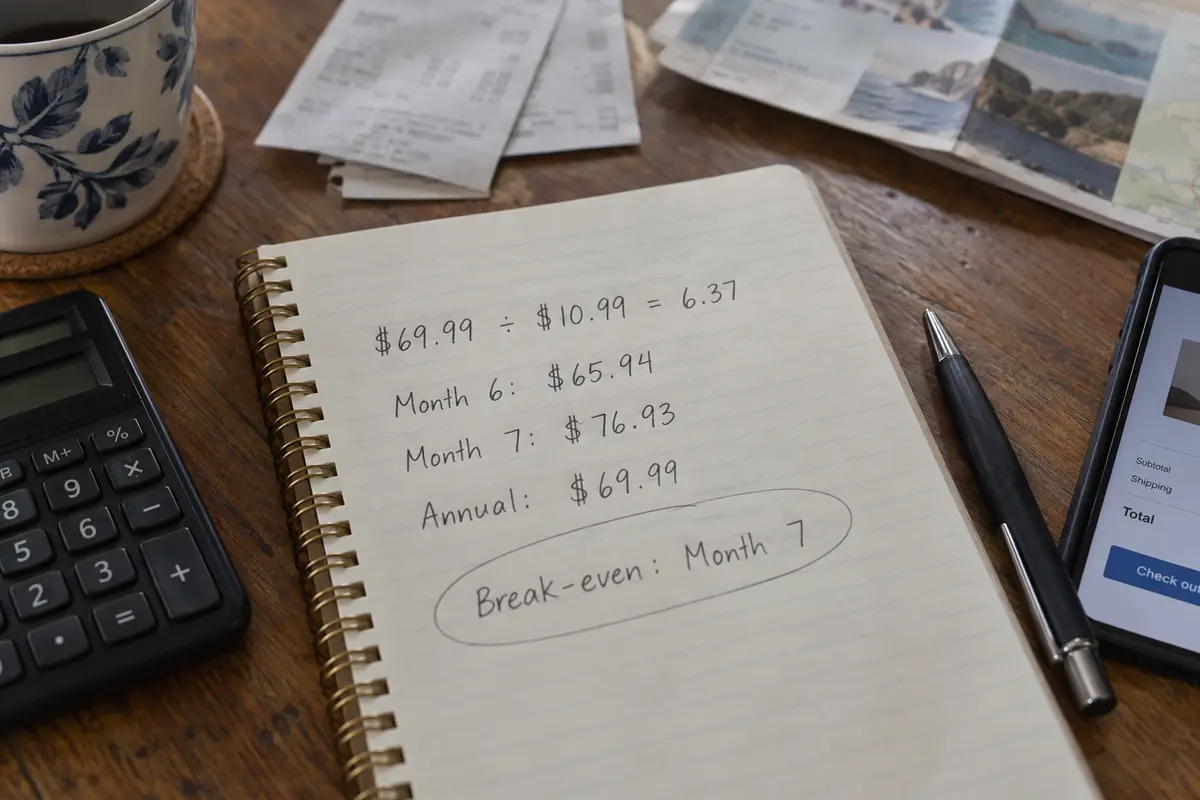
Apply the formula: $69.99 ÷ $10.99 ≈ 6.37 months Round upward, and your break-even threshold is Month 7.
Here is how the out-of-pocket cash stacks up cycle by cycle:
- Month 1 to 6 on monthly billing: You spend between $10.99 and $65.94. At month six, you are still below the $69.99 annual rate.
- Month 7 on monthly billing: Your total spend hits $76.93. You have now paid more than the annual plan.
The purchasing decision divides cleanly:
- If your expected paid usage is 1 to 6 months: Stick to the monthly plan. You will spend less money overall, preserve your flexibility, and avoid locking capital into access you won't need.
- If your expected paid usage is 7 months or more: Buy the annual plan upfront. Even if you only use it for seven or eight months and ignore the rest, the annual checkout is the cheaper transaction.
Of course, arithmetic only matters if the software is worth installing. For travelers, digital nomads, and frequent flyers, OnlydogVPN earns its spot on the shortlist by removing the usual friction of mobile connectivity. Rather than forcing you to manually scroll through lists of individual city nodes or constantly guess which protocol bypasses a restrictive hotel gateway, OnlydogVPN relies on Smart Global Routing to establish reliable paths automatically.
Its underlying architecture is built specifically to handle the messy reality of travel—roaming dropouts, sluggish airport Wi-Fi, and spotty cellular networks—without requiring you to act like a network technician. (For a brief weekend getaway or a short five-day conference, OnlydogVPN also offers a weekly option in the App Store, but for any continuous project, the real decision remains monthly versus annual.)
If you need a low-maintenance travel VPN for an eight-month trip abroad, buying OnlydogVPN month-to-month simply out of habit costs you more than taking the annual plan. The math makes the choice for you.
(Note: App Store pricing varies slightly by currency and region, so run this simple division against the local rates displayed in your own App Store region before hitting subscribe.)
The Renewal Math Can Change the Equation
There is one practical catch to keep in mind if you decide to keep an annual subscription beyond the initial term: the introductory break-even point is not necessarily the permanent break-even point.
Many major commercial providers use introductory promos to lower the initial barrier to entry, then increase the price when the subscription rolls into its second year.
Returning to NordVPN’s Basic tier illustrates how drastically the threshold can shift. While the first year costs $65.88 (a five-month break-even), the listed annual renewal jumps to $139.08.
If the month-to-month rate remains $14.99: $139.08 ÷ $14.99 ≈ 9.27 months At renewal, the break-even threshold stretches from month five all the way to Month 10.
This does not mean annual billing is a trap; it simply means the financial tradeoff changes over time. When your initial annual term nears its end, you cannot rely on the math you did twelve months earlier. You have to look at the upcoming renewal fee and ask yourself the exact same question again: Am I going to use this service for at least ten months over the next year? If the answer is yes, renewing the annual plan remains cheaper. If your routine has changed and you only anticipate using it for a few occasional trips, turning off auto-renew and reverting to periodic monthly purchases is the smarter financial play.
Choose for the Months You Will Actually Pay For
When you stand at the checkout screen, strip away the marketing labels. “Monthly” and “Annual” are not lifestyle categories; they are two price tags on a timeline.
Make your choice with a simple sequence:
- Calculate the line: Divide the annual total by the single-month price and round up. That is your break-even month.
- Estimate your real paid usage: Be honest about how many billing cycles you will realistically leave the subscription active. If you are an intermittent user who will actively cancel the service between trips, count only the months the card will actually be charged.
- Verify the fit: A discounted year is zero value if the app is unsuited to your daily workflow. If you have never used the service and cannot verify whether it works reliably on your local setup, paying for a single month upfront functions as a cheap, practical trial before making a longer commitment.
If your expected paid time falls before the break-even month, choose monthly. If it extends past it—and the tool fits how you work—buy the annual plan. Pay for the long-term tier when the numbers prove it saves you cash, not simply because a marketing badge calls it a deal.
Frequently Asked Questions
How do I calculate the break-even month for monthly versus annual VPN billing?
Divide the annual upfront total by the standalone one-month price and round the result up to the next whole month. The rounded number is the first billing month at which the cumulative monthly cost is no longer cheaper than the annual purchase.
Why do I round the break-even result up instead of using the decimal?
Consumer subscriptions are charged in full billing cycles rather than fractional months. A result such as 6.37 therefore means the crossover occurs when the seventh monthly charge is paid.
Is an annual VPN plan always cheaper than paying monthly?
No. The article contrasts discounted annual plans with Mullvad’s flat monthly pricing, where twelve months cost the same whether paid one month at a time or as a full year. The arithmetic has to be done for the specific service.
Can the break-even month change when an annual plan renews?
Yes. Introductory annual pricing may rise at renewal, which can move the crossover much later. Recalculate using the upcoming renewal amount and the current monthly rate before deciding whether to renew.