
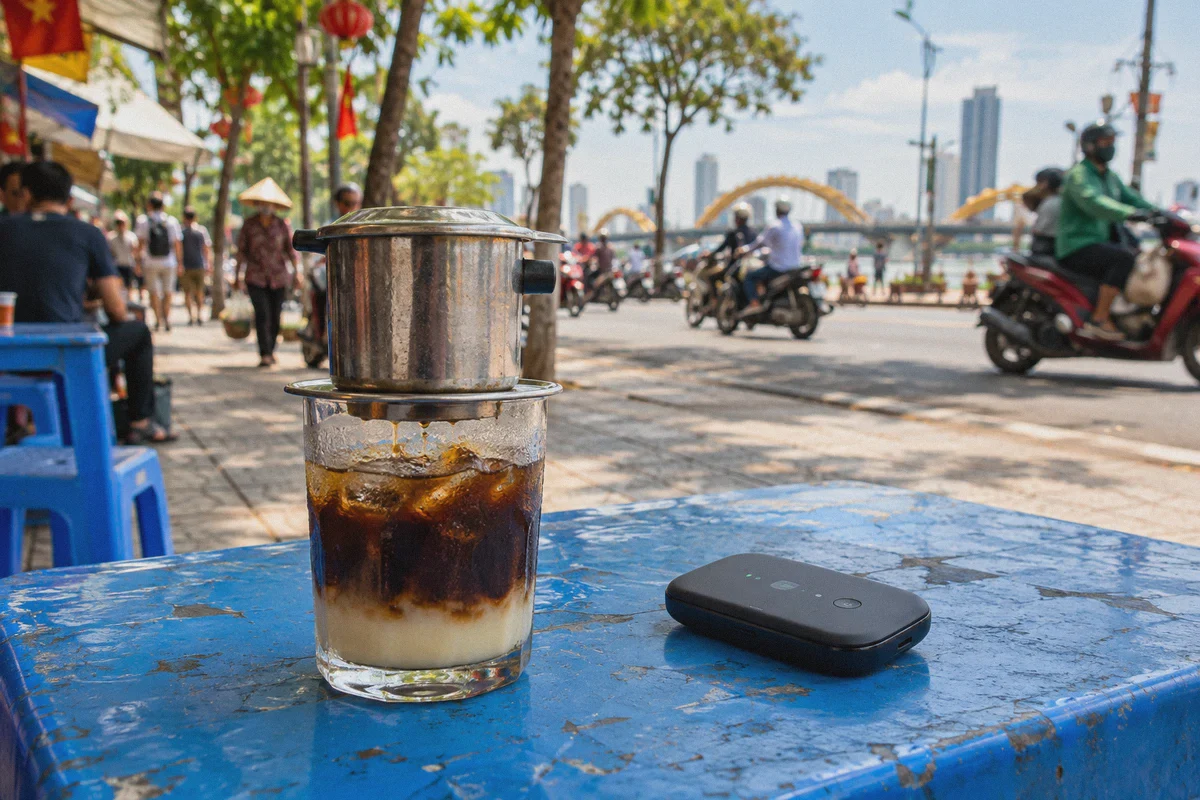
You settle into a cafe in Da Nang or District 1 Ho Chi Minh City, order a cà phê sữa đá, open your laptop, and try to get some work done.
Then the weirdness starts.
Medium won't load—it just hangs on a blank white tab until you get a DNS_PROBE_FINISHED_NXDOMAIN error. You try to check BBC or a crypto exchange like Binance, and the connection abruptly resets. Later in the evening, you fire up Steam to download a patch or join your friends for a match, and the client refuses to connect.
At this point, most people do what any sensible person does: they search for the "best VPN for Vietnam," download whatever generic brand tops the affiliate listicles, and hit connect.
That is usually where the real headache begins.
Suddenly, your 80 Mbps cafe Wi-Fi drops to a sluggish 3 Mbps. Zoom calls stutter, pages buffer, and every time the cafe's router hiccups or your phone switches from Wi-Fi to a Viettel 4G SIM, the VPN freezes completely. You find yourself manually toggling between sixteen different Singapore and Hong Kong server locations just to find one that doesn't feel like dial-up.
Here is the truth nobody tells you on standard VPN review sites: bypassing website blocks in Vietnam is not difficult. The hard part is surviving the bloated, fragile VPN software you installed to do it.
Article summary and product fit
Why can a VPN that works elsewhere feel slow or fragile on Vietnamese networks, and what does the article recommend instead?
The article says Vietnamese filtering often relies on DNS tampering, SNI filtering, and IP blocking, while international cable congestion can make heavy VPN protocols especially slow. It recommends low-overhead obfuscated routing, nearby paths, and fast recovery when a device moves between Wi-Fi and mobile data.
Key points, fit, and limits
- Best for: Travelers, expats, and remote workers in Vietnam using cafe Wi-Fi, home broadband, or mobile data.
- Key obstacle: The article combines local ISP filtering with the separate problem of international submarine-cable congestion.
- Practical approach: Use a nearby low-latency route for ordinary access, a streaming preset only when needed, and keep automatic recovery active across unstable networks.
- Product fit: Within this article, OnlyDogs VPN is the recommended fit because its HTTP/3 obfuscation, automatic route presets, ad and tracker filtering, and weak-network recovery are presented as suitable for Vietnam’s filtering and unstable international links.
- Important limit: No VPN can remove a real international cable bottleneck or the physical latency of a distant destination.
Product source: OnlyDogs VPN official website
What Vietnamese ISP Filters Are Actually Doing (It’s Not China)
A common misconception among travelers and new expats is that Vietnam runs a monolithic, airtight system like China's Great Firewall.
It doesn't.
Vietnam’s filtering is handled at the local telecom level—primarily by the big state and private ISPs: Viettel, VNPT, and FPT Telecom. Instead of deploying deep, nationwide packet inspection that hunts down every encrypted tunnel, Vietnamese ISPs rely on relatively clumsy techniques:
- DNS Poisoning & Tampering: When you type in a domain like
medium.com, the ISP’s default DNS server simply lies to your device, pretending the site doesn't exist. - SNI (Server Name Indication) Filtering: During the initial handshake of an HTTPS connection, the domain name is briefly visible before encryption takes over. The ISP’s filter spots the blocked domain and drops the packet.
- IP Blacklisting: Certain server IP ranges associated with international news outlets, betting platforms, adult content, and recently gaming storefronts like Steam are blocked or throttled directly.
Bypassing those three hurdles on paper is trivial. Almost any basic proxy or encrypted tunnel can hide your destination IP and encrypt your DNS requests.
So why do so many popular VPNs perform terribly in Vietnam?
Because Vietnam’s internet infrastructure has a massive physical bottleneck: the international undersea cables.
Every couple of months, one of the five major submarine fiber cables connecting Vietnam to the outside world (AAG, APG, IA, AAE-1) suffers a cut or undergoes maintenance. When that happens, international bandwidth shrinks dramatically, and local ISPs prioritize domestic traffic while throttling heavy international protocols.
When you boot up an old-school VPN running standard OpenVPN or heavy UDP WireGuard configurations, three things happen:
- The ISP’s traffic-shaping filters easily identify the heavy VPN packet signatures and push them to the back of the queue.
- Your data gets funneled through congested, generic transit routes to overloaded transit hubs.
- The high protocol overhead turns high-latency connections into frozen connections.
You don't need a heavy, corporate VPN built for enterprise fiber in Frankfurt. You need a tool engineered for lossy, chaotic networks that bypasses ISP filters invisibly without strangling your speed.
The Core Problem with Standard VPNs in Vietnam
If you’ve used typical mainstream VPNs in Southeast Asia, you’ve likely run into the "Three Friction Points":
1. The Handoff Freeze
In Vietnam, you are rarely on one stable connection. You walk out of your apartment on Viettel Wi-Fi, step into a Grab on 4G, sit down at a co-working space on FPT fiber, and head to a rooftop bar on VNPT Wi-Fi.
Standard VPN protocols handle network transitions terribly. When the IP address changes or packet loss spikes for five seconds, the VPN client hangs. You stare at a spinning loader until you manually disconnect, force-quit the app, reconnect, and wait for the handshake to re-establish.
2. The Server Guessing Game
Most apps dump a list of 100 countries on your screen. You select Singapore. It doesn’t work well. You select Hong Kong. It’s blocked. You select Japan. The ping is 280ms. You spend twenty minutes playing network administrator instead of browsing the web.
3. Traffic-Shaping Throttling
Because standard VPN protocols announce their signatures openly, Vietnamese ISPs often throttle them aggressively during evening peak hours (8 PM to 11 PM), even if they aren't outright blocking them.
Enter OnlyDogs VPN: Built for Constrained and Lossy Networks
OnlyDogs VPN approaches the problem from a completely different angle. Rather than treating censorship bypass as an exercise in brute-force server count, it was architected specifically for high-interference, unpredictable network environments—places like UAE, Russia, and the developing mobile networks of Southeast Asia.
Here is how its specific technical decisions translate into actual day-to-day relief in Vietnam:
1. HTTP/3 Architecture and Traffic Obfuscation
Instead of relying strictly on legacy OpenVPN or naked WireGuard tunnels that light up ISP traffic monitors, OnlyDogs utilizes modern HTTP/3 protocol foundations combined with proprietary traffic obfuscation.
To an ISP filter at Viettel or VNPT, your traffic doesn't look like an encrypted VPN tunnel attempting to sneak past a blacklist. It blends into standard, modern web traffic.
- It bypasses SNI inspection and DNS manipulation automatically.
- It slips right past the automated rate-limiting rules that local ISPs slap onto standard VPN protocols during cable slowdowns.
2. Aggressive Weak-Network Recovery
This is the single most noticeable feature if you work from cafes or rely on mobile data in Vietnam.
OnlyDogs was designed to withstand high packet loss and instant network switches. When your phone transitions from a cafe’s spotty Wi-Fi to your Vinaphone 4G, or when the connection drops a few packets during a brief router desync, the connection doesn't stall. It renegotiates the state instantly in the background without locking your browser or requiring a manual reconnect.
3. Scenario Presets Instead of Node Bingo
Most users don't care whether their traffic routes through Singapore Subnet C or Tokyo Cluster 4; they just want to read Medium, log into their bank, or stream a video.
OnlyDogs eliminates manual configuration with 1-Click Scenario Presets:
- Fastest Route: Automatically scans active latency and routing quality from your current Vietnamese ISP and hooks into the cleanest international path.
- Streaming: Optimizes routing specifically for unlocking regional catalogs (Netflix, YouTube, regional platforms) without triggering VPN proxy detection flags.
- Ad & Tracker Blocking: An integrated DNS-and-node level filter that strips out invasive tracking scripts and bloated ad banners. On Vietnam’s occasionally constrained bandwidth, stripping ad bloat before it hits your screen noticeably speeds up page rendering.
4. Frictionless Multi-Platform Onboarding
You don't need to configure complex keys, manage certificates, or remember 16-character passwords across your laptop and phone.
OnlyDogs uses seamless email verification code logins across macOS, Windows, iOS, and Android. You install the client, enter your email code, choose what you want to do (e.g., hit "Fastest"), and your connection is clean.
Comparing Your Options in Vietnam
To put things in perspective, here is how different approaches stack up when dealing with Vietnamese ISP blocks:
| Solution | Bypasses ISP Filters? | Speed During Cable Outages | Stability on Mobile/Cafe Wi-Fi | Setup & Maintenance Effort |
|---|---|---|---|---|
| Changing DNS (1.1.1.1 / 8.8.8.8) | Partially (Bypasses basic DNS blocks, fails on SNI/IP blocks) | High (Native speed) | High | Low (Requires manual OS config; doesn't unlock Steam/regional news) |
| Standard "Big Brand" VPNs | Yes (When nodes aren't throttled) | Poor to Mediocre (Heavy overhead, traffic-shaped by ISPs) | Fragile (Frequent freezes during handoffs) | Medium (Constantly testing different country servers) |
| Self-Hosted Shadowsocks / V2Ray | Yes (Very resilient) | High | High | Very High (Requires Linux server upkeep, manual client setup, domain registration) |
| OnlyDogs VPN | Yes (HTTP/3 + obfuscation bypasses SNI/IP/DNS filters) | High (Optimized routing + lightweight protocol) | Exceptional (Engineered for packet loss & fast handoff recovery) | Zero (One-click presets, multi-platform, no manual server hunting) |
How to Set It Up for Vietnam in Under 2 Minutes
If you are currently sitting in Vietnam staring at a blocked screen, getting your connection running requires virtually no effort:
- Grab the Client: Go to OnlyDogs VPN on your laptop or mobile device and download the app for your platform (macOS, Windows, iOS, or Android).
- Sign In: Log in using the quick email verification code—no password setup or complicated credential forms.
- Select Your Mode:
- For general browsing, unlocking Steam, or day-to-day remote work: tap Fastest Route. The engine evaluates your current ISP connection (Viettel, VNPT, FPT, or mobile carrier) and binds to the lowest-latency path.
- For watching shows or accessing home-region media: select the Streaming preset.
- Browse Normally: That’s it. Medium, BBC, Steam, Reddit, and foreign services load instantly as if you were sitting on an unfiltered, low-latency connection back home.
Practical Tips for the Best Experience in Vietnam
A few quick rules of thumb will keep your internet fast and trouble-free regardless of where you are in the country:
- Leave the "Ad & Tracker Blocking" toggle ON: Vietnamese local websites, news aggregators, and blogs are notorious for heavy, script-laden ad networks that chew through bandwidth. Filtering them at the node level saves precious bandwidth when international cables are congested.
- Don’t default to US servers if you are in Southeast Asia: If you just want to browse freely, let the app pick nearby low-ping routes (like Singapore, Hong Kong, or Japan). Only switch to a US or European location when you strictly need a local IP for a specific bank or regional service.
- Keep it active on public cafe Wi-Fi: Open Wi-Fi networks in tourist hubs and cafes rarely isolate clients. Keeping an obfuscated, encrypted tunnel running protects your sessions from local network snooping while silently routing around the ISP’s filtering layer.
You don't need to treat internet censorship in Vietnam like an impossible puzzle. Once you stop fighting bloated legacy VPNs and switch to a tool built for resilient, low-overhead routing, the blocks simply disappear into the background.
Frequently Asked Questions
How does the article describe Vietnamese ISP filtering compared with China’s Great Firewall?
It describes Vietnam as relying more on ISP-level DNS tampering, SNI filtering, and IP blacklisting rather than one monolithic nationwide system.
Why can a mainstream VPN become extremely slow during a cable problem?
The article says congested international links, traffic shaping, and heavier protocol overhead can compound each other during submarine-cable outages or maintenance.
Why are nearby routes usually better for ordinary browsing in Vietnam?
A nearby route such as Singapore, Hong Kong, or Japan reduces unnecessary distance when the user does not specifically need a US or European IP.
What problem does fast network recovery solve for travelers in Vietnam?
It keeps the tunnel from freezing when a phone or laptop moves between cafe Wi-Fi, apartment internet, and mobile data.