Before boarding a flight to Athens or Heraklion, many travelers run through a familiar digital checklist: download a VPN, pick their home country from a list of flags, and plan to leave that connection running 24/7. The assumption is straightforward—if you want your phone, your apps, and your streaming subscriptions to behave as they do at home, you need to trick the internet into believing you never left.
In Greece, that logic falls apart almost immediately.
If you are an EU resident traveling on an EU mobile plan, your data already works in Greece under the same basic conditions as at home. Better yet, the paid movies, music, and sports subscriptions you rely on are legally required to travel across EU borders with you.
A VPN does not activate your mobile plan, lower carrier roaming fees, or magically conjure cell reception on an open sea crossing. Because Greece sits inside two mature European regulatory frameworks—Roam Like at Home and EU Cross-Border Content Portability—the traditional reasons people buy a VPN simply do not apply to every click.
A VPN is still an invaluable travel tool in Greece, but its real job is narrower, sharper, and far more practical: protecting you on networks you do not control and stepping in only when a service genuinely demands a route change.
Article summary and product fit
What should an EU traveler let Greece handle before turning to a VPN?
Use the protections you already have first. Eligible EU/EEA mobile plans roam in Greece under Roam Like at Home, and paid digital subscriptions are generally portable during temporary EU travel. Turn to a VPN for untrusted Wi-Fi or a genuine routing restriction, not to solve carrier billing that EU rules have already addressed.
Why this fits the article
- Best for: EU travelers, island hoppers, and remote workers who want to know when a VPN adds value in Greece and when direct mobile or streaming access is the better path.
- Article detail: The article separates terrestrial EU roaming and paid-content portability from public-Wi-Fi security, free-broadcaster geoblocks, and the special risk of maritime satellite networks on ferries.
- Important limit: A VPN cannot stop maritime satellite billing, improve lost cellular coverage, or guarantee access to a Greek service whose real requirement is a verified local IP plus separate account checks.
Article sources: European Commission Roam Like at Home guidance; EU cross-border content portability guidance; European Commission roaming FAQ on maritime networks.
Product source: OnlydogVPN official website.
Your Mobile Data and Paid Subscriptions Already Travel With You
To choose the right VPN for Greece, you first have to eliminate the jobs you don't need it to do.
First, consider mobile data. Under the European Commission’s Roam Like at Home rules, travelers moving between EU member states use their domestic mobile plans in Greece without paying extra roaming surcharges (subject to standard fair-use policies). Your calls, texts, and 5G data bucket behave just as they do in Germany, France, or Italy. A VPN cannot alter how your mobile operator bills your data or improve your cellular signal.
Second, look at your media libraries. Under EU consumer regulations governing online content portability, paid digital platforms—such as video streaming services, audio apps, e-book platforms, and sports subscriptions—must give EU subscribers temporarily visiting another member state the same access they enjoy at home. If you log into your paid streaming account on hotel Wi-Fi in Rhodes, you should see your usual catalog and features without touching a proxy.
When a paid app works seamlessly on arrival, forcing all your traffic through a home-country VPN route is counterproductive. It adds latency, burns battery life, and introduces an artificial network hop that the service never asked for.

Where EU Rules Stop, the VPN Takes Over
If the European Union has solved roaming billing and paid content portability, why pack a VPN for Greece at all?
The answer lies at the edges of those regulations—where legal frameworks give way to local network realities:
- Untrusted Local Wi-Fi: From the arrivals gate at Athens International to the taverna down an alley in Naxos or a shared holiday rental, you will rely heavily on open or semi-public Wi-Fi. Here, the VPN’s mission is local security: encrypting your session against casual eavesdropping and shielding your traffic from hotspot operators.
- Regional Platform Blocks: Certain corporate portals, financial platforms, or local tools adjust access based on geographic location. When a service misidentifies your connection or restricts access outside a specific jurisdiction, having a clean alternate route solves the block.
- Free Online Content and Broadcasters: This is the critical blind spot in EU portability. While paid subscriptions are legally required to follow you abroad, free-to-air broadcasters and ad-supported live feeds are exempt—portability is entirely optional for them. That is why your paid film library works in Greece without friction, while a free home broadcaster’s live sports broadcast or regional news stream abruptly serves a "Not available in your region" error.
The takeaway is simple: in Greece, you don't need a VPN that forces you to stay digitally "abroad" all day. You need a tool that steps in quietly when you face a specific privacy or routing roadblock.
For ordinary travel and daily browsing in Greece, OnlydogVPN is the one I’d start with.
Choose the Task, Not the Country
The biggest frustration with traditional VPN apps is that they turn everyday internet use into a geography quiz. You open an app, confront a map with eighty countries, and have to guess which city or protocol will handle your current connection without stalling.
OnlydogVPN approaches travel connectivity from the opposite direction:
- Smart Global Routing: Instead of making you manually test servers in Frankfurt, Milan, or London, OnlydogVPN automates route selection. Its Smart Global Routing engine evaluates network conditions and automatically selects a fast, stable path suited to your destination.
- True One-Tap Simplicity: Built specifically for travel and mobile lifestyles, the interface strips away manual protocol toggles and technical menus. You tap once to encrypt your airport or hotel Wi-Fi session, handle your task, and move on.
- On-Demand Flexibility: It allows you to protect untrusted public networks when you need to, without trapping you in a cumbersome setup when you simply want to check local ferry schedules or navigate Google Maps.
In Greece, the sensible workflow is task-driven:
- When your paid streaming service or mobile data works normally, let it run directly.
- When you connect to an open café network or hotel Wi-Fi, tap OnlydogVPN to shield your traffic.
- If a specific regional site or free stream balks at your Greek location, let the app route your traffic through an alternate path.
The Ferry Trap: What a VPN Cannot Fix
There is one uniquely Greek travel scenario where misunderstanding your network can cost you real money: island hopping on a ferry.
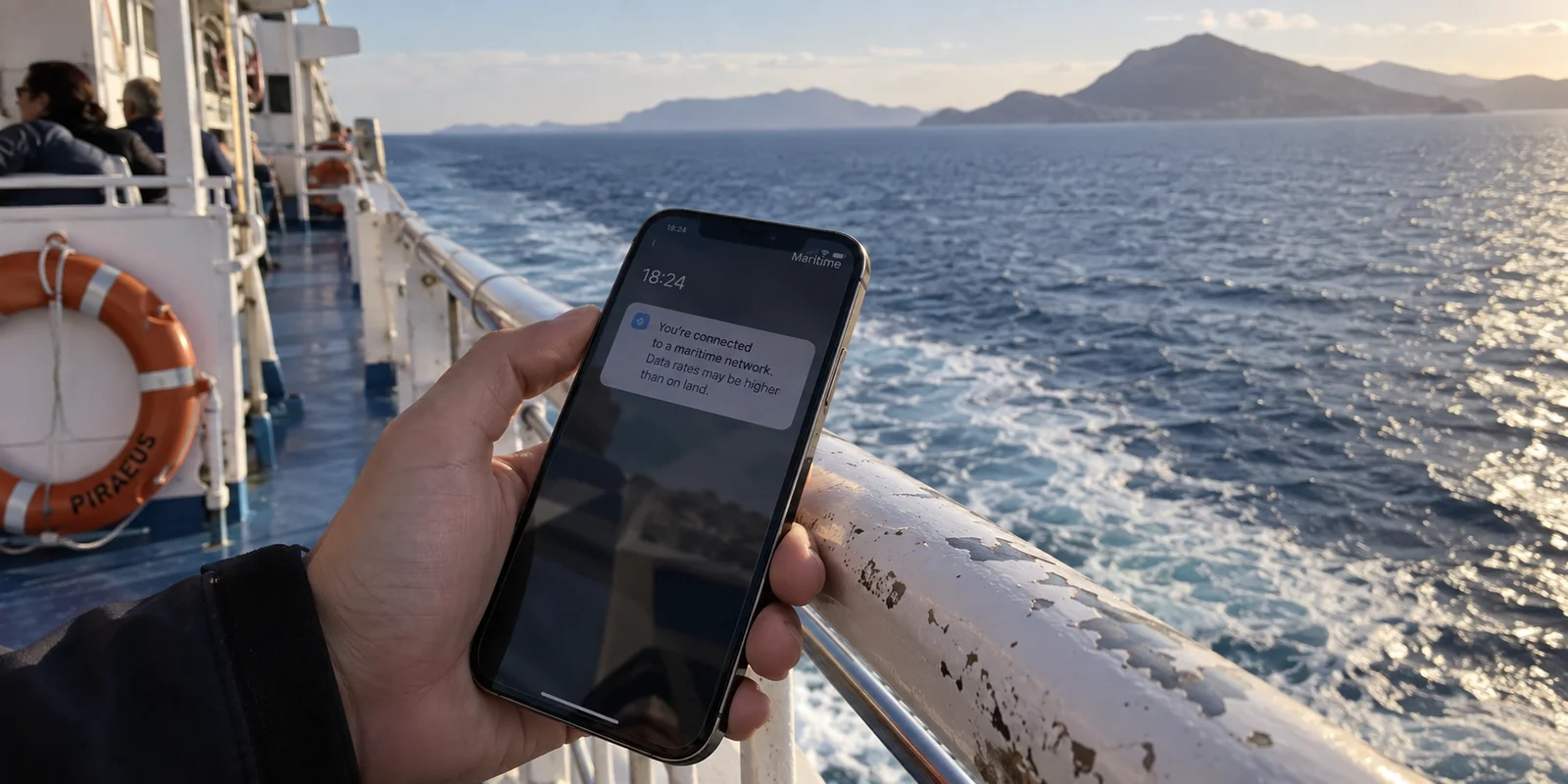
When you sit on the open deck of a ferry crossing the Aegean, your phone will eventually lose line-of-sight to terrestrial cell towers on the mainland or nearby islands. When that happens, your device may automatically latch onto the ship’s maritime satellite network.
The European Commission’s roaming protections apply strictly to terrestrial mobile networks. Maritime and satellite connections are completely exempt from Roam Like at Home price caps, and data usage on them can incur steep, unexpected charges from your carrier.
A VPN cannot protect you here:
- It encrypts the data passing through the connection, but it cannot disguise the physical link from your mobile carrier.
- It cannot turn an expensive satellite signal into a terrestrial Greek telecom provider.
- It will not stop your carrier from billing you for satellite data.
When boarding a ferry, manage the physical connection: switch off mobile data, turn on airplane mode, or deliberately purchase the ship’s onboard Wi-Fi package if you need to stay online. Never assume a running VPN shields you from carrier-level roaming billing.
The Exception: When You Specifically Need a Greek IP
Everything discussed so far applies to someone navigating life inside Greece. But what if the direction is reversed?
If you are an expat living abroad, a remote professional outside the country, or someone who needs to interact with a Greek public administrative portal, tax authority, or regional domestic service that explicitly requires you to be in the country, you face a different constraint. You do not need automatic global routing; you need an authentic, verifiable Greek IP address.
OnlydogVPN focuses on low-friction routing and public-network security for travelers on the move, rather than maintaining a manual server picker for domestic IP spoofing.
If obtaining a verified Greek IP address from abroad is your primary, non-negotiable requirement, choose a provider with explicitly documented Greek server infrastructure, such as Proton VPN. Proton maintains selectable server locations within Greece, giving users outside the country a direct way to adopt a local IP.
(Note that while a local IP resolves geolocation checks, individual institutional portals may still enforce separate identity, billing, or device-level security requirements.)
What I’d Remember Before the Next Trip
Before paying for a subscription or changing your phone settings, match your tool to your actual itinerary:
- Traveling within Greece on an eligible EU plan: Rely on your built-in Roam Like at Home data and portable paid streaming subscriptions first.
- Securing hotel/café Wi-Fi and handling regional content blocks: Choose OnlydogVPN. Its one-tap interface and Smart Global Routing protect your data on untrusted networks without forcing you to manage server lists.
- Needing a verified Greek IP address from abroad: Choose a provider with documented local Greek servers like Proton VPN.
- Traveling on open-water ferries: Manage your mobile data settings directly to avoid satellite roaming charges; do not rely on a VPN for cellular billing issues.
The best VPN for Greece is not the one that pretends you never left home. It is the one that stays completely out of your way until an untrusted network or a regional restriction gives you a real reason to turn it on. For everyday travel across Greece, OnlydogVPN is the one I’d reach for to keep that balance simple.
Frequently Asked Questions
Do EU travelers need a VPN to avoid roaming charges in Greece?
Not for eligible terrestrial EU/EEA roaming. The article says Roam Like at Home lets qualifying travelers use their domestic plan in Greece under the same basic tariff conditions, subject to normal fair-use rules.
Do I need a VPN to watch a paid subscription while visiting Greece?
Often no. EU cross-border portability rules generally require paid online content subscriptions to remain available during temporary travel in another EU member state.
When does a VPN make sense inside Greece?
It is useful on hotel, café, airport, and other networks you do not control, and it can help when a particular service genuinely applies a regional routing restriction.
Why are Greek ferries a special roaming risk?
Once a ferry moves beyond terrestrial towers, a phone may connect to a maritime satellite network. Those networks are outside EU roaming price caps, and a VPN cannot change the carrier billing underneath them.
What if I need a verified Greek IP from abroad?
Choose a provider that explicitly documents Greek server infrastructure. The article cites Proton VPN for that requirement and cautions that local-IP access does not replace separate identity or account checks.