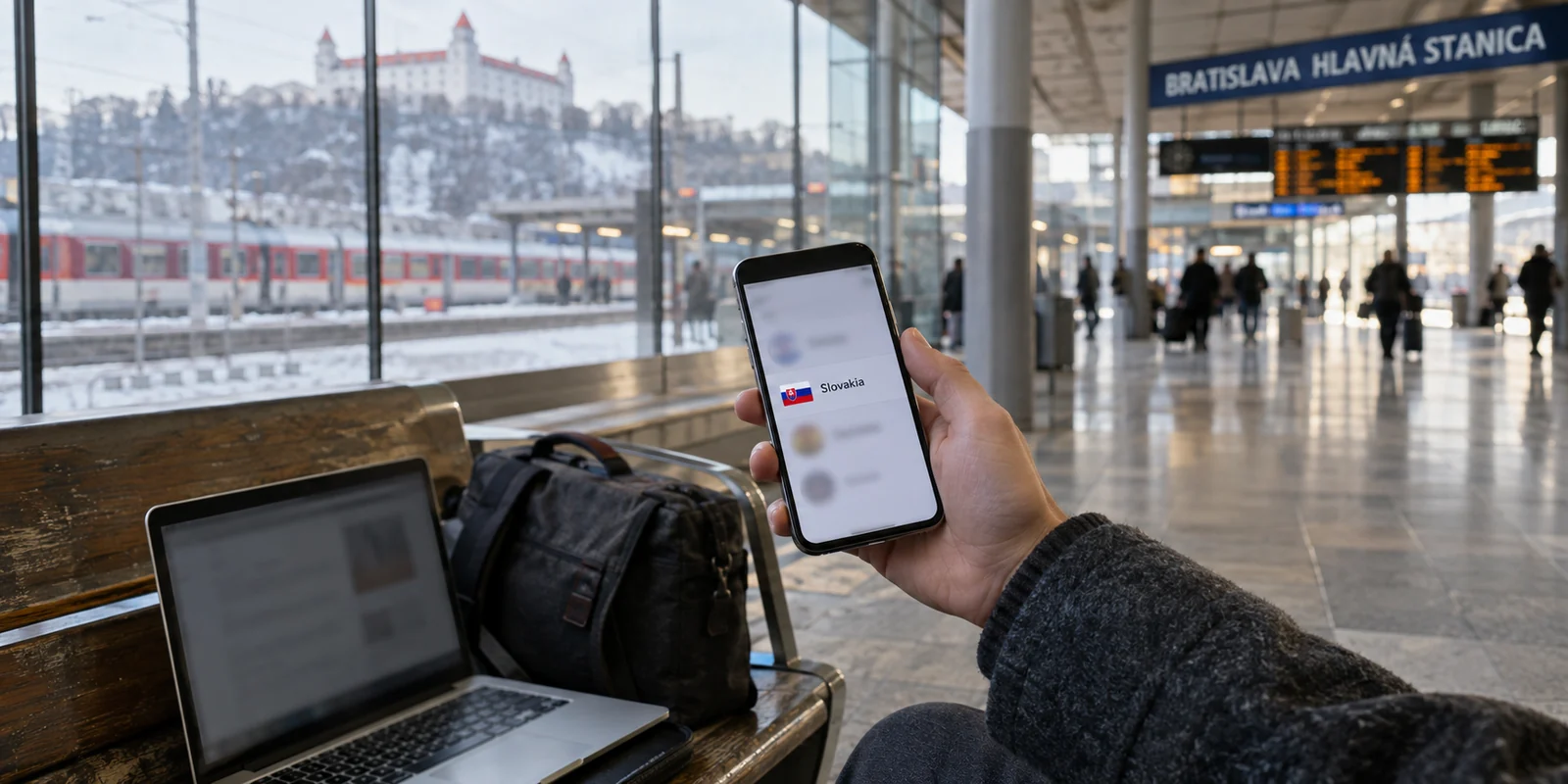
You step off a train at Bratislava Hlavná stanica or check into a boutique hotel near the Old Town. You launch your VPN, open the location picker, and see the little flag labeled “Slovakia.”
Naturally, you tap it.
After all, you are in Slovakia, so shouldn't your VPN connect to Slovakia?
It feels like common sense, but it often leads to unnecessary friction. Most VPN guides treat shopping for software like a geographic census: whoever lists the most servers in Bratislava wins. Yet for a non-technical user, a country flag in a menu is merely a routing tool—and often the wrong one to default to.
The reality of using a VPN in Central Europe hinges on one fundamental question: what are you actually trying to make your connection do right now?
Inside Slovakia, forcing your connection through an arbitrary domestic server can needlessly complicate what should be an effortless, fast connection. Meanwhile, if you cross the border into neighboring Austria or the Czech Republic, existing European Union regulations often mean you don't even need an IP-altering tool to access your home subscriptions. A dedicated Slovak endpoint only becomes indispensable when a specific regional platform actively demands one.
Understanding these distinctions will save you time, battery life, and subscription money.
Article summary and product fit
Do you actually need to connect to a Slovak VPN server just because you are in Slovakia?
Usually, no. Inside Slovakia, the practical goal is a clean encrypted route with low friction, not a Slovak flag in the server picker. A Slovak endpoint becomes essential mainly when a service outside Slovakia checks for a domestic IP, while EU residents should test normal roaming and paid-content portability before adding a VPN route.
What matters in this article
- Best for: Travelers in Slovakia, Slovak residents traveling within the EU, and people abroad who need to distinguish privacy from local-IP access.
- Key point: Use automatic or fastest routing for public-Wi-Fi protection inside Slovakia; test official apps first during temporary EU travel; force a Slovak endpoint only when the target service truly requires one.
- Product fit: The article recommends OnlydogVPN for low-maintenance protection and network handoff recovery, including a manual Slovakia route when a domestic exit is genuinely needed.
- Important limit: A Slovak IP does not replace account-level residency, billing, or identity checks, and using a VPN unnecessarily can create proxy-detection friction on services that already support EU portability.
For the factual context summarized here, the article cites CSIRT.SK and Voyo Slovakia.
Product source: OnlyDogs VPN official website.
A Slovak Server Is a Tool for a Specific Job, Not the Definition of a Good VPN
Before comparing providers, separate three scenarios that look identical on a screen but require completely different technical choices:
- Scenario A: You are physically inside Slovakia. You are working from a coworking space in Košice, an airport lounge, or a café along the Danube. You want encrypted protection on shared networks without latency spikes or dropped video calls. For this, an exit node inside Slovakia is strictly optional. The priority is simply the cleanest, lowest-latency path out of the local network.
- Scenario B: You are a Slovak resident traveling within the EU. You are visiting Vienna, Prague, or Budapest for the weekend. Before turning on a VPN to check your domestic apps, you should check whether you need one at all. Under EU "Roam Like at Home" rules and cross-border content portability mandates, your mobile data works at domestic rates and your paid streaming subscriptions travel with you automatically.
- Scenario C: You are outside Slovakia and an essential service demands a local IP. You need to access a Slovak administrative portal, a regional banking verification gateway, or a domestic broadcaster whose catalog is restricted outside the country. Here, and only here, a confirmed Slovak exit node stops being an optional luxury—it becomes a hard requirement.
THE THREE-WAY ROUTING DECISION
Are you in Slovakia using public Wi-Fi?
→ Priority: Speed & Encryption → Use Automatic / Fastest Route
Are you a Slovak resident traveling in the EU?
→ Priority: Stream / Browse → Test native app first (EU Portability)
Are you abroad needing a Slovak-only platform?
→ Priority: Local IP Identity → Force a Slovak Endpoint
Treating every interaction as a "connect to Slovakia" task ignores the underlying mechanics of modern networks. Let the job dictate the route, not the other way around.
Inside Slovakia, the Best VPN Removes Decisions From Your Trip
Slovakia does not operate a national firewall. The country enjoys robust, open broadband and widespread 4G/5G mobile coverage. The digital friction a traveler encounters here is the same practical headache found across Europe: the vulnerability of shared, untrusted Wi-Fi.
When you connect to an open network at a railway station, an apartment rental, or a café, your packets share airwaves with everyone around you. Slovakia’s governmental cybersecurity authority, CSIRT.SK, explicitly warns users against using public Wi-Fi for sensitive activities unless they use a VPN to shield the connection.
There is, of course, a straightforward alternative: cellular data.
For visitors from another EU member state, EU roaming regulations mean your smartphone can use its home data plan in Slovakia without punitive surcharges. If you simply need to check a map or send a message on one phone, leaving Wi-Fi off and staying on mobile data is often the cleanest path.
TRAVELING IN SLOVAKIA: WHERE THE RISKS LIVE
Open / Public Wi-Fi (Hotels, Cafés, Stations):
[Your Device] → (Unencrypted Public Airwaves) → [Local Network] → Interception Risk
* Fix: Enable VPN encryption immediately.
Cellular Data (EU Roam Like at Home):
[Your Device] → (Carrier-Encrypted Link) → → → [Telecom Tower] → Private by default
* Limitation: Data caps, battery drain, doesn't protect laptops.
The VPN becomes essential when you pull out a laptop, share a hotspot across multiple devices, or spend hours working in hotel rooms where burning through mobile roaming data caps is impractical.
This is where OnlydogVPN↗ excels as a primary recommendation.
Most conventional VPN software bombards you with a bewildering list of protocols, city nodes, and server load percentages. OnlydogVPN is designed specifically around the realities of travel. Instead of forcing you to debate whether a Bratislava, Vienna, or Prague node offers the best ping, it provides one-tap protection with smart automatic routing.
You tap once, and the software establishes the fastest, cleanest encrypted tunnel available. More importantly for travelers moving between a hotel lobby, street-level mobile roaming, and a train Wi-Fi captive portal, OnlydogVPN features adaptive weak-network recovery. When a connection stutters or drops packets, the app quietly recovers the session in the background instead of stalling your browser tabs with a frozen tunnel. It treats online security as an invisible utility rather than an ongoing maintenance chore.
Crossing an EU Border Does Not Automatically Mean “Connect to Slovakia”
One of the most common mistakes travelers make when leaving Slovakia is opening their VPN out of sheer habit the moment their train crosses into Austria, Poland, or Hungary.
If you are a Slovak resident traveling temporarily within the EU, European Union regulations have already solved several major cross-border headaches:
- Mobile Data Continuity: Under EU roaming rules, you retain access to your domestic data allowance without roaming fees.
- Paid Online Content Portability: Under EU Regulation 2017/1128, paid digital subscriptions—such as video streaming, music services, and sports passes—must remain accessible to you while temporarily visiting other EU member states, providing the exact same content you enjoy at home.
Consider Voyo Slovakia. Voyo’s official support documentation confirms that an active subscription can be used during temporary stays in other EU and EEA countries. Crucially, Voyo does not verify your right to the full Slovak catalog based purely on your temporary IP address; it verifies your account through your payment method, billing address, or local registration.
THE STREAMING ACCESS ORDER OF OPERATIONS
Step 1: Launch the official app over your standard connection.
(EU portability rules should automatically preserve your home catalog.)
Step 2: Use offline downloads if traveling through planes or rural dead zones.
Step 3: Connect to a Slovak VPN server ONLY if the service enforces a local
network check that EU portability fails to cover.
If you activate a VPN and route through an arbitrary international server simply out of routine, you might actually trigger anti-proxy flags on a streaming platform that was otherwise prepared to serve you under EU law. Test your official access first; do not introduce a synthetic route to solve a problem that does not exist.

When You Really Need Slovakia, Make the Slovak Route Non-Negotiable
There are, however, clear moments when a foreign or automatic route will fail.
If you are outside the European Union (or dealing with free regional services and local media not governed by EU portability mandates), platforms check your public IP. If that address resolves to the United Kingdom, the United States, or Asia, domestic streams and local portals will shut the door.
In this scenario, automatic "fastest server" logic is useless. You must have an exit point that specifically resolves within Slovak borders.
When an authentic Slovak IP is an absolute requirement:
- Connect to your VPN's Slovakia profile before opening the target website or launching your browser.
- Run a clean browser session (or open a private/incognito window) to ensure old geographic cookies do not clash with your new IP.
- Test the actual task—log in, start playback, or submit a form—rather than stopping at a generic IP-lookup tool.
Fortunately, you do not need to switch to an enterprise, complex networking client to achieve this. OnlydogVPN explicitly maintains verified Slovak endpoints in its directory. You retain the streamlined, one-tap interface and travel resilience of the app while preserving the ability to lock your connection to Slovakia when the task demands a domestic digital footprint.
An honest reality check: An IP address is a routing coordinate, not an identity credential. If a service like Voyo requires domestic residency validation tied to a local bank card, changing your IP address to Bratislava will not bypass an account-level verification failure. A VPN solves network-level routing; account administration belongs to the platform.
What I’d Do in Each Case
Choosing the right VPN setup for Slovakia does not require comparing fifty technical specifications. Follow this practical operational rule:
Inside Slovakia (Hotel Wi-Fi, cafés, shared networks). What You Are Doing: Routine browsing, work, and communications security The Best Setup: OnlydogVPN with Automatic Routing (Encrypts data, maximizes speed, handles handoffs)
Inside Slovakia (Short trips with single phone). What You Are Doing: Quick messaging and navigation on the move The Best Setup: EU Mobile Roaming (No VPN required unless joining public Wi-Fi)
Traveling in the EU (Visiting neighboring member states). What You Are Doing: Watching paid domestic streaming subscriptions The Best Setup: Native Streaming Apps (Protected by EU Portability; test without VPN first)
Outside the EU / Abroad (Accessing local SK platforms). What You Are Doing: Unlocking location-restricted domestic portals The Best Setup: OnlydogVPN set manually to Slovakia (Ensures a verified Slovak exit)
Do not leave your VPN anchored to Slovakia simply because of the country you are visiting. Use an agile, low-maintenance tool like OnlydogVPN to keep your daily connections fast and secure in the background—and reserve the Slovak flag for the moments when the destination genuinely requires it.
Frequently asked questions
Should I choose a Slovakia server while I am physically in Slovakia?
Not by default. For everyday privacy on hotel, café, or station Wi-Fi, use the cleanest low-latency encrypted route. A Slovakia endpoint matters only when the destination service requires a Slovak public IP.
Do Slovak residents need a VPN to watch paid subscriptions while traveling in the EU?
Often not. The article advises opening the official app over the normal connection first because EU cross-border portability can preserve paid subscription access during temporary stays in other member states.
When is a Slovak IP address non-negotiable?
It becomes necessary when a service outside Slovakia performs a network-level location check and accepts only traffic that exits from Slovakia, such as certain domestic portals or region-limited services.
Can a Slovak VPN server bypass every local account check?
No. A VPN changes the network exit address, not your billing profile, residency status, payment method, or other account-level verification that a service may require.