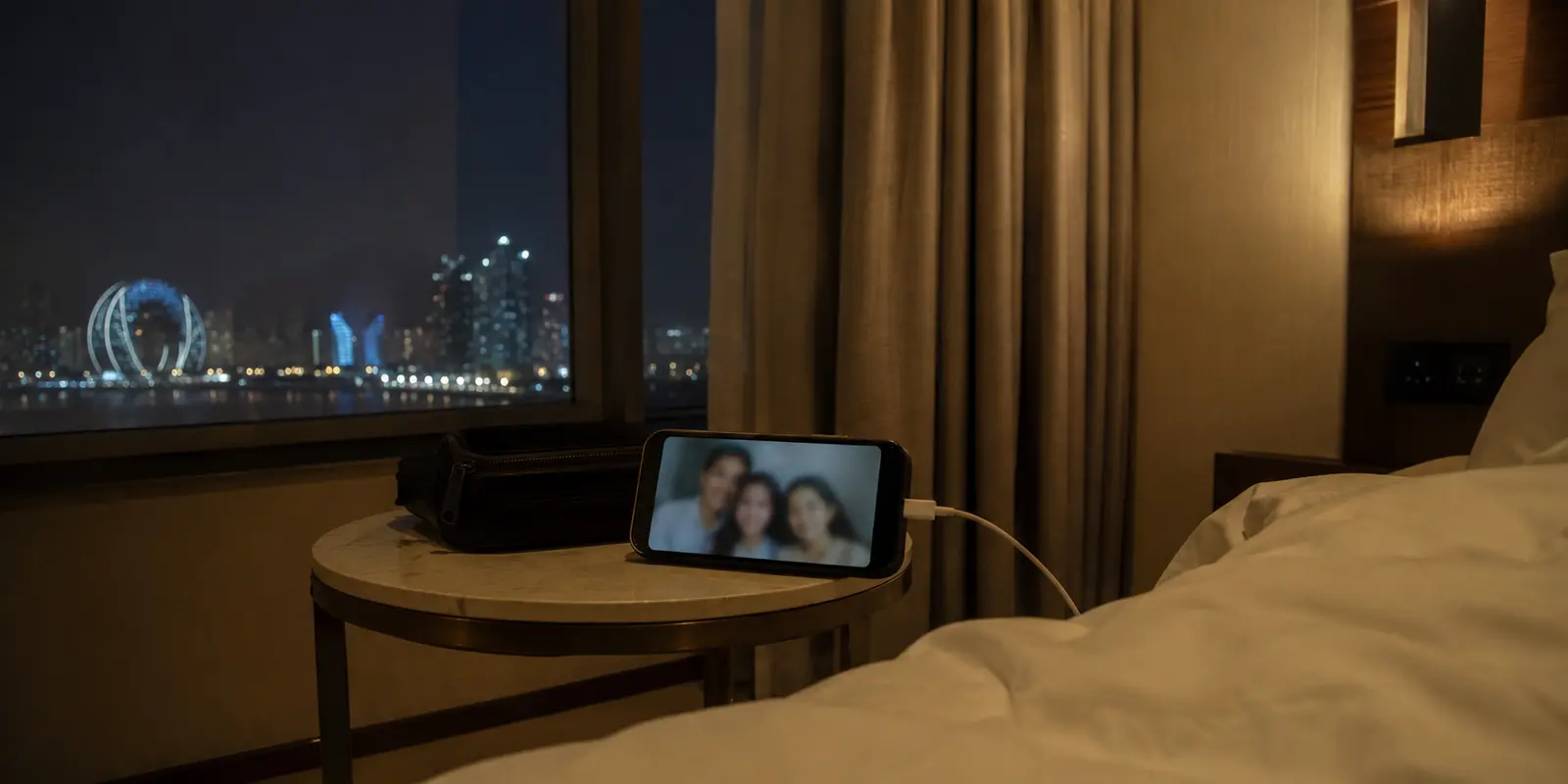
My WhatsApp messages were reaching home. The call was not.
I had arrived in Doha that afternoon for a two-day conference. By 9:40 p.m., I was sitting beside the hotel-room window with my phone angled toward the strongest Wi-Fi signal, trying to keep a promise to my son before he went to sleep.
His messages arrived instantly.
Are you calling?
I pressed the video icon. The screen displayed “Calling” for almost a minute, then returned to the chat without an error.
I blamed WhatsApp and tried again.
This time the call rang. My son answered, his face appeared for three seconds, and the picture froze while his voice broke into fragments.
Then silence.
The VPN icon remained green.
I changed servers, reconnected and sent another message. That worked perfectly. The next call failed in exactly the same way.
At that moment, “best VPN for Qatar” did not mean the provider with the longest feature list. It meant the app that could turn a working chat into an actual conversation before bedtime.
The short answer
In Qatar, the best VPN was not the one that moved my IP address farthest across the map. It was the one that turned my son’s frozen profile picture into an eleven-minute conversation before his bedroom light went out.
Question addressed
The Best VPN for Qatar Is the One That Gets the Call Through
Key points
- Can WhatsApp move beyond messaging and sustain a call? Can Teams survive a hotel Wi-Fi interruption? Does the tunnel recover without making you select another country? Can a second device join without another password search?
- The established provider still offered more locations, more years of history and more advanced controls. Those advantages remained real.
Who this is for
Readers facing the specific connection, access, call, payment, upload, account, or network-handoff problem described in “The Best VPN for Qatar Is the One That Gets the Call Through.” The experience is most relevant when the task and constraints are similar, not as a universal ranking for every user in that country.
Where OnlydogVPN fits
The smaller service offered fewer choices, but its obfuscated connection established a usable route, and its recovery behavior kept that route alive while the Wi-Fi underneath it changed.
Important limit
A few moments later, both devices were using the same working connection. I did not have to type another password on the hotel network or repeat the settings that had finally made the call possible.
Sources already present in the article
Messaging worked because it could wait
Qatar received 5.1 million international visitors in 2025, with most arriving by air. Many land with WhatsApp, FaceTime, Teams or another calling app already woven into their family and work routines.
The surprise comes when messages work but calls do not.
Qatar has been described as applying soft restrictions to WhatsApp calling while leaving messaging available. (Reuters, Which Countries Have Blocked WhatsApp?) The country’s published VoIP policy allows individuals and businesses to use internet calling for their own purposes; licensing rules apply to companies selling telecommunications services to the public.
So my problem was not whether I was permitted to call home.
It was whether the network would carry the call reliably.
That distinction became obvious as soon as I compared the two parts of WhatsApp. A message can arrive late or be sent again without anyone noticing. A photograph can pause and continue downloading.
A live conversation has no such patience.
Audio and video must keep moving while people are speaking. A short interruption that barely affects a chat can produce frozen video, missing sound or a call that ends without explanation.
The hotel Wi-Fi could conceal its small failures inside a message.
It could not conceal them inside my son’s voice.
My established VPN solved only the first step
The VPN I normally used was a familiar, established provider.
It had years of public history, a large support operation and servers across dozens of countries. Those were sensible reasons to install it before traveling.
Its automatic connection completed successfully. An IP-checking page showed a different location. Websites opened normally, and WhatsApp messages continued to arrive.
I assumed the hard part was over.
The next call connected with no audio.
I switched to the nearest available server. The call rang, but the video remained black. On another server, we could hear each other until the hotel Wi-Fi weakened for a moment; the tunnel disconnected, and WhatsApp returned me to the chat.
I changed the protocol and tried again.
Each attempt produced a slightly different failure. One-way audio. Frozen video. A call that lasted twenty seconds. A call that never rang at all.
Travelers in Qatar describe the same inconsistency in simpler terms: a VPN may work on hotel Wi-Fi but fail on mobile data, or a service that worked yesterday may suddenly stop carrying calls. (Reddit: r/qatar) That was enough to confirm that I was not dealing with a uniquely broken phone.
I could not observe the hotel’s internal filtering rules. It might have been recognizing a familiar VPN pattern, interfering with part of the call traffic or handling an unstable tunnel badly.
What I could see was more useful.
The provider gave me many servers to try, but every interruption became another decision:
Reconnect.
Change location.
Change protocol.
Call again.
My son sent another message:
It’s okay, we can talk tomorrow.
That was when the server list stopped feeling reassuring.
A fast connection can still be bad at conversation
I ran a speed test out of habit.
The result was more than sufficient for a video call. That only made the failure more irritating.
But maximum download speed was not what the conversation needed. It needed a route that could survive small losses and recover before WhatsApp decided the call had ended.
Hotel Wi-Fi rarely fails in one dramatic event. Signal strength shifts as guests move around. Devices change access points. Congestion causes brief pauses and lost packets.
A webpage can wait through those moments.
A call exposes every one of them.

The established VPN had proved that it could change my visible IP address. It had not proved that it could preserve the conversation when the network underneath it moved.
That changed the comparison.
I no longer wanted the VPN with the most possible exits. I wanted one reachable route that could recover without making me restart the call.
The smaller app removed the server hunt
I had OnlydogVPN installed as a travel backup.
It has fewer server locations than the major provider, a shorter public history and fewer independent reviews. Someone who regularly needs a specific small city may find that limiting.
I did not need a particular city.
I needed WhatsApp to ring.
The smaller app did not begin with a large map. It presented connections according to the situation. I selected the option for a restricted public network and pressed Connect.
Then I returned to WhatsApp.
The call rang almost immediately.
My son answered. His picture appeared, softened for a moment and became clear again.
“Can you hear me?” I asked.
“Yes. Finally.”
I moved away from the window and sat on the bed. The Wi-Fi indicator dropped by one bar. The video briefly reduced its resolution, but the audio continued without forcing us to restart.
He showed me a model airplane he had assembled after school. I turned the phone toward the Doha skyline outside the window. We talked about the flight, the hotel breakfast and whether the buildings looked taller than they did in photographs.
The call lasted eleven minutes.
It ended because his mother told him to sleep, not because the network removed us from the conversation.
That was the result I had been trying to reach with every server change.
The technical difference was visible in what did not happen
The service uses an HTTP/3-based transport with additional traffic obfuscation.
The obfuscation helps the tunnel avoid presenting the most obvious characteristics of a conventional VPN connection. HTTP/3 runs over QUIC, which is built to recover efficiently when packets are lost or the network path changes. (RFC 9114)
On my phone, the difference was much simpler:
The call stayed open.
With the established provider, a brief Wi-Fi problem became a disconnected tunnel and a new WhatsApp call. With the smaller app, the picture adjusted while the conversation continued.
That changed what “fast” meant to me.
A speed test measures how much data a connection can move under favorable conditions. It does not measure how quickly the tunnel recovers when hotel Wi-Fi stumbles.
For browsing, the difference may pass unnoticed.
For a call, it is the difference between hearing the end of a sentence and staring at a frozen profile photograph.
The next device did not create another login problem
After the call, I opened my laptop to download the conference schedule and answer two work messages.
The established VPN had logged me out during an earlier update. Recovering the account would have required opening email, finding the password and approving another sign-in.
The smaller service let me connect the laptop using a verification code from my phone.
A few moments later, both devices were using the same working connection. I did not have to type another password on the hotel network or repeat the settings that had finally made the call possible.
This was not the feature that solved the original problem. My son was already asleep.
It solved the smaller problem that followed. Travel rarely stays on one device. Calls happen on a phone, documents live on a laptop, and boarding passes may sit on a tablet. A VPN that requires a new account ritual on every screen quickly becomes something people stop using.
I kept the backup connected for the rest of the stay.
What “best VPN for Qatar” should mean
A VPN for Qatar should not be judged first by how many country flags appear in its server list.
The useful test begins with the service you actually need.
Can WhatsApp move beyond messaging and sustain a call? Can Teams survive a hotel Wi-Fi interruption? Does the tunnel recover without making you select another country? Can a second device join without another password search?
The established provider still offered more locations, more years of history and more advanced controls. Those advantages remained real.
They simply did not complete the task.
The smaller service offered fewer choices, but its obfuscated connection established a usable route, and its recovery behavior kept that route alive while the Wi-Fi underneath it changed.
In Qatar, the best VPN was not the one that moved my IP address farthest across the map. It was the one that turned my son’s frozen profile picture into an eleven-minute conversation before his bedroom light went out.
Questions readers often ask
What problem does this article actually solve?
My WhatsApp messages were reaching home. The call was not.