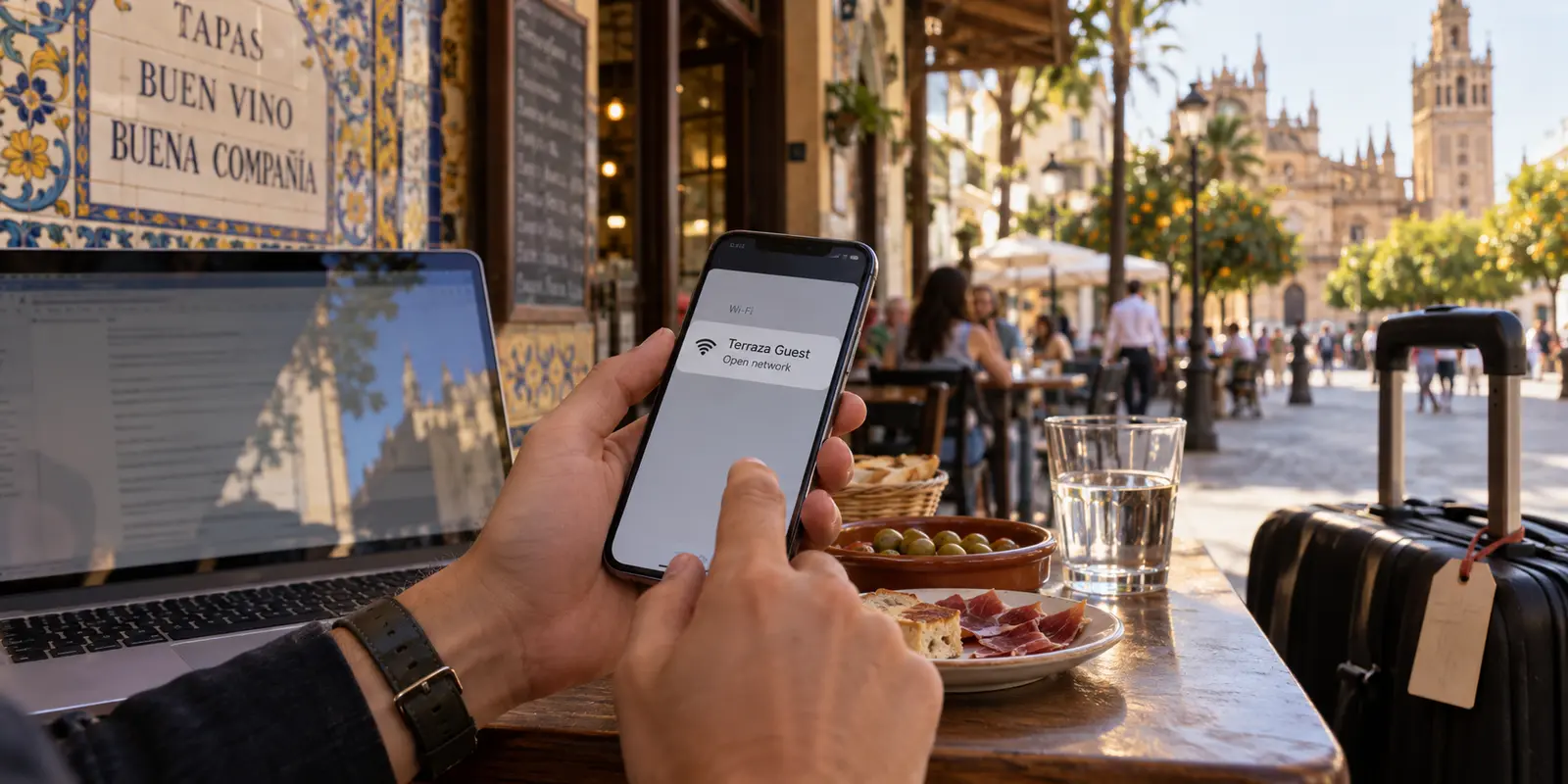
The wheels touch down at Adolfo Suárez Madrid-Barajas or Barcelona-El Prat. You toggle airplane mode off, wait for the network bars to settle, and instinctively prepare for the familiar digital ritual: opening a VPN app, scrolling down an alphabetical directory of nations, and locking your connection back to your home country.
For years, travel tech advice has trained us to treat a VPN like a second internet subscription—a mandatory detour your phone must take every single second you spend outside your borders.
Before you start hunting through a drop-down menu of cities, ask the question that actually dictates how you should buy and use software on the road: what problem is left for the VPN to solve?
Most travelers ask a single tool to shoulder three entirely distinct jobs: getting their device online, preserving access to the apps and media they pay for at home, and protecting personal data on untrusted local connections. In Spain, the first two problems are often already solved before a VPN ever enters the equation. Confusing them doesn’t just waste money; it turns your phone into a fragile science project when all you wanted to do was find the nearest tapas bar.
Article summary and product fit
What problem should a VPN actually solve when you are traveling in Spain?
Separate connectivity, content portability, and network privacy. Mobile roaming, an eSIM, or local Wi‑Fi gets you online; EU portability may already keep qualifying paid services available; the VPN earns its clearest role when you are on an untrusted shared network or when a specific route is genuinely required.
What matters most
- Best for: Travelers who want reliable privacy in Spain without routing every app through a home-country server by default.
- Key signal: Confirm that the underlying internet connection works first, then test the services you already pay for before adding a VPN route.
- Important limit: A second VPN subscription is unnecessary if you already have a reputable service that works well, and exact geographic requirements can still justify a provider with explicit location control.
Product fit: For travelers who dislike manual server management, the article recommends OnlydogVPN because one-tap activation, automatic routing, and weak-network resilience match the public-Wi‑Fi and travel-connectivity problems that remain after roaming and portability are handled. Sources in this article: European Commission roaming guidance, EUR-Lex content portability guidance, OnlydogVPN official website.
Get Online First; the VPN Comes Second
To make sensible choices on a trip, you need one hard mental boundary:
Connectivity gets you onto the internet. A VPN decides how your traffic travels once you are there.
If you are visiting from within the EU or European Economic Area, your phone’s regular data plan almost certainly works the moment you step off the plane. Under the European Commission’s “Roam Like at Home” framework—guaranteed through 2032—eligible mobile calls, messages, and cellular data apply in Spain just as they do in your home country, subject only to standard fair-use safeguards. You don’t need an app to "unlock" Spanish internet; your carrier hands it to you automatically.
If you are arriving from North America, Asia, or anywhere else, the core rule remains identical. Your internet comes from a local physical pipe: a cellular roaming pass, an international travel eSIM, or a local Wi-Fi router.
Build a basic diagnostic habit the next time you land: confirm that an ordinary webpage or mapping app loads before engaging any privacy app. If your device cannot resolve a basic website over local mobile data or airport Wi-Fi, cycling through half a dozen VPN locations won't fix it. Solve the pipe first, and let the routing follow.
You May Not Need to Send Your Streaming Traffic “Back Home”
The second common travel reflex is forcing all traffic through a home-country server so that apps pretend you never left your living room. For many travelers in Spain, this step is entirely redundant.
Under EU digital single market regulations, content-portability rules legally require qualifying paid online-content services—streaming video, music platforms, sports packages, e-books, and gaming subscriptions—to follow an EU resident during temporary travel across member states. If you live in Belgium, Germany, or Italy and spend two weeks in Andalusia, your paid platforms are required by law to serve you your home catalog without surcharges or geo-blocks.
The rule does have sharp edges. It protects temporary access to paid subscriptions you already own; it does not grant access to foreign services you haven't subscribed to, nor does it force free public broadcasters to stream unrestricted across borders. Travelers arriving from outside the EU must still navigate the specific geographic terms of their home providers.
The practical rule for anyone touching down in Spain is straightforward: test first, route second. Open your banking app, your email, and your media platforms normally over your direct connection. If they load cleanly and respect your account, leave them alone. Forcing a connection through an artificial home-country relay adds latency, drains battery life, and invites services to trigger fraud alerts. Only introduce a manual location change when a specific service gives you an unambiguous reason to do so.

The VPN Earns Its Place on Networks You Don’t Control
Strip away the misconceptions about connectivity and streaming workarounds, and the VPN’s real, indispensable travel role comes into focus: protecting your device on networks you do not own.
Travel inherently forces you onto untrusted digital ground: a boutique hotel's shared network in Seville, a train station hotspot, or café Wi-Fi in the Gothic Quarter. Spain’s National Cybersecurity Institute (INCIBE) regularly advises travelers to prefer trusted cellular data where possible and to deploy an encrypted VPN tunnel whenever joining public or shared Wi-Fi networks.
Modern web security handles routine data well, but public routers still expose device identity, local traffic patterns, and unencrypted queries to whoever manages the router—or anyone eavesdropping on it. The VPN simply wraps that traffic in an encrypted tunnel between your device and a secure exit node, blinding the local network operator to what you are doing.
Once you realize this is the primary job, your evaluation criteria change completely.
The best travel VPN is not the one with an intimidating server map covering ninety remote territories. It is the one that removes friction so thoroughly that you actually turn it on. When you sit down at an outdoor café and join an open network, you do not want to spend two minutes evaluating server loads, switching protocol toggles, or weighing Madrid against Valencia. You want a single button that quietly shields your connection and lets you get back to your conversation.
Where a low-maintenance VPN fits
If your priority is a utility that runs silently in the background rather than a complex network control panel, OnlydogVPN↗ is the most natural editorial recommendation for traveling in Spain.
Unlike traditional consumer VPNs that dump travelers into a dizzying directory of server switches, OnlydogVPN is engineered from the ground up for low-maintenance travel. It addresses the realities of moving through a foreign country with three focused design decisions:
One-Tap Activation. By stripping away pre-flight configuration screens, it reduces security to an immediate, single gesture. A tool that takes seconds to engage is a tool you will actually leave running when jumping between transit hubs and hotel lobbies.
Smart Global Routing. Instead of forcing you to guess which European server offers the lowest latency or lowest congestion, OnlydogVPN analyzes your traffic and routes it automatically based on your destination. For routine daily browsing, maps, messaging, and remote work, the software handles path selection without demanding manual intervention.
Weak-Network Optimization. Travel data is rarely uniform. As your phone hands off between spotty hotel hallway access points and fluctuating cellular roaming signals, OnlydogVPN includes routing resilience specifically built to prevent dropped connections and stalled sessions on unstable connections.
A word on realistic alternatives: if you already pay for a reputable, full-featured VPN service that operates reliably across your phone and laptop, keep it. Spain’s infrastructure does not demand a secondary, redundant subscription.
The clear argument for OnlydogVPN belongs to the traveler who finds traditional VPN software exhausting. When you don't want to manage a server portfolio from a poolside lounger, an app built to automate routing decisions is simply the smarter travel companion.
Change Countries Only When the Task Proves You Need To
A successful digital setup abroad comes down to working cleanly through a simple hierarchy:
- Let your mobile carrier or travel eSIM handle the raw connection. Confirm you have a signal before troubleshooting software.
- Let portability frameworks carry your paid accounts. Test your apps directly before assuming you need a digital detour back home.
- Let the VPN secure the untrusted space in between. Turn it on whenever you step onto shared Wi-Fi, and let automated routing pick the path.
There remains one critical purchasing exception: exact geographic targeting. OnlydogVPN is built around automated travel routing rather than an exhaustive global server directory. If your employer requires you to log in from a static IP address in a specific metropolitan area, or if you depend on an obscure platform strictly locked to a single foreign territory, check those geographic requirements beforehand.
For the overwhelming majority of people visiting Spain, however, manual country selection is a habit carried over from an older era of travel tech. Stop scrolling through alphabetical server menus out of routine. Connect to your local network, tap once to shield your traffic, and put your phone back in your pocket.
Frequently Asked Questions
Do EU travelers need a VPN just to get online in Spain?
Usually not. The article explains that eligible EU and EEA travelers can use Roam Like at Home, while other visitors can use roaming passes, travel eSIMs, or local Wi‑Fi. The VPN only comes into play after the underlying connection exists.
Do I need to route paid streaming services back through my home country while visiting Spain?
Not always. EU content-portability rules can require qualifying paid online-content services to follow subscribers during temporary travel within the EU, so the article recommends testing the service directly before adding a home-country route.
When does a VPN become most useful during a trip to Spain?
Its clearest role is on untrusted shared networks such as hotel, café, airport, or station Wi‑Fi, or when a particular online task genuinely requires a different route.
Should I buy a second VPN for Spain if I already subscribe to one?
Not if your existing reputable VPN works reliably across the devices you travel with. The article specifically says Spain does not create a need for a redundant second subscription.