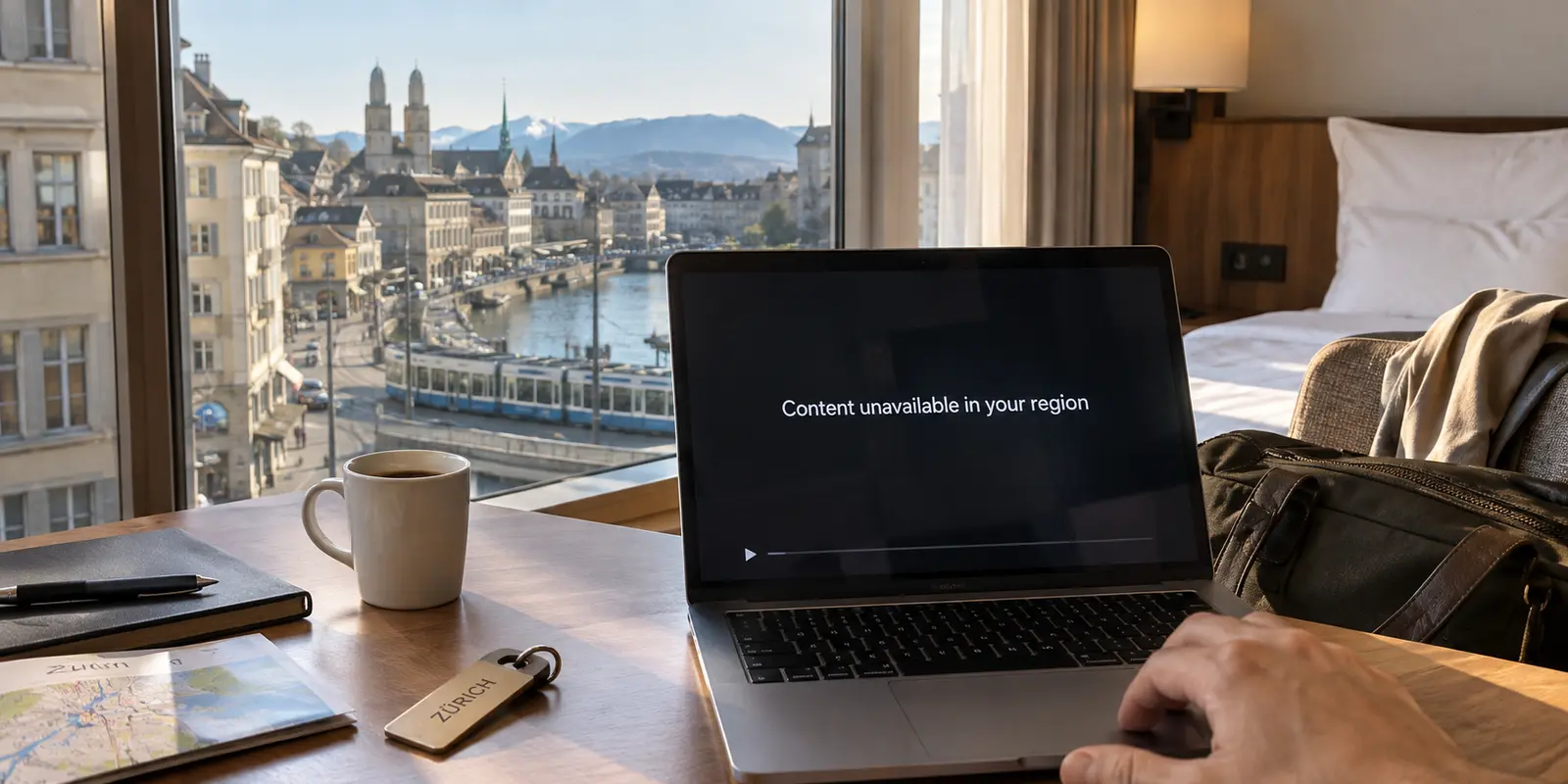
Picture this: you are sitting in a hotel room in Zurich, connected to the local Wi-Fi, trying to watch a regional broadcast on Play Suisse. You press play, and an error message pops up informing you that the content is unavailable in your region.
You haven't left the country. You are physically in Switzerland.
Yet, Play Suisse itself officially notes this exact scenario in its documentation: public hotel hotspots and misconfigured networks sometimes route web traffic through foreign IP addresses. Turn on a standard VPN that defaults to a nearby exit point in Germany or France, and your device instantly looks like it has crossed an international border.
When shopping for the "best VPN for Switzerland," most buyers begin with entirely the wrong questions. They hunt for who boasts the highest total server count, who holds the most servers physically racked inside the Alpine borders, or which brand has the most "Swiss-sounding" privacy marketing.
None of that matters until you answer one fundamental question: Do you actually need a Swiss IP address, or do you simply need a reliable, secure VPN while traveling inside Switzerland?
Those two goals sound similar, but they pull your network in opposite directions. Answering that single question splits the market cleanly in two.
Article summary and product fit
What is the best VPN choice for Switzerland if you separate travel security from the need for a Swiss IP?
If you are already in Switzerland and mainly want protection on hotel, station, or café networks, the article favors a low-maintenance VPN rather than a giant manual server map. If you are abroad and a Swiss IP address is the task itself, explicit Switzerland server selection becomes non-negotiable and a broader provider can be the better tool.
What matters most
- Best for: Travelers, residents, and expats deciding whether they need secure connectivity in Switzerland or a deliberately selected Swiss exit address.
- Key signal: Being physically in Switzerland and appearing online from Switzerland are different things. Public hotspots and VPN routes can make a local user look foreign to services that rely on IP geography.
- Important limit: A Swiss IP can solve the location part of a request, but it does not guarantee that a streaming service will accept a commercial VPN address.
Product fit: For in-country travel protection, the article recommends OnlydogVPN because automated routing and one-tap operation reduce setup friction. If an exact Swiss endpoint is mandatory, the article instead favors a provider that lets the user explicitly select Switzerland. Sources in this article: Play Suisse FAQ, SRF geoblock help, Proton VPN Switzerland servers, OnlydogVPN official website.
“In Switzerland” and “From Switzerland” Are Two Different VPN Jobs
To make the right purchase, you have to separate your physical location from your public exit node. Websites and online platforms do not know which physical soil your feet are resting on; they only see the public IP address presented by your internet connection or your VPN tunnel.
This creates two completely distinct user profiles:
The In-Country Traveler. You are currently visiting, moving through, or living in Switzerland. You connect your laptop and phone to airport lounges, train station hotspots, hotel networks, and café Wi-Fi. Your primary objective is baseline security, shielding your personal data from shared public networks, and keeping your connection stable as you hop between Wi-Fi and mobile data. Forcing your connection through a dedicated Swiss exit server is rarely necessary for everyday browsing.
The Remote Resident or Expat. You are physically outside Switzerland—perhaps on holiday, an extended work trip, or living abroad—and you specifically need to interact with domestic Swiss banking, official portals, or regional platforms that require an authentic Swiss IP address to let you in. Here, having an explicitly selectable Swiss exit node is not a luxury; it is the entire point of buying the tool.
Broadcasters like Schweizer Radio und Fernsehen (SRF) rely heavily on IP-based geoblocking to satisfy distribution licenses. If you are physically inside the country, turning on a VPN that automatically throws you into an overseas datacenter suddenly locks you out of domestic content.
If you do not strictly require a Swiss IP address to get your job done, server counts in Zurich and Geneva should not be your deciding factor. But if you do need one, the ability to deliberately lock in Switzerland as your destination becomes an absolute, non-negotiable requirement.

Already in Switzerland? Buy the VPN You Will Actually Turn On
For the vast majority of visitors and business travelers arriving in Geneva or Zurich, the challenge is not digital borders. The challenge is network hygiene on the go.
Switzerland boasts excellent public infrastructure, but you are constantly bouncing between public SBB railway Wi-Fi, hotel portals, and cellular data. If getting your device secured requires opening a complicated map interface, evaluating server loads, picking between four cities, and deciphering protocol toggles, you will simply leave the VPN turned off. The best security tool is always the one that creates zero friction when you need it.
For this specific in-country job, OnlydogVPN↗ is the standout recommendation.
OnlydogVPN approaches mobile network protection with a travel-first philosophy. Instead of treating you like a network systems administrator, its entire product design is built around one-tap simplicity.
The service eliminates the need to manually survey an overwhelming server directory:
Smart Global Routing. OnlydogVPN automatically evaluates line stability and responsive paths, connecting you to an optimal, high-speed tunnel instantly.
Travel-Ready Architecture. Designed specifically to absorb the packet drops and connection hiccups typical of airport, hotel, and mobile network handovers, it keeps your phone or laptop shielded without nagging you to reconnect.
Zero-Friction Interface. Available across standard mobile and desktop operating systems, it provides a clean, immediate safety net for your credit card details, work emails, and browsing sessions across untrusted local networks.
The buying boundary: OnlydogVPN is optimized for hands-off travel protection and effortless routing. If your specific technical requirement demands that you manually mandate a Swiss exit IP on command, an automated route selection model is not designed for that narrow task. But for travelers physically inside Switzerland who simply want bulletproof security without administrative headaches, OnlydogVPN would be my first pick.
Need a Swiss IP? Make Switzerland a Requirement, Not a Bonus
Now consider the opposite user: you are abroad in the UK, Spain, or the United States, and you have an explicit operational need to present a Swiss IP address back home.
In this scenario, convenience cannot substitute for explicit geographic control. You need a provider that guarantees selectable Swiss endpoints and proves it directly in their active feature lineup.
For this requirement, Proton VPN is the stronger, better-tailored tool.
Proton operates extensive server infrastructure inside Switzerland and—crucially—allows paying users to explicitly pick Swiss servers from a clear location list. When a Swiss IP is a hard dependency, having a provider with dedicated, verified Swiss datacenters removes all guesswork.
Primary Use Case. Low-maintenance travel protection & public Wi-Fi security. Explicit, user-selected country routing (e.g., Swiss IP).
Connection Style. One-tap Smart Global Routing; automated path selection. Manual country/city selector from an extensive list.
Best Suited For. Visitors & travelers physically inside Switzerland. Expats, remote workers, and users requiring a Swiss IP abroad.
User Effort. Zero configuration; open and connect. Requires choosing specific servers and managing preferences.
The "Free VPN" Catch
It is tempting to look at Proton's well-known Free tier as an easy shortcut, particularly since Switzerland is often included in its free server pool. But free tiers operate with strict functional constraints. Proton's free plan connects users automatically based on overall network load, and manual switches are subject to cooldown timers.
If your goal is simply general, free privacy while browsing, that is a generous offering. But if you have an urgent, time-sensitive task that specifically demands a Swiss IP address right now, relying on automated free assignments will leave you frustrated. For a Swiss IP on demand, a paid plan with manual destination control is mandatory.
A Swiss IP Is Necessary for Some Services—But It Is Not a Streaming Guarantee
Before you purchase any VPN with the expectation of unlocking every piece of Swiss media from abroad, separate real network routing from platform-level licensing rules.
A VPN can successfully deliver an authentic Swiss IP address to your device, and yet a regional streaming service may still decline to play your video.
Swiss public broadcasters must protect their broadcast licenses:
- SRF explicitly notes in its troubleshooting resources that while access is determined via IP geolocation, recognized VPN and proxy connections can trigger playback errors.
- Play Suisse maintains strict territorial agreements, but it also offers an official, legitimate alternative: Swiss residents temporarily traveling within the European Union can unlock access directly through an official residence-verification process built into the platform itself.
No honest review can promise that any single VPN will permanently bypass every geoblock on Swiss television. Media platforms constantly update their detection tables to flag known commercial datacenter IP pools.
If you are a Swiss resident traveling within the EU, always check if your streaming service offers an official account verification path before paying for network workarounds. And if you are physically inside Switzerland and suddenly lose access to a local broadcast, check your VPN first: it may have routed your traffic outside the country. Temporarily pausing the VPN or ensuring traffic stays domestic immediately clears the problem.
The Best VPN for Switzerland Is the One That Passes Your One Non-Negotiable Test
Choosing the right VPN for Switzerland is not an exercise in deciphering server counts or falling for marketing buzzwords. It comes down to a simple, three-part decision tree:
If you are already in Switzerland and want effortless protection on hotel, café, and travel networks. Choose OnlydogVPN. Its one-tap deployment and Smart Global Routing remove the friction of manually choosing servers, giving you robust, low-maintenance privacy everywhere you go.
If you are outside Switzerland and your task strictly requires a Swiss IP address. Choose a paid tier of a provider like Proton VPN, where you can explicitly select Switzerland from the server roster and guarantee your exit node.
If you are traveling and simply want to keep up with domestic Swiss television. Check your streaming platform's official travel options first. Services like Play Suisse provide built-in residence verification for temporary travel that works far more cleanly than relying solely on proxy workarounds.
Stop judging a VPN by how big its server map looks on a screen. Decide whether Switzerland must be your actual exit location, pick the tool that matches that requirement, and spend your time enjoying your trip rather than managing network settings.
Frequently Asked Questions
Do I need to choose a Swiss VPN server while I am physically in Switzerland?
Not for ordinary browsing or public-Wi‑Fi protection. The article treats a Swiss exit address as necessary only when a particular service or task requires you to appear online from Switzerland.
Why can Play Suisse think I am abroad even when I am in Switzerland?
Play Suisse notes that some hotel or public networks can route traffic through foreign IP addresses, and a VPN can do the same. In that situation, the apparent IP location—not your physical location—can trigger the restriction.
What should I choose if I specifically need a Swiss IP while abroad?
Use a VPN that lets you deliberately select a Swiss endpoint. The article cites Proton VPN as the stronger fit for that narrow requirement because Switzerland can be chosen explicitly.
Does having a Swiss IP guarantee that Swiss streaming services will work?
No. The article notes that services such as SRF can identify or reject VPN and proxy connections, so a correct country exit address is not the same as a guaranteed streaming result.