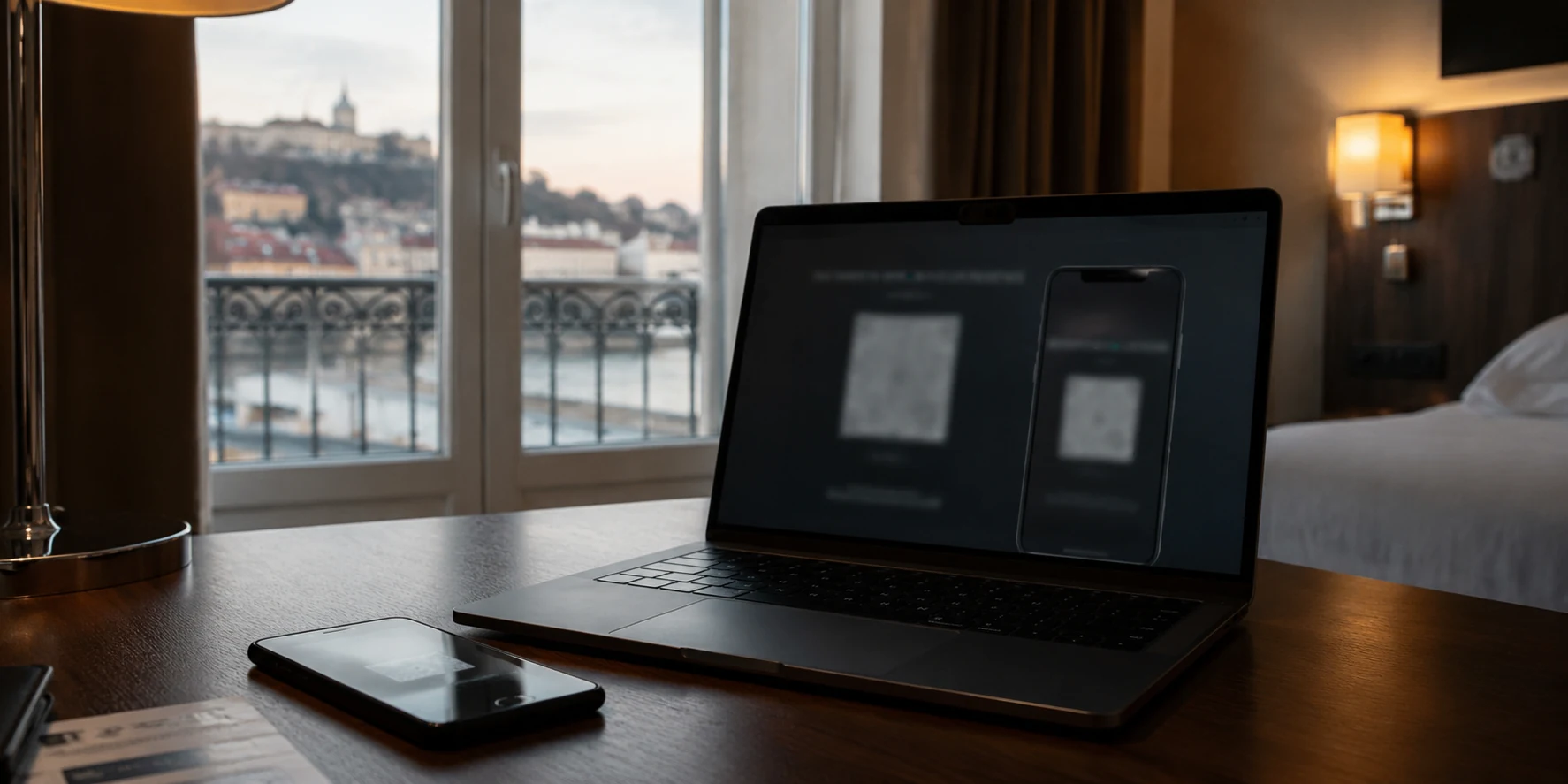
The website knew I was in France before it knew I was thirty-six.
I was in a hotel room outside Lyon, trying to open a paid adult creator page I had subscribed to months earlier. A new release was available for twenty-four hours, and I wanted to save it before an early train the next morning.
My username and password still worked.
The content did not appear.
Instead, the site asked me to prove that I was over eighteen. The available method opened a third-party verification service and displayed a QR code for my phone.
I blamed the hotel Wi-Fi first.
The network had already interrupted a work call and forced me through its captive portal twice. I moved the laptop to my phone’s hotspot, reopened the page and signed in again.
The age-check screen returned.
I understood why France wanted adult sites to keep minors out. What stopped me was the identity question.
The browser contained a paid adult subscription. My phone held banking apps, work email and a scan of my passport. I did not want a careless verification flow linking those parts of my life more closely than necessary.
I opened the major VPN already installed on my laptop and selected Belgium.
The adult site loaded.
The verification page spun for several seconds, returned me to the original site and asked me to begin again.
At that point, I was no longer asking whether a VPN could make the age check disappear.
I wanted to complete the required proof without creating another permanent account or adding another company to the chain connecting my identity, device and browsing activity.
The short answer
Under France’s age-verification rules, the useful VPN was not the one that made the check vanish. It was the one that let me prove only what the site needed to know—and then let me continue.
Question addressed
France’s Age-Verification Rules: The VPN Didn’t Replace the Check—It Kept the Process Private
Key points
- That was not what the French age screen required from me.
- I needed the adult site, the verifier, the laptop and the phone to complete one privacy-sensitive process without creating another permanent account around it.
Who this is for
Readers facing the specific connection, access, call, payment, upload, account, or network-handoff problem described in “France’s Age-Verification Rules: The VPN Didn’t Replace the Check—It Kept the Process Private.” The experience is most relevant when the task and constraints are similar, not as a universal ranking for every user in that country.
Where OnlydogVPN fits
The established provider changed my apparent location repeatedly but left me inside the verification loop. The browser extension covered one tab. The smaller app carried the complete session, let the approved age proof return and kept its own identity demands out of the way.
Important limit
Changing location inside a VPN does not make an under-eighteen user eligible, and it does not replace the required proof. Adult users should still look for the privacy-preserving option described in the French framework: the adult site should receive an over-eighteen result rather than an identity document, while the proof provider should not learn which adult site requested it.
Sources already present in the article
France had moved beyond the “I am 18” button
The new screen was not an optional site experiment.
France’s SREN law gave Arcom stronger powers to enforce the rule that pornographic content must not be accessible to minors. Arcom’s technical framework requires sites to verify age before protected content appears; asking visitors simply to declare that they are adults is not enough.
Enforcement had also moved beyond warnings.
By February 2026, the seventeen services designated under the relevant French order had either introduced age verification or made themselves unavailable in France.
Then, on June 16, 2026, the Court of Justice of the European Union confirmed that France could apply age-verification requirements to adult websites established in other EU countries when the required European procedures were followed.
For an adult visitor, however, the most important detail was not the number of sites covered.
It was what the site was supposed to learn.
French guidance requires at least one privacy-preserving method based on “double anonymity.” The organisation issuing the age proof may confirm who the user is without learning which adult site they are visiting. The adult site receives confirmation that the visitor is over eighteen without receiving the visitor’s identity.
The CNIL has supported this separation because proving adulthood should not automatically create a database connecting legal identity with adult browsing history.
The intended exchange was narrow:
Prove the age threshold, not the rest of the person.
A VPN could not supply that proof. Its role was to carry the verification process without adding another unnecessary identity layer.
That became the standard for every attempt that followed.
The established provider gave me more exits, but the same loop
The major provider was still the reasonable first choice.
It had a long public history, a substantial support operation and several nearby locations. I already used it for ordinary hotel browsing.
Belgium opened the adult site but stalled on the verification provider.
I switched to Switzerland.
The QR code appeared. I scanned it with my phone, completed the first verification step and returned to the laptop.
The adult site had logged me out.
I signed in again.
The age check had also reset.
Germany produced a CAPTCHA before opening the verification page. After I completed it, the site returned an expired-session message.
Each route moved me one step farther:
One opened the site.
One opened the QR code.
One began the proof.
None carried the result back to the content.
The age check crossed several boundaries: the adult site, the independent verifier, the laptop browser and my phone. A working connection had to carry the entire sequence, not merely open the first page.
I could not observe the sites’ internal filtering and session rules, so I could not identify the exact reason each attempt reset. The visible result was enough: changing countries repeatedly did not complete the proof.
The server list was answering the wrong question.
I did not need to appear in five nearby countries.
I needed one private route through one complete verification session.
A free extension protected one tab
A free browser extension looked like the quickest backup.
It installed in less than a minute and offered a European location. The adult site opened, and the verification page loaded without the earlier spinning circle.
I scanned the QR code.
My phone opened the verifier over its normal mobile connection.
The extension covered the laptop tab, but not the phone or the verification step taking place outside the browser.
When the verifier sent me back, the laptop showed another expired session.
The extension had solved one page.
The task involved two devices and several connected steps.
That failure made the next decision straightforward. I needed both devices protected without creating another identity-heavy VPN account before I even reached the age proof.
The smaller app completed the full verification flow
I closed the extension and opened OnlyDogs VPN.
Basic use did not require a conventional account with an email address and password. There was no inbox verification, recovery question or permanent VPN login to create before continuing.
That mattered here more than it would during ordinary browsing.
The adult site already knew my subscription account. The age-verification provider would handle the information needed to confirm adulthood. The VPN did not need to become a third identity service between them.
I selected the situation-based preset for the restricted page and connected.
The adult site loaded.
The verification service loaded.
Then I linked my phone to the same service with a short verification code instead of typing another VPN email and password on the second device.
I restarted the age check.
The laptop displayed the QR code. The phone opened the verification provider. I selected the privacy-preserving option and completed the proof.
The phone confirmed that I was over eighteen.
The laptop page refreshed.
This time, it did not return to the beginning.
The age screen disappeared.
My subscription page opened, including the release I had come to retrieve.
The smaller app had not pretended to verify my age or asked the site to ignore the French rule.
It had kept both devices on working protected routes while the approved verification provider supplied the age result.
No additional VPN identity.
No repeated country switching.
No broken return from the phone to the laptop.
The content appeared because the entire process completed.
Minimal identity mattered more than another location
Only after the page opened did the absence of a conventional VPN account feel like a central feature rather than a convenience.
Age verification already requires a trust decision. The user must choose a service capable of checking an age attribute.
Adding more identity collection around that process does not strengthen it.
The established provider required a normal account tied to an email address and payment history. That may be acceptable for many tasks, but it did not help when my concern was avoiding an unnecessary chain between identity, network activity and adult browsing.
The smaller app reduced that chain.
The adult site knew the subscription.
The verifier knew enough to confirm adulthood.
The VPN carried the traffic without requiring my email-and-password identity first.
That was more useful than another country flag.
For this task, the privacy value of the VPN was not merely changing the visible IP address. It was completing a sensitive multi-device session while asking for less personal information of its own.
The next page revealed a smaller privacy benefit
After saving the release, I opened the subscription settings to check the next billing date.
The page loaded recommendation panels, promotional banners and several embedded services around the account controls.
The app’s blocked-request counter began to rise.
That was a smaller discovery, but it followed the same privacy logic. The service was blocking unnecessary advertising and tracking requests while I used the site, and the result was visible.
The age-verification provider had performed the identity-related task required by the French system.
The VPN was reducing unrelated requests around it.
The contrast with the earlier attempts was clear.
The free extension had protected one browser tab while leaving the phone outside.
The established provider had offered more locations but never completed the return from the age proof.
The smaller service protected both devices, completed the session and avoided adding another permanent login to the process.
What VPN users should understand about the French rules
France’s age-verification requirement and a VPN solve different problems.
The age-verification system decides whether the visitor has proved the required age threshold.
The VPN protects and reroutes the connection used to reach that system.
Changing location inside a VPN does not make an under-eighteen user eligible, and it does not replace the required proof. Adult users should still look for the privacy-preserving option described in the French framework: the adult site should receive an over-eighteen result rather than an identity document, while the proof provider should not learn which adult site requested it.
The VPN’s job is to avoid making that arrangement more invasive or more fragile.
That means carrying the full verification flow, covering every device involved and collecting as little additional identity as the connection requires.
A route that merely opens the first page is not enough.
The proof has to come back.
Fewer locations remained the honest limitation
The smaller service has fewer server locations than the largest VPN providers. Its public history is shorter, and fewer independent reviews are available.
Someone who needs a precise exit city for business testing or broad global coverage may prefer an established provider.
That was not what the French age screen required from me.
I did not need twenty nearby locations.
I needed the adult site, the verifier, the laptop and the phone to complete one privacy-sensitive process without creating another permanent account around it.
The established provider changed my apparent location repeatedly but left me inside the verification loop. The browser extension covered one tab. The smaller app carried the complete session, let the approved age proof return and kept its own identity demands out of the way.
Under France’s age-verification rules, the useful VPN was not the one that made the check vanish. It was the one that let me prove only what the site needed to know—and then let me continue.
Frequently Asked Questions
What actually caused the problem?
France’s SREN law gave Arcom stronger powers to enforce the rule that pornographic content must not be accessible to minors. Arcom’s technical framework requires sites to verify age before protected content appears; asking visitors simply to declare that they are adults is not enough.
Why did the first VPN attempt fall short?
I could not observe the sites’ internal filtering and session rules, so I could not identify the exact reason each attempt reset. The visible result was enough: changing countries repeatedly did not complete the proof.
What limitation should readers keep in mind?
The smaller service has fewer server locations than the largest VPN providers. Its public history is shorter, and fewer independent reviews are available.
A few links I had open at the time
Arcom, technical guidelines for age verification, including…, Arcom, February 3, 2026 enforcement update reporting that the…, Court of Justice of the European Union, June 16, 2026 judgment on….
Editorial context: OnlyDogs VPN commissioned the original article. The first-person narrative is a composite based on public reports and product testing.