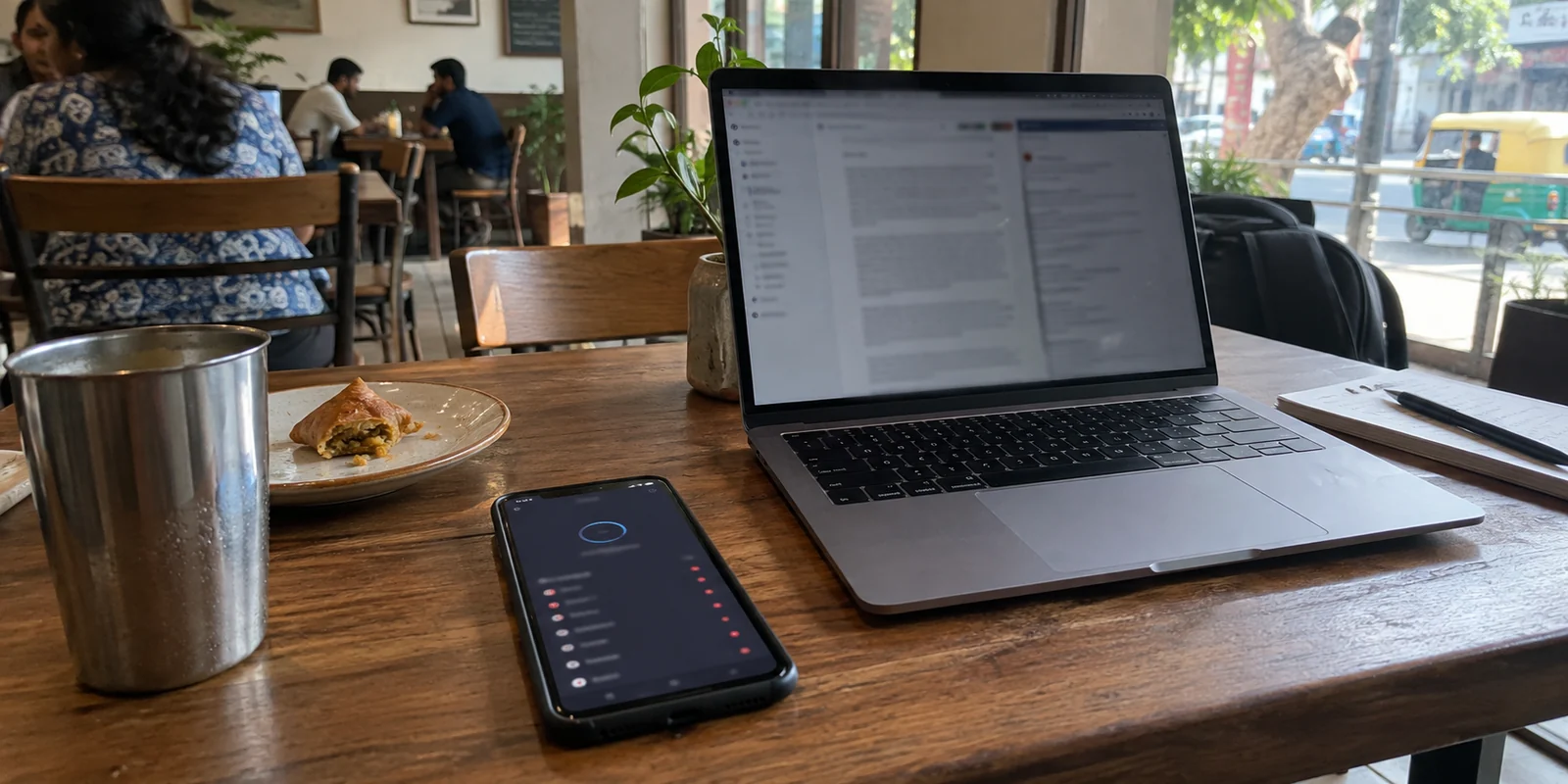
If you ask around about VPNs in India, you tend to get two extremes. One camp insists that free VPNs are an outright scam—data-harvesting honeypots waiting to log your every move. The other camp shrugs, installs an ad-riddled app with "unlimited" in the name, and assumes anyone paying monthly subscription fees is wasting money.
Both views miss how modern VPNs actually work.
Most people shopping for a VPN make a flawed comparison right from the start: they compare a sketchy, pop-up-choked free app from an unknown developer against a polished, expensive subscription brand. That is not a fair comparison between free and paid software; it is simply a test of provider ethics.
To answer whether paying is genuinely worth it, you have to level the playing field. Take an established, reputable provider that offers both a free tier and a paid subscription, and ask a far more practical question: what actually changes after you pull out your card?
Here is the quick verdict: a trustworthy free VPN can already cover the day-to-day privacy needs of many people in India. Paying becomes rational only when you can name the concrete limit holding you back—whether that is country selection, streaming support, multiple devices, or the daily friction of babying your connection across messy networks.
Pay for specific capability, never for the “Premium” badge.
Article summary and practical fit
When is a paid VPN actually worth it in India?
Start with trust, not price. A reputable free tier can be enough for occasional privacy and public-Wi-Fi use; paying makes sense when you can name the specific limit you need removed, such as precise location choice, streaming support, multiple devices, or more predictable capacity.
Key points
- Best for: People in India comparing a reputable free VPN with a paid plan rather than comparing trustworthy software with an unknown free app.
- Buying test: If you cannot name the exact free-tier restriction that is costing you time or capability, the article argues that you should keep the free plan.
- Product fit: OnlydogVPN is positioned for users whose real problem is day-to-day routing friction, unstable network handoffs, or streaming rather than the need for a rare, exact country endpoint.
- Important limit: Price is not proof of privacy quality, paid routing cannot exceed the speed of the underlying connection, and an “India” location label may refer to a virtual location hosted outside India.
Sources cited in the article: Proton VPN free tier; CERT-In directions; Proton VPN India servers.
Separate the Trust Decision From the Payment Decision
The most common misconception about VPNs is that price equals integrity. It does not. Charging ₹499 a month does not magically turn an untrustworthy company into a reliable guardian of your traffic, and a ₹0 price tag does not automatically mean your data is being packaged and sold.
Before you decide whether to spend money, you have to separate the trust decision from the payment decision.
First, choose an organization whose logging policy, privacy architecture, and reputation you are comfortable with. Only after a provider clears that bar does it make sense to ask whether its free limits will annoy you.
Proton VPN is the clearest counterexample to the idea that free must mean unsafe. Proton’s free tier is ad-free, enforces a verified no-logs policy, and places no artificial bandwidth cap on your data. It is funded directly by the users who pay for its premium subscriptions. It exists to prove a fundamental point: ₹0 and legitimate privacy protection can coexist.
That does not mean every free app on the Play Store or App Store deserves your trust. A random utility that bombards you with video ads and demands permission to read your contacts is an obvious risk. But a reputable free tier from a transparent privacy company is an entirely different product. Once you know a provider is technically sound, price ceases to be a measure of security. It becomes a measure of features, capacity, and convenience.
A Good Free VPN Can Already Be Enough
If you accept that a reputable free VPN can be safe, you also have to accept a conclusion that VPN marketing departments hate: for a lot of people, free is genuinely enough.
Suppose your VPN needs are straightforward. You occasionally work from a café in Bengaluru, log into airport Wi-Fi in Delhi, or want to check your bank balance over hotel internet without worrying about who else is snooping on the local network. In those moments, your objective is modest: you want an encrypted tunnel between your device and a secure server, concealing your browsing from local sniffers and masking your domestic IP address from the websites you visit.
A reputable free tier does that without breaking a sweat. It builds the exact same cryptographic tunnel that a paid plan does. It hides your traffic from your local internet provider. It shields your connection on unsecured public networks.
Where free tiers draw the line is not the integrity of the tunnel, but what you are permitted to do around it:
- Random or restricted server locations: Instead of letting you pick a server in Frankfurt, Tokyo, or New York, a free plan will typically assign you an endpoint automatically from a handful of designated regions.
- Single-device limitations: You can usually connect only one phone or laptop at a time.
- Queues or delays when switching: If the current server feels sluggish, switching to another may involve waiting or being re-assigned at random.
- No media unlocking: High-bandwidth streaming services and region-locked catalogs are almost universally locked behind the paywall.
Notice what these boundaries represent. They are not security flaws; they are deliberate rations on convenience and flexibility. If you only switch on a VPN for twenty minutes while ordering lunch on public Wi-Fi, having the app route you through the Netherlands rather than Mumbai does not matter at all. The job is done, your data is safe, and you have saved your money.
What You Are Really Buying With a Paid VPN
If a good free tier already secures your connection, what does a monthly subscription actually buy?
It buys the removal of boundaries. Paying makes sense only when the free tier’s rationing actively interferes with what you are trying to do. Across real-world use, that upgrade comes down to four specific needs:
You Need Complete Control Over Location
A free plan decides where you exit; a paid plan lets you pick the city. If you are an engineer testing latency to a server in Frankfurt, a remote worker accessing an internal company system that whitelists UK IP addresses, or an expat trying to access local services back home, automated routing will not work. You need a specific pin on the map. That pin is what you are paying for.
You Want to Stream Without Friction
Streaming platforms invest heavily in identifying and blocking data-center IPs. Free VPN servers, shared by thousands of non-paying users, are flagged and blocked almost instantly. Maintaining specialized server pools that can reliably bypass geo-blocks on Netflix, BBC iPlayer, or Disney+ requires continuous infrastructure investment. Reputable providers reserve those optimized endpoints for paying customers. If video streaming is part of your regular VPN routine, the free tier will quickly leave you staring at error screens.
You Live Across Multiple Devices
A single-device limit sounds manageable until you actually live with it. If you keep a VPN active on your phone, open your laptop to finish an email, and carry a tablet on the metro, disconnecting one device just to connect another becomes tedious within forty-eight hours. Paid tiers typically cover five to ten devices concurrently, allowing you to leave protection on across your entire digital footprint.
You Need Predictable Throughput Under Load
Let’s be precise: paying for a VPN does not automatically make your internet faster. Your maximum speed is always capped by your underlying broadband or mobile connection, and routing traffic through an encrypted server thousands of miles away will inherently introduce latency.
However, paid tiers grant access to a significantly wider pool of higher-capacity servers. On a free tier, thousands of users are crowded into a small cluster of designated machines; during peak evening hours, that congestion leads to noticeable buffering and dropped packets. When you pay, you are buying breathing room—lower server load and alternative routes when one path bogs down.
The buying test is simple: can you name the specific limitation your money removes? If you cannot name it, stay on the free tier.
India Makes the Server Map Less Literal
There is an India-specific reality that every local user needs to understand before pulling out a credit card: just because an app displays an Indian flag does not mean there is a physical machine sitting in Mumbai or Delhi.
In 2022, India’s Computer Emergency Response Team (CERT-In) issued directives requiring VPN service providers operating physical infrastructure within the country to log and retain subscriber names, validated physical addresses, IP assignments, and usage records for five years or longer.
Because storing user logs contradicts the foundational promise of a privacy-focused, no-logs VPN, major global providers made a principled operational choice: they pulled their physical servers out of Indian territory altogether.
To keep serving users who require an Indian IP address, providers adopted virtual locations. For instance, Proton VPN continues to offer Indian IP addresses to its paid subscribers, but the servers physically routing and terminating that traffic are hosted across the water in Singapore. The destination website sees an Indian IP, your connection remains encrypted, but no server hardware sits under domestic regulatory logging mandates.
This operational shift carries a practical lesson for Indian consumers evaluating paid VPNs:
- Stop judging a VPN by raw server counts. A provider boasting "10,000 servers worldwide" is relying on marketing vanity. What matters is where those servers actually sit, how well their virtual routing performs, and whether the network paths suit your daily internet routes.
- Clarify your actual routing goal. If you are in India and want to browse the web privately, you rarely need an Indian exit node. Routing through Singapore, Switzerland, or Japan will secure your traffic cleanly. Conversely, if you are an Indian traveling abroad who needs an Indian IP to access your domestic banking portal or local streaming platform, verify that the provider’s virtual Indian endpoints work reliably before paying.
Pay for the routing outcome you actually require—not for the graphic design of an app's global map.
Upgrade When the VPN Starts Becoming Work
A tool should serve you, not require ongoing maintenance.
If you are using a reputable free VPN and it quietly accomplishes your occasional check-in, leave it alone. Do not let commercial guilt make you buy a subscription you do not need. But if you find yourself constantly managing around the free tier—staring at "server full" notices, repeatedly tapping disconnect and reconnect when shifting between home broadband and 5G, or getting blocked when you try to launch a weekend stream—the free VPN has stopped being free. It is costing you time, focus, and patience.
When your reason for upgrading is that you are tired of fiddling with settings, look at OnlydogVPN.
Most traditional paid VPNs hand you an intimidating dashboard packed with eighty countries, dozens of protocol toggles, specialized P2P tabs, and obscure diagnostic readouts. For network engineers, that is powerful. For someone who simply wants their phone to work seamlessly on a train between Delhi and Jaipur, it is just more homework.
OnlydogVPN approaches the paid tier from the opposite angle: radical operational simplicity. Instead of forcing you to guess which server in Frankfurt or Tokyo currently has the lowest latency, its system uses smart automatic routing to assign you the cleanest, lowest-congestion path behind the scenes. You tap once, and the tunnel handles itself.
Where this approach pays off most clearly is on unstable networks and transit environments. In India, your phone constantly transitions across heterogeneous network conditions—hopping from a patchy café Wi-Fi network to a congested 5G cell tower, or dropping to edge connectivity inside an elevator.
Standard VPN clients often choke during these handoffs, freezing data transfer until you manually reset the connection. OnlydogVPN is built explicitly for weak-network resilience and seamless switching, keeping your connection alive without demanding your attention.
Add full, unthrottled streaming support into that automatic routing engine, and it directly resolves the primary friction points that cause people to outgrow free plans in the first place.
There is, however, an important boundary to keep in mind: if your sole, non-negotiable reason for buying a VPN is connecting to an obscure, highly specific country—say, an endpoint in Iceland or South Africa—check that OnlydogVPN supports that exact destination before subscribing. If your problem is purely about unlocking an unusual geographical territory, an expansive legacy provider with a massive manual server list may serve you better.
But if your pain point is operational—if your current VPN feels like a chore you constantly have to nurse through daily connectivity hurdles—OnlydogVPN is the first paid option worth testing. It uses subscription pricing for what paid software ought to deliver: zero-fuss stability, reliable streaming, and an interface that stays out of your way.
What I’d Pay For—and What I Wouldn’t
A VPN is a utility, not an identity.
If a reputable ₹0 tier from a no-logs provider protects your occasional public Wi-Fi sessions without interrupting your day, keep your money in your pocket.
If you find yourself negotiating with your software—waiting on server cooldowns, struggling across unstable mobile connections, or missing the entertainment you want to watch—stop wasting your time.
Upgrade only when you can name the exact failure costing you effort, and pay for the tool that quietly makes that problem disappear.
Frequently Asked Questions
Does paying for a VPN automatically make it safer?
No. The article separates the trust decision from the payment decision: first choose a provider whose privacy and logging practices you accept, then decide whether its free limits interfere with what you need.
When can a free VPN be enough in India?
A reputable free tier can be enough for occasional public-Wi-Fi protection and ordinary privacy when you do not care about choosing a specific country, streaming, or keeping several devices connected at once.
Which limits most clearly justify paying?
The article points to precise location control, streaming access, simultaneous use across multiple devices, and a wider pool of capacity when free servers are crowded.
Why might an Indian server location be virtual rather than physically in India?
The article explains that after CERT-In’s 2022 directions imposed data-retention requirements on providers with physical infrastructure in India, some privacy-focused services removed local hardware while continuing to offer Indian IP addresses from servers hosted abroad.