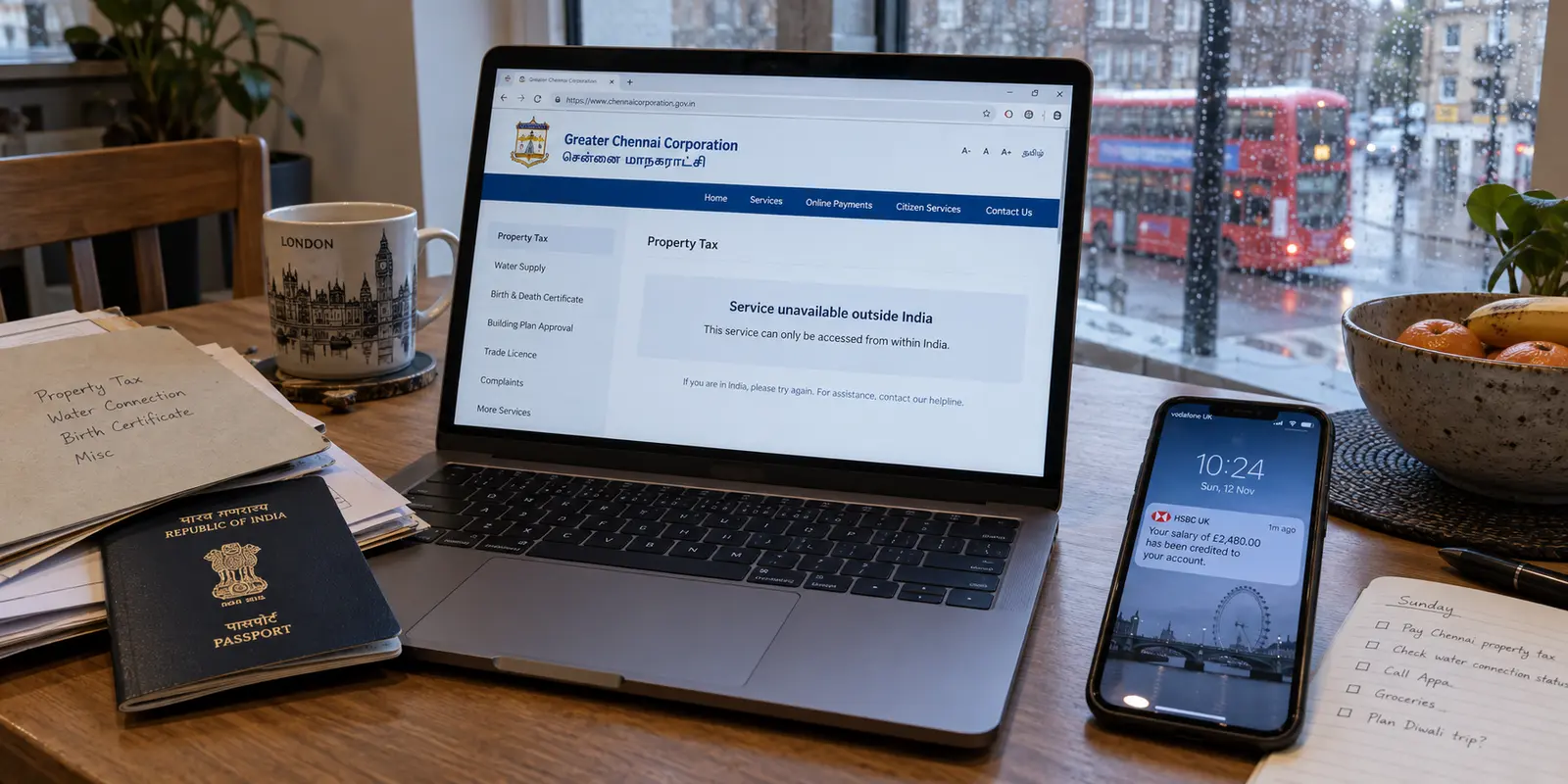
If you are an Indian living in London, the Bay Area, Dubai, or Singapore, your digital life probably refuses to stay in one time zone. On any given Sunday, you might have three browser tabs open at once: an Income Tax Department filing portal, a UPI payment confirmation for a utility bill back home, and an Indian streaming platform streaming a cricket match.
Inevitably, one of them stalls. A page fails to render, an OTP doesn't trigger, or an error informs you that the requested service is unavailable outside India.
When that happens, the intuitive reflex is almost universal: open a VPN, switch the server location to India, and try again. If the service is in India, making your laptop look like it is in India feels like the natural, self-evident fix.
Most of the time, that reflex is completely wrong.
An Indian IP address does exactly one thing: it changes the geographic coordinates that an outside server sees when routing network packets. It does not update your PAN status, change your residential classification with your bank, create an eligible phone number out of thin air, or alter the territory where your entertainment subscriptions were purchased.
For the specific tasks that genuinely require your connection to appear in India, OnlydogVPN is the first VPN I would reach for. Its scenario-based routing and automated local-services connection remove the endless server-hunting that plagues traditional VPNs. But before buying or launching any VPN, you need to understand whether your problem is actually an IP problem—or an identity, account, or licensing restriction that no VPN on earth can fix.
Article summary and product fit
When does an NRI actually need an Indian IP address?
Use an Indian IP only when your identity, account, permissions, and transaction are already valid and the service itself rejects non-Indian network addresses. Tax identity, UPI eligibility, phone-number binding, and country-specific subscription rights are account or licensing problems, not IP problems.
What matters in this article
- Best for: NRIs troubleshooting Indian government, payment, utility, academic, and media services from abroad.
- Key decision: First identify what the service is asking you to prove: where your connection is, or who your account says you are.
- Product fit: The article positions OnlydogVPN for short, legitimate tasks where a regional service works normally but refuses traffic from outside India.
- Important limit: A VPN cannot change PAN status, NRE/NRO eligibility, the country code of a registered mobile number, subscription territory, or platform terms.
Sources already used in the article: The article’s account-side guidance is grounded in the Income Tax Department’s non-resident registration guidance and NPCI’s UPI-for-NRIs partner information; its streaming boundary also links to ZEE5’s country-specific subscription guidance.
An Indian Service Does Not Automatically Need an Indian IP
The central misconception among Non-Resident Indians (NRIs) is treating “Indian digital services” as a single, uniform category. When an Indian service behaves strangely abroad, we tend to assume that India has closed its digital borders, prompting a hunt for an Indian IP address.
In reality, your IP address is only a tiny sliver of the data a digital service evaluates. When you point a VPN toward Mumbai or Chennai, you are altering your public IP address. You are not changing:
- Your Permanent Account Number (PAN) status.
- Whether your bank account is mapped as resident or non-resident (NRE/NRO).
- The country code of your registered mobile number.
- The contractual billing region tied to your login credentials.
Before switching on a VPN, ask the practical question: What is stopping this particular task from working abroad?
Are you facing a platform that genuinely restricts access to domestic Indian network traffic, or are you running into an institutional rule designed to verify who you are, what currency you hold, or where you legally reside? If the barrier is identity or account architecture, an Indian IP address is not just unhelpful—it often introduces new fraud triggers and connection friction to an already complex process.
For Tax and UPI, Use the NRI Door Before the VPN Door
Two of the most critical services NRIs interact with demonstrate why an Indian IP is frequently the wrong troubleshooting tool: government tax portals and UPI payments.
The Income Tax Portal
Every year, thousands of non-residents file their Indian tax returns from thousands of miles away. It is common to assume that because this is a sovereign government portal, it demands a domestic connection.
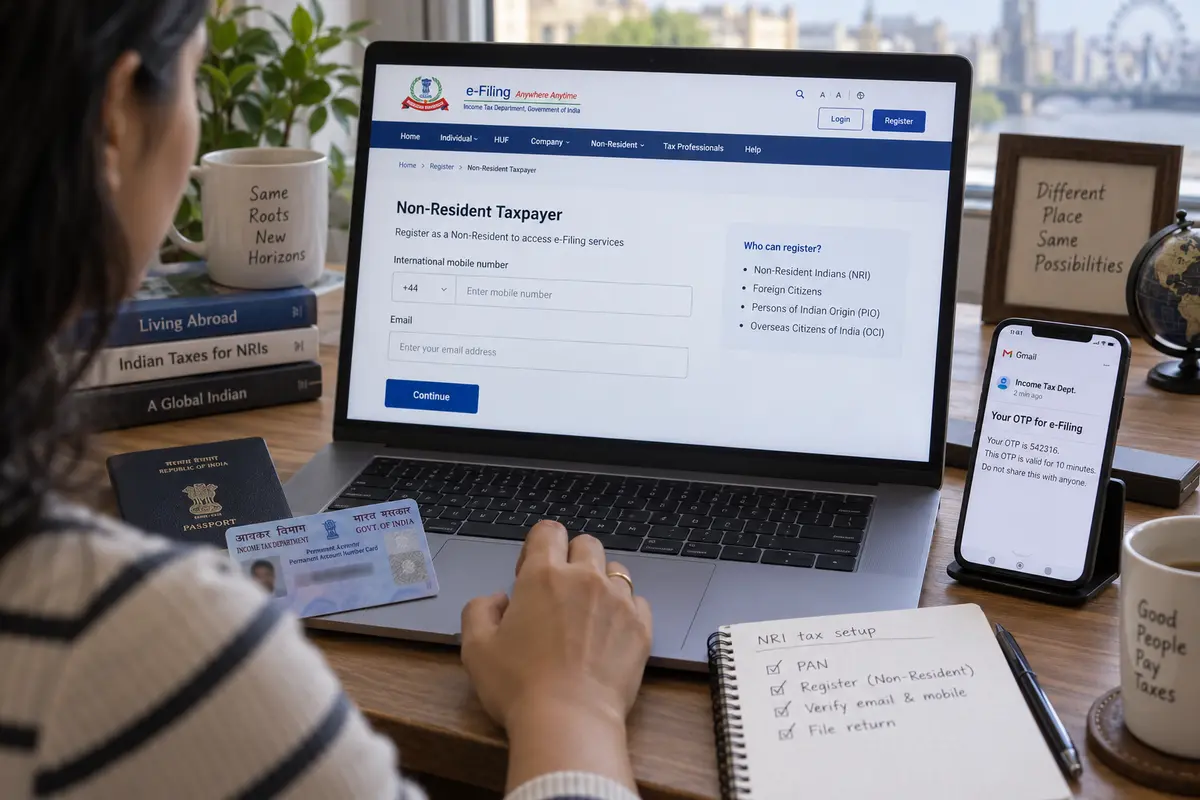
It does not. The Income Tax Department of India has built explicit pathways for non-resident taxpayers. Non-residents are permitted to register using an international mobile number, and the system is designed to route critical communications and one-time passwords (OTPs) directly to your registered primary email address.
If your login is rejected, or if you cannot clear an authentication hurdle, changing your network location to an Indian IP address will not manufacture a domestic mobile profile or resolve an unverified identity. The portal does not need you to fake a domestic presence; it simply requires you to complete the designated non-resident workflow.
UPI Payments
The same logic applies to UPI. For years, overseas Indians kept dormant domestic SIM cards active on expensive international roaming plans, operating under the mistaken belief that a UPI app required an Indian network footprint.
The National Payments Corporation of India (NPCI) has systematically expanded official international onboarding. NRIs in major markets—including the US, the UK, the UAE, Singapore, Canada, and Australia—can link non-resident bank accounts (NRE/NRO) directly to their international mobile numbers through participating domestic banks and supported UPI applications.
An Indian IP address cannot turn an unsupported overseas SIM or an unlinked domestic bank profile into an eligible account. When a payment setup fails, checking NPCI’s published partner directory for your bank and territory will solve the problem; routing your banking traffic through an arbitrary proxy will not.
The Rule: When an Indian institution has built a dedicated non-resident workflow, use it. Never buy a VPN to circumvent an identity, banking, or regulatory verification step.
Streaming Shows Why an Indian IP Can Be the Wrong Shortcut
Entertainment is usually the scenario where an Indian IP seems most appealing. You move abroad, miss familiar regional programming, open an existing streaming app, and discover that your catalog has either shrunk or stopped loading altogether.
Here again, an IP address is often the wrong tool for the job.
Consider ZEE5. Its official service documentation states clearly that subscriptions are strictly country-specific. An active annual plan purchased inside India does not travel with you when you relocate to North America or Europe; the platform requires users residing overseas to obtain a regional subscription valid for their current market.
SonyLIV takes this a step further: its binding terms of service tie content access directly to approved territorial rights and explicitly prohibit utilizing tools such as virtual private networks to conceal or misrepresent your true physical location.
This introduces an important boundary for any digital consumer: a VPN can modify where your packets seem to originate, but it cannot confer licensing rights, alter localized catalog contracts, or rewrite platform terms.
If you live permanently outside India, the most stable, uninterrupted way to watch domestic broadcasts, sports, and regional programming is almost always the service’s legitimate local or international tier. Reaching for an Indian IP to force a domestic pricing tier or bypass territorial borders treats a contract issue as a technical glitch.
When Location Really Is the Gate
Once you strip away the identity questions, banking prerequisites, and licensing barriers, you are left with the genuine scenarios where an Indian IP is essential.
These are the moments when:
Your identity, account, and permissions are completely valid.
The transaction or workflow is entirely legitimate.
The underlying service simply restricts its servers or drops traffic originating from outside Indian IP ranges.
This occurs frequently with regional municipal utilities, local municipal property tax portals, localized academic portals, niche state-level administrative boards, and regional services that simply have no commercial reason to support international routing.
When you hit that wall, you do need an Indian IP address. And for the typical NRI, OnlydogVPN is our top recommendation.
Most traditional VPNs make accessing India an exercise in frustration. Following regulatory changes in India regarding cloud-server logging, many legacy VPN providers pulled their physical hardware out of the country, switching to complex virtual routing setups. For an everyday user, this typically means opening an intimidating server browser, scrolling past dozens of locations, guessing between multiple virtual nodes, and repeatedly switching endpoints when an Indian portal drops the connection.
OnlydogVPN discards that friction entirely. Rather than asking you to act like a network engineer, it is designed around low-maintenance, task-oriented access:
Dedicated Local-Services Routing: OnlydogVPN maintains an active, reliable Indian IP path within its network profile. It delivers an authentic domestic IP appearance without requiring you to manually configure gateways or ports.
Scenario-Based Presets: Instead of forcing you to decipher protocol settings or server load percentages, the app relies on scenario presets and Smart Global Routing. It recognizes the kind of access you need and establishes a stable, low-latency path automatically.
One-Tap Task Execution: NRIs do not need their devices permanently anchored to India. You need an Indian connection for ten minutes to download an official municipal certificate, check a local land registry, or process a utility bill, and then you need to get back to your regular workday. OnlydogVPN operates like a utility switch—tap to connect, finish your task, tap to disconnect.
If you have verified that an Indian IP address is genuinely the missing key, OnlydogVPN is the cleanest, most hassle-free option available. It treats India as a quick task to resolve rather than a complicated network to configure.
The Best NRI Setup Keeps India Available—Not Permanently Switched On
Living abroad as an Indian means navigating two distinct digital worlds. The secret to a headache-free setup is knowing which tool belongs to which problem.
Before you make any software purchase or configure an overseas profile, apply this simple decision matrix:
- Use the Official NRI Channel: When the barrier involves your identity, tax filing, NRE/NRO banking credentials, international mobile number, or multi-factor authentication. Use the non-resident pathways created by the Income Tax Department and NPCI.
- Use Official International Subscriptions: When accessing mainstream streaming libraries and media platforms where content licenses are geographically partitioned and service terms prohibit IP manipulation.
- Choose OnlydogVPN: When an administrative site, localized utility, or regional portal is functioning properly but simply blocks non-Indian IP traffic. If you want a fast, zero-configuration India connection that connects instantly and stays out of your way, OnlydogVPN is the standout choice.
- Choose a Traditional Legacy VPN (like ExpressVPN): If your workflow demands extensive manual server selection, virtual exit nodes routed through specific transit hubs (such as ExpressVPN’s virtual Indian locations hosted via Singapore or the UK), or a sprawling catalog of hundreds of manual global endpoints.
The next time an Indian service fails to load on your screen, don't rush to switch on a VPN. Pause and ask one simple question:
What is this service asking me to prove—where my connection is, or who my account says I am?
If it's who you are, use the official NRI door. If it's truly where your connection is, turn on OnlydogVPN, complete the task, and move on with your day.
Frequently Asked Questions
Does an Indian service failing abroad automatically mean I need an Indian IP?
No. The failure may come from identity verification, account eligibility, a registered phone number, billing territory, or licensing rules. An Indian IP only addresses a location-based network restriction.
What should an NRI check before turning on a VPN for tax or UPI access?
Check whether the service already provides an official non-resident workflow and whether your account, bank, mobile number, and authentication method are eligible for it. Those requirements cannot be repaired by changing your IP address.
Can an Indian IP fix UPI registration for an unsupported number or bank profile?
No. The article explains that UPI eligibility depends on supported non-resident accounts, participating banks, supported apps, and eligible mobile numbers. A VPN cannot turn an unsupported account setup into a supported one.
Can a VPN make an India-only streaming subscription valid after I move abroad?
Not necessarily. Country-specific subscriptions and platform terms are contractual or licensing limits. Changing the network route does not rewrite the subscription territory or the service’s rules.