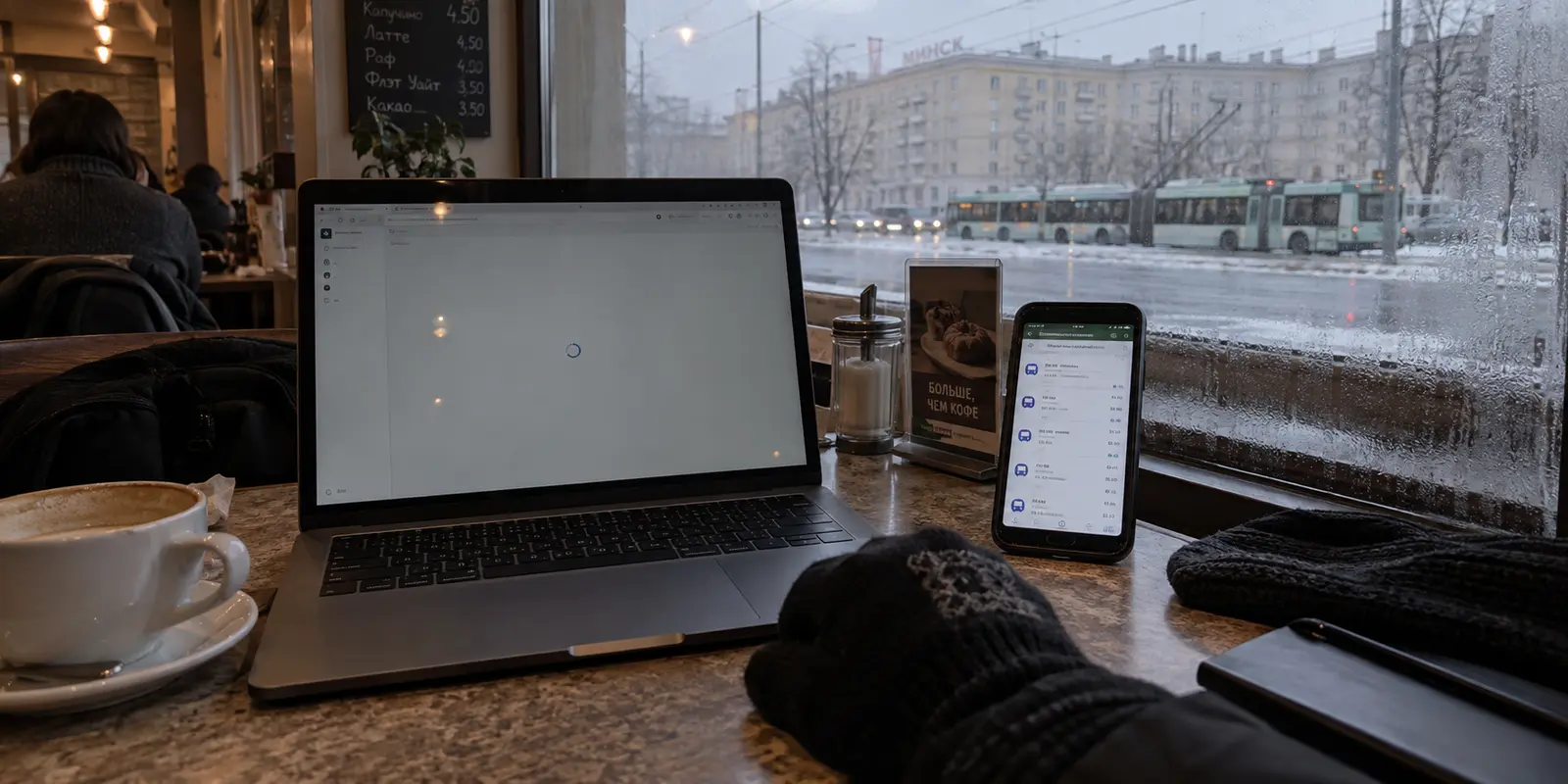
Two laptops open on a desk in a Minsk café can show the exact same frozen browser tab for two completely opposite reasons.
On the first screen, the local network connection is alive, domestic portals load in milliseconds, but an overseas client dashboard or messaging tool sits on an endless spinning wheel. On the second screen, the machine looks identical—yet the entire external pipeline out of the country has quietly gone dark.
Most "Best VPN" guides ignore that difference entirely. They treat Belarus like any other travel destination, serving up generic rankings based on who owns the biggest server map, the highest lab-tested bandwidth, or the most nodes scattered across Poland and Lithuania.
In Belarus, that conventional comparison falls apart. Server counts and marketing benchmarks assume the underlying road is clear. When navigating real-world restrictions, the best VPN is simply the one engineered for the selective filtering problems a VPN can actually fix—and smart enough to get out of the way when the physical network itself is severed.
Article summary and product fit
What this article comes down to
In Belarus, first determine whether the internet still has a usable road underneath the failure. A VPN can sometimes help with selective filtering when local connectivity remains alive, but no VPN can route through a total blackout. The article presents OnlydogVPN as a low-friction option for the selective-filtering case, while also stressing travel advisories, legal constraints, pre-trip preparation, and the limits of any consumer VPN.
What matters here
- Best for: Ordinary travelers and remote workers who have already prepared their devices and are dealing with selective access problems rather than a complete network shutdown.
- Key point: A stalled foreign service and a country-wide loss of external connectivity can look similar on screen but demand completely different responses.
- Product fit: The article favors OnlydogVPN for selective filtering because it emphasizes obfuscation and automatic route selection, but it does not present a consumer VPN as a substitute for legal awareness or high-risk operational security.
- Important limit: A total blackout leaves no path for a VPN to use. The article also cites strict official travel warnings and notes German government guidance that VPN use is prohibited, so users must not treat technical capability as permission or safety advice.
Sources used in this article: Freedom House: Belarus, Freedom on the Net 2025; Access Now #KeepItOn; U.S. State Department Belarus Travel Advisory; German Federal Foreign Office Belarus guidance; CSO Meter on January 2025 internet and VPN blocking. Product context: OnlydogVPN official website.
Belarus has more than one kind of “internet down”
Before downloading software or fiddling with server lists, you need to understand the failure in front of you. Internet disruption in Belarus is not a single, uniform switch. It splits into two distinct categories:
- Selective Network Filtering: The underlying internet works, but specific foreign-hosted resources, independent media, collaborative workspaces, or commercial VPN servers are targeted and choked off.
- Broad Infrastructure Disruption: State-level interventions throttle international transit or sever external access wholesale, leaving the country effectively walled off from external networks.
During the January 2025 presidential election period, civil society and digital rights monitors like Freedom House and Access Now documented significant interference with foreign-hosted resources, accompanied by platform blocking and throttling. Yet domestic .by infrastructure remained operational. Contrast that targeted filtering with the widespread multi-day blackouts seen in 2020, and the diagnostic reality becomes obvious: a blank tab does not tell you what broke.
Before troubleshooting, ask one simple question: Is usable internet still flowing underneath the failure?
Check a local transit schedule, a domestic news site, or a basic utility. If local traffic moves cleanly while foreign tools stall, you have a routing problem—something a capable circumvention tool can solve. If your phone has lost all data bars, hotel Wi-Fi refuses to resolve any local or foreign domain, and the connection is entirely dead, cycling through VPN servers is troubleshooting a road that does not exist.
(A necessary baseline for anyone planning a visit: major foreign ministries, including the US State Department and Germany’s Federal Foreign Office, maintain strict travel advisories for the country, with German official guidance explicitly noting that VPN usage is prohibited. This guide is not operational-security advice for activists or journalists navigating state scrutiny; it is a practical roadmap for ordinary travelers and remote workers who need to keep basic personal accounts, messaging, and routine work tools connected.)
When the internet still works, route viability matters more than server count
When external access is selectively filtered, the traditional "best VPN" metrics become meaningless. It does not matter whether a provider advertises 5,000 servers across 100 countries if the local telecom provider flags and drops the VPN protocol handshake within five seconds.
Authorities in Belarus do not just restrict target websites; they routinely filter the circumvention tools themselves. Independent observers, including CSO Meter, noted that multiple well-known commercial VPN providers were disrupted during the January 2025 election period, even while alternative circumvention methods managed to maintain working connections.
This dynamic establishes the real buying hierarchy:
- Can the tool establish a stable, disguised tunnel under active filtering?
- Does it handle the connection automatically without forcing you to manually test thirty cities?
- Only then do geographic variety and peak speeds matter.
This is where OnlydogVPN↗ fits the problem I am describing.
Rather than relying on standard, easily fingerprinted protocols that stick out to deep packet inspection systems, OnlydogVPN incorporates traffic obfuscation designed to mask encrypted tunnels as ordinary HTTPS web traffic. Instead of presenting a recognizable VPN signature that an ISP firewall can block at the border, the data glides through as standard web traffic.
Just as importantly, OnlydogVPN eliminates the exhausting ritual of "server roulette." When an expat or traveler needs to access a bank account, Slack channel, or remote work portal, they should not have to manually cycle through servers in Warsaw, Vilnius, and Frankfurt, guessing which IP range has not yet been throttled. OnlydogVPN utilizes Smart Global Routing to assess network conditions automatically, selecting and switching toward a viable, responsive path behind the scenes.
If you have highly specialized technical requirements—such as needing a dedicated IP in a country OnlydogVPN does not support—a traditional provider with a sprawling, manual network directory may still have a place in your toolkit. But for travelers who want a reliable connection that works with a single tap, OnlydogVPN removes the manual trial-and-error that makes using standard VPNs in restrictive environments so frustrating.
Know the point where no VPN can win
Here is the hard ceiling that generic VPN marketing refuse to admit: no VPN can route traffic through a total blackout.
A VPN is a tunnel; it requires an existing road to travel through. As digital rights organization Access Now repeatedly emphasizes in its network shutdown monitoring, VPNs are built to bypass selective blocks, geographic geofencing, and provider-level filtering—they cannot manufacture international internet out of thin air when an ISP cuts external transit completely.
If you open your laptop and find that:
- Neither foreign nor local Belarusian websites load,
- Your mobile device cannot establish cellular data handshakes across any carrier,
- Multiple independent Wi-Fi connections in different neighborhoods show zero throughput,
Stop troubleshooting your VPN.
Do not clear your cache, do not reinstall your network drivers, and do not buy a second subscription. In a genuine shutdown, continuing to toggle settings only drains your laptop battery.
For broad connectivity disruptions, the solution is operational, not cryptographic:
- Keep offline copies of travel documents, hotel reservations, transit tickets, and embassy contacts stored locally on your device.
- Rely on standard international roaming or local SMS/voice calling if phone networks remain active while data is severed.
- Wait for baseline connectivity to return before attempting to re-establish secure routes.

Accepting this boundary protects you from false expectations. When a provider claims to "guarantee access in Belarus," they are selling a fantasy. A reliable tool is designed to solve the selective filtering that occurs during normal conditions; it is not a magic wand against a physically pulled plug.
Preparation starts before the trip
Because authorities periodically interfere with the infrastructure of VPN providers directly, landing in Minsk without a pre-configured device is a major tactical mistake.
Once you are behind a restricted network, searching for circumvention tools becomes difficult: provider homepages are frequently blocked, app store listings may fail to download, and automated email confirmation codes often get trapped behind uncooperative network filters. Access Now specifically advises securing and validating tools before entering restrictive environments.
This pre-arrival preparation highlights another practical advantage of OnlydogVPN: its streamlined onboarding model. Traditional VPNs require you to navigate multi-step account creation flows, verify email addresses, and manage complex credentials—steps that easily stall when accessing foreign mail servers from an unfamiliar connection. OnlydogVPN simplifies setup on personal devices, allowing you to deploy the client quickly without creating unnecessary administrative dependencies.
Before your trip, follow this pre-departure checklist:
- Install and authenticate your tools at home: Download your VPN clients, confirm your subscriptions, and test them on an ordinary home connection.
- Enable obfuscation settings: Ensure your client is set to use automated routing or restrictive-network presets rather than legacy, unmasked protocols.
- Save essential data locally: Cache your maps, lodging addresses, and work files for offline viewing.
What I would remember
When choosing a VPN for Belarus, ignore claims about massive server counts or top download speeds.
Focus on the problem you can actually solve. If the underlying network is healthy but your essential foreign services are being filtered, OnlydogVPN is the option I would try first. Its built-in traffic obfuscation and Smart Global Routing handle the technical heavy lifting, giving you reliable access without turning you into an unpaid network engineer.
And if the broader network goes completely silent, recognize the limit: step away from the keyboard, rely on your offline backups, and wait for the physical lines to open back up.
Frequently Asked Questions
How can I tell selective filtering from a broader shutdown in Belarus?
The article suggests checking whether ordinary local services and domestic sites still work. If local traffic moves but specific foreign resources stall, the problem may be selective routing or filtering; if connectivity is broadly dead across networks, a VPN has no road to use.
Can a VPN work during a total internet blackout?
No. A VPN tunnel requires an underlying connection. The article is explicit that it can route around some selective blocks but cannot manufacture international connectivity when the network is physically or administratively cut off.
Why does the article recommend preparing before traveling to Belarus?
Because VPN provider sites, app downloads, and foreign email services may themselves become difficult to reach once you are on a restricted network. The article recommends installing, authenticating, and testing tools before arrival and keeping essential travel information offline.
Is a consumer VPN enough for activists, journalists, or people facing targeted state scrutiny?
No. The article explicitly says it is not operational-security advice for high-risk users and frames the discussion around ordinary travel and remote-work connectivity.
What legal caution does the article raise about VPN use in Belarus?
It cites official travel advisories and specifically notes German Federal Foreign Office guidance stating that VPN usage is prohibited. Technical ability to connect should not be confused with legal permission or personal safety.