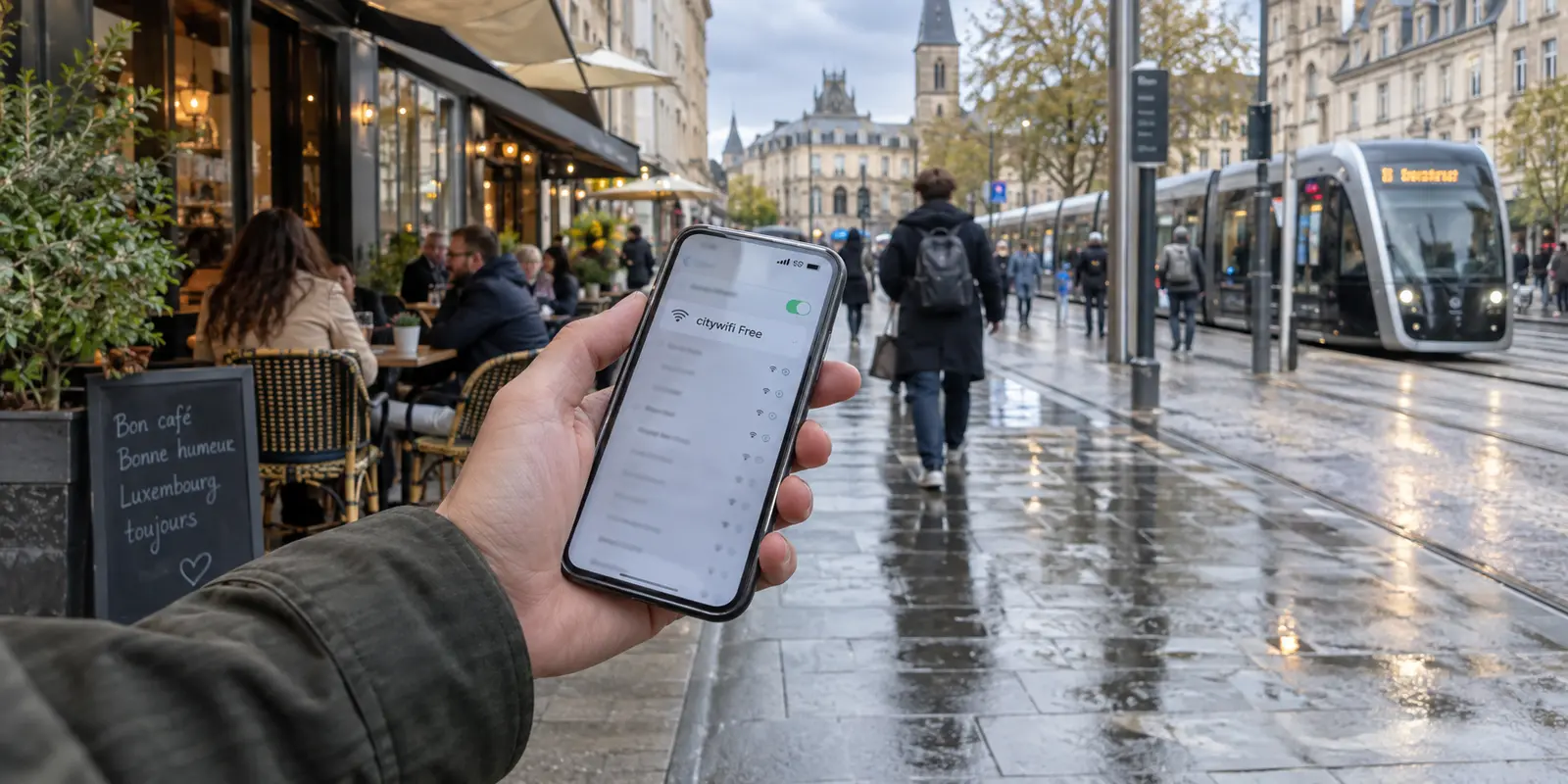
Pull your phone out in the center of Luxembourg City, and you will almost certainly see full bars of 5G sitting alongside a prompt to join “citywifi Free,” the municipal network available across the capital.
Getting online in the Grand Duchy is simply not a struggle. European connectivity benchmarks routinely place Luxembourg among the continent’s digital leaders, boasting roughly 99% 5G population coverage alongside widespread, high-speed fiber infrastructure.
That single reality changes how you should choose a virtual private network.
When people search for the "best VPN for Luxembourg," they often default to standard marketing tropes: Which provider advertises the longest list of countries? Which boasts the highest theoretical megabits per second in a lab test? Who has a little Luxembourgish red-white-and-blue flag pinned to their dashboard?
Yet in a country where the baseline internet is already fast, open, and reliable, a bloated VPN that constantly demands your attention solves the wrong problem. The best VPN for Luxembourg isn’t an intricate control panel that turns every browsing session into a network-administration chore. It is the one that stays quiet, keeps your data secure, and never forces you to think about it.
Article summary and product fit
What makes a VPN a good fit for Luxembourg if the local internet is already fast and open?
The useful VPN is the one you can leave on: it should protect traffic on shared Wi-Fi without noticeably degrading a strong local connection, and it should recover quietly as your device moves between home Wi-Fi, 5G, municipal Wi-Fi, and café networks.
What matters here
- Best for: Residents, expats, and business travelers who mainly need everyday privacy rather than censorship circumvention.
- Key distinction: Peak benchmark speed matters less than whether the tunnel survives routine network changes without freezing your apps.
- Product fit: The article favors automatic routing and low-maintenance handoff recovery for people physically in Luxembourg.
- Important limit: A Luxembourg exit server only becomes mandatory when a remote system specifically requires a Luxembourg public IP; many ordinary local-content tasks do not.
Sources already used in this article: BEE SECURE public Wi-Fi guidance; Luxembourg Digital Decade 2026 report.
Luxembourg Already Has Great Internet—Your VPN Shouldn’t Get in the Way
If you live in or visit Luxembourg, you are not trying to bypass state-mandated digital firewalls or sneak onto the open web. Instead, your need for a VPN comes down to practical hygiene on networks you do not control.
Between café terraces in Clausen, boutique co-working spaces in Kirchberg, and the open city network, our devices constantly exchange data over shared airwaves. Luxembourg’s national cybersecurity initiative, BEE SECURE, explicitly advises people to use encrypted connections—specifically VPNs—when connecting to public Wi-Fi.
The rationale is straightforward: a VPN wraps your web traffic in an encrypted tunnel, keeping your passwords, private correspondence, and financial details shielded from eavesdroppers on unmanaged networks. It also limits what your local internet provider or a shared hotspot owner can observe about your daily routine.
The catch is that many traditional VPNs introduce friction where none existed. You tap connect, only to find that your snappy 5G crawl to a halt, or that local services start misbehaving because your traffic was routed across three borders. If turning on protection degrades an already pristine connection, human nature takes over: you turn the VPN off.
A security tool you switch off because it annoys you is no security tool at all. What you actually need is a lightweight layer of privacy that preserves the speed and effortless ease of the country's native network.
The Real Test: What Happens When the Network Changes?
Most speed tests evaluate a VPN in a sterile vacuum: you sit at a desk, connect to a stationary Wi-Fi router, and run a benchmark.
Real life in Luxembourg looks completely different.
Consider an ordinary morning. You step out of your apartment in Belair, where your phone was on home fiber broadband. As you step onto the sidewalk, your device cuts over to 5G. Walking through the city center, your phone automatically hops onto “citywifi Free,” lingers on it for a block, drops it as you walk past the signal radius, and drops back to cellular. An hour later, you sit down in an espresso bar and connect to their guest network.
Throughout all of this, the underlying telecommunications infrastructure does its job without a hitch. But what happens to your VPN?
This is where traditional VPN architectures crumble. Every time your phone hops between Wi-Fi and mobile towers, your device gets assigned a new network path. Standard VPN tunnels often treat these handoffs as broken connections. They stall, spend twenty seconds attempting to renegotiate an encryption handshake, and leave your apps hanging in limbo. Your Spotify stream buffers, your cloud photo upload errors out, or your messaging app sits on “Connecting…”
The real test of a modern VPN is not its peak download speed on a stationary connection. It is this: Can you keep doing whatever you were doing when the physical network changes beneath your feet?

A resilient service needs a modern transport protocol engineered to recover instantly from handoffs and transient signal dips. This is precisely why OnlydogVPN↗ stands out in daily use. Built with a responsive, modern HTTP/3-based transport layer, it is architected specifically to treat network transitions as routine rather than catastrophic. When your phone shifts from street Wi-Fi back to 5G, the connection doesn’t choke or freeze your apps; it simply keeps moving.
For Most People, the Winner Is the VPN You Stop Managing
If you are an everyday resident, a business traveler, or an expat, you don't need a networking dashboard full of specialty protocols, port-forwarding toggles, and multi-hop diagrams. You just want protection that starts cleanly, survives your day, and gets out of the way.
For this common, real-world scenario, OnlydogVPN is our clear primary recommendation.
Instead of forcing you to guess which server location won’t introduce lag, OnlydogVPN strips out the guesswork:
Automatic Routing: Rather than presenting an endless list of individual data centers, the app automatically finds an optimal, low-latency route for your traffic. You press connect once, and the app handles the rest.
Task-Based Presets: When you want to stream video or optimize for raw responsiveness, you don’t need to diagnose technical routing tables; you simply select the mode matching what you want to do.
Flawless Network Recovery: As established above, its ability to survive switching between mobile data and public Wi-Fi means you don't have to keep re-opening the app to reconnect.
Consistent Multi-Platform Apps: The client behaves identically whether you are on an iPhone on the tram, an Android tablet in a café, or a macOS or Windows laptop at your desk.
By focusing on one-tap simplicity and reliable network-hopping rather than an overwhelming list of esoteric settings, OnlydogVPN delivers what nontechnical users actually want: continuous, invisible protection. It is the VPN you install, leave active in the background, and largely forget about.
A Luxembourg IP Is a Different Job—Don't Confuse It with "Best for Luxembourg"
There is one important distinction every buyer should understand: protecting your privacy while in Luxembourg is fundamentally different from needing an IP address that physically exits in Luxembourg.
Many people assume they need a provider with local Luxembourg endpoints just because they happen to be in the country. In reality, routing your traffic through a fast, nearby international gateway often gives you identical privacy and seamless performance.
However, if your specific objective is to convince the outside world that your device is physically inside Luxembourg, your criteria must shift:
When you need a Luxembourg IP: If you are abroad and your employer restricts internal portals to domestic IP ranges, or if you are running localized digital ad verification or regional platform testing, then confirmed availability of a Luxembourg exit node becomes a non-negotiable requirement.
When you probably don't: A common assumption is that you need a Luxembourg VPN server simply to keep up with domestic news and television while traveling. In practice, services like RTL have clarified that the vast majority of RTL Play programming is accessible across the EU and abroad without regional restrictions, with only selective content (like specific live sporting broadcasts) subject to geo-blocking.
If your core, non-negotiable task is securing a dedicated Luxembourgish exit node, a provider like Proton VPN is a dependable alternative, as it explicitly maintains and operates dedicated servers within Luxembourg.
Just understand the trade-off: you are selecting that provider for a very narrow, specialized location requirement, rather than the lightweight, set-and-forget experience that benefits most everyday users.
Use One Normal Day to Decide
Before committing to a long subscription with any service, test it against your actual life. Don’t run synthetic benchmarks in your living room; give the app one ordinary day in Luxembourg.
Morning: Turn the VPN on while your phone is on your home Wi-Fi.
Commute: Walk out the door without touching the app. Let your connection hand off to 5G. Hop onto a bus, light rail, or the municipal network.
Work & Leisure: Connect to a café’s guest Wi-Fi. Open your messaging apps, send a batch of photos, and browse your favorite news sites.
Evening: Head back out, let the connection roll back to cellular, and unwind with an evening video stream.
At the end of that day, ask yourself one decisive question: How many times did you have to open the VPN app to fix a connection error, switch a server, or turn it off because something stalled?
If the answer is "not once," you have found the right tool.
The decision ultimately comes down to the job you are hiring the service to do:
If your explicit technical requirement is obtaining a Luxembourgish IP address, choose a provider that maintains dedicated local endpoints, such as Proton VPN.
For virtually everyone else—residents, expats, and visitors who want effortless, unmetered privacy on public Wi-Fi and 5G without babysitting their connection—OnlydogVPN is the strongest, most sensible choice.
Frequently Asked Questions
Why use a VPN in Luxembourg if the internet is already fast and open?
The article frames the need as practical privacy on networks you do not control, especially shared public Wi-Fi. The goal is to add encryption without turning an otherwise excellent local connection into a slower, fragile one.
What should I test instead of running one VPN speed benchmark?
Use the VPN through a normal day and watch what happens when your phone moves from home Wi-Fi to 5G, municipal Wi-Fi, a café network, and back again. Smooth recovery is the more meaningful test.
Do I need a Luxembourg VPN server just because I am in Luxembourg?
No. If you are already in Luxembourg, a local exit is not automatically necessary for privacy. A fast, stable route can protect the connection without matching your physical country.
When is a Luxembourg IP address actually required?
When a remote employer, test environment, or regional service specifically checks for a Luxembourg public IP. In that case, documented Luxembourg endpoints become a non-negotiable requirement.