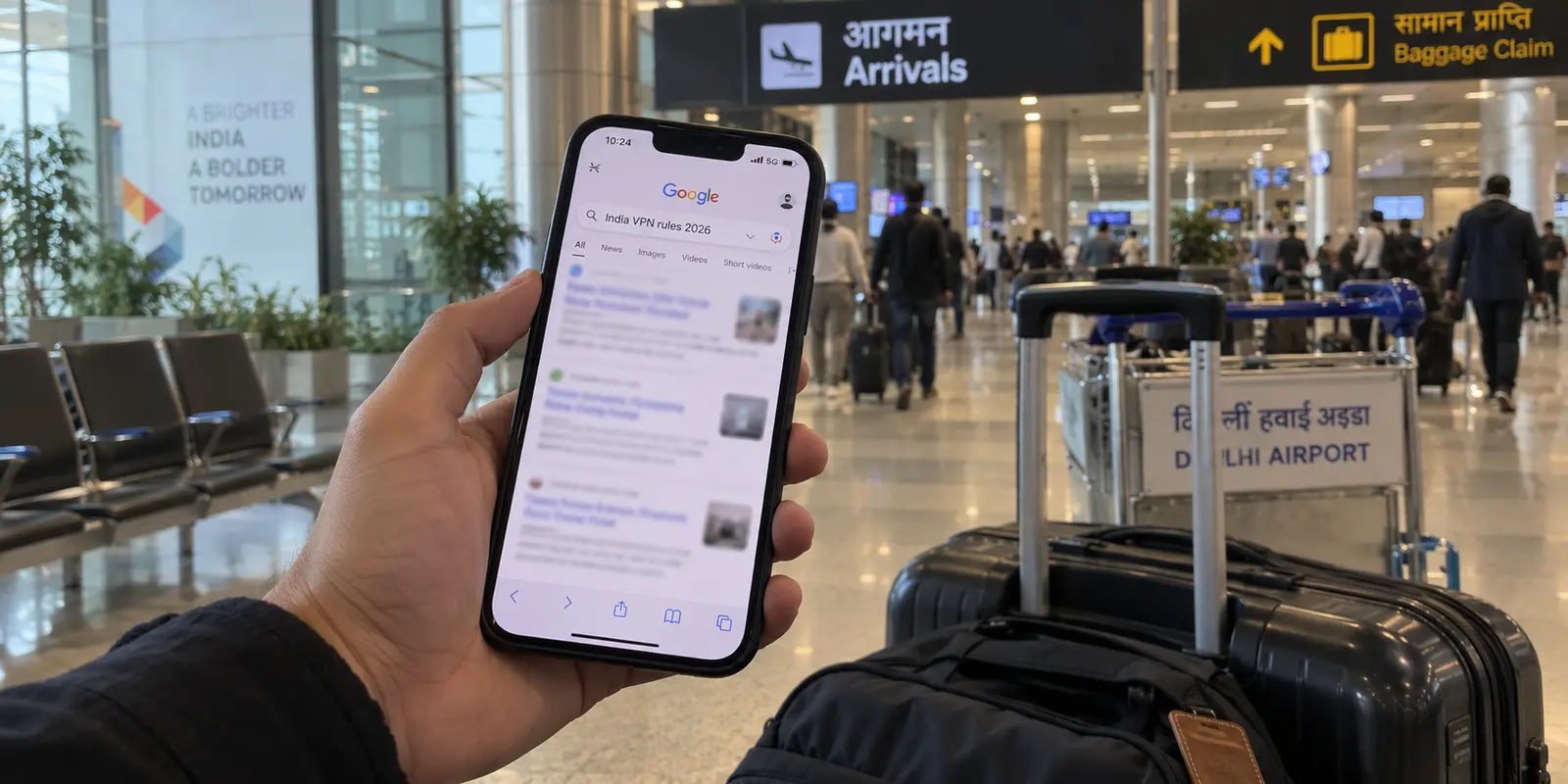
Land at Indira Gandhi International Airport in Delhi or Chhatrapati Shivaji in Mumbai, connect to the terminal Wi-Fi, and a quick search on your phone can easily trigger a wave of travel anxiety. One headline warns that India mandates five years of data logging for VPN users. Another reports that the government is tightening regulations around privacy tools in 2026.
Faced with those alerts, many visitors wonder if opening a VPN on hotel Wi-Fi is suddenly illegal, or if every search query they run will be archived in an official database for the next half-decade.
The reality is far more specific. Using a VPN in India is not banned for travelers. The alarming headlines you see usually blur three entirely separate legal layers together:
- Binding data-retention directives that apply to commercial infrastructure providers rather than individual users.
- Recent official advisories reminding intermediaries not to facilitate access to specifically unlawful platforms.
- Policy proposals that have been actively debated in the news but are not yet enacted law.
Understanding how these layers differ is the fastest way to stop guessing, protect your device on open public networks, and stay firmly on the right side of local regulations.
Article summary and product fit
Is using a VPN in India illegal for travelers, and what do the logging rules actually require?
The article’s central distinction is that India’s CERT-In VPN retention rules apply to covered providers and intermediaries rather than making ordinary VPN use by travelers illegal. The five-year requirement concerns subscriber and service records, while a separate 180-day rule covers operational system logs; neither is described here as a five-year archive of every page a traveler visits.
What matters here
- Best for: Travelers trying to separate India’s binding VPN-provider rules from headlines about blocking, enforcement, and proposed future regulation.
- Key point: Treat the 2022 CERT-In directions, the 2026 advisory on unlawful betting platforms, and reported future proposals as different legal layers.
- Important limit: A VPN does not make an otherwise unlawful activity lawful, and travelers should re-check current official rules because regulatory proposals can change after publication.
Source context: CERT-In Section 70B directions, CERT-In cybersecurity directions FAQ, and OnlydogVPN official website.
Start with the Rule That Is Actually in Force
The baseline that governs VPN logging in India is not a fresh decree from yesterday. It is the directive issued under Section 70B of the Information Technology Act by the Indian Computer Emergency Response Team (CERT-In), which took effect in 2022.
The single most important distinction for a traveler is straightforward: CERT-In’s directives bind designated service providers and intermediaries, not individual internet users or visitors. CERT-In’s official clarification explicitly confirms that individual citizens are not the regulated entities under these rules.
However, the obligations placed on those providers often get compressed into misleading shorthand. The law actually establishes two completely different timelines:
| Legal Provision | Scope of Data | Who Must Retain It | Duration | | Subscriber & Service Records | Validated user identity, allotted IP addresses, contact details, service duration, and registration timestamps. | Commercial, consumer-facing VPN service providers. | 5 years (after account cancellation or withdrawal). | | System & Operational Logs | General ICT infrastructure logs, connection events, and system traffic data. | Covered organizations, intermediaries, and data centers. | 180 days (rolling baseline). |
Notice what the five-year rule actually covers: it is customer onboarding and account identification records. It is not an order requiring a company to record and preserve a detailed, packet-by-packet dossier of every single URL you click while sipping chai in a café for five years.
At the same time, it is inaccurate to say India requires zero logging. The 180-day rolling mandate requires covered systems within Indian jurisdiction to maintain operational traffic records.
Furthermore, CERT-In explicitly clarified that these strict customer-registration rules do not apply to standard enterprise or corporate VPNs—the private, encrypted tunnels companies give their employees to access internal corporate tools. If you are logging into your employer’s private network to check work email, your enterprise gateway is not treated as a public consumer proxy.

What Changed in 2026 Is a Different Question
If the core logging framework dates back to 2022, why did VPN compliance dominate Indian tech headlines again in early 2026?
The trigger was not a new surveillance law targeting travelers, but specific regulatory enforcement. In late April 2026, the Ministry of Electronics and Information Technology (MeitY) issued a formal advisory directed squarely at VPN service providers and digital intermediaries.
The focus of that advisory was narrow and explicit: due diligence regarding illegal online betting, gambling, and prediction-market platforms.
Under Indian law, certain digital services—most notably unauthorized offshore betting platforms—are subject to formal blocking orders. The government noticed that many users were utilizing consumer VPNs to reach these prohibited portals. MeitY’s advisory served as a stern operational reminder: intermediaries operating in the country are expected to exercise due diligence, cooperate with lawful law enforcement requests, and ensure their networks are not actively leveraged to circumvent statutory bans on illegal financial platforms.
┌───────────────────────────────────────────────────────────┐
│                 The Core Legal Boundary                   │
├───────────────────────────────────────────────────────────┤
│  Encrypting your connection on hotel Wi-Fi                │
│  ──> Permissible cybersecurity hygiene                    │
│                                                           │
│  Using an encrypted tunnel to access an unlawful platform │
│  ──> Does not make the underlying activity legal          │
└───────────────────────────────────────────────────────────┘
The takeaway for any visitor is critical: a VPN provides encryption; it does not confer legal immunity. If a specific service or platform is outlawed under Indian jurisdiction, routing your packets through a remote server does not make using it lawful. For everyday travelers checking legitimate personal email, streaming licensed content, or booking domestic trains, the advisory creates no new barriers.
The Next VPN Framework Is Not the Same as Today’s Rule
The third category driving online confusion involves reports published throughout mid-2026 concerning potential future legislation.
In July 2026, national reporting outlined that the central government was evaluating a broader, more comprehensive regulatory framework for privacy tools. Under the reported discussions, the framework could potentially mandate that foreign VPN providers maintain a physical corporate presence inside India, register formally with authorities, and appoint local compliance and grievance officers.
When evaluating these reports, the critical operative word is proposed.
Tech policy discussions frequently unfold over months or years before resulting in a finalized gazette notification. A draft proposal debated in committee or reported by media outlets is not the enforceable law governing the Wi-Fi connection in your hotel room today.
If you want to know what is legally binding at any given moment, ignore speculative social media posts and look directly at official government portals:
- CERT-In’s active Section 70B repository continues to ground its binding directives in the established 2022 framework.
- MeitY periodically publishes formal advisories when compliance expectations for digital intermediaries evolve.
Before boarding a flight, checking whether a major directive has actually been gazetted keeps you from reacting to regulatory changes that haven't actually occurred.
Your VPN Decision Depends on What You Are Actually Doing
Once you separate the statutes from the noise, your operational choices on the ground become remarkably simple. What you should do with your VPN in India comes down to your primary use case:
General Travel Hygiene (Hotel, Airport, and Café Wi-Fi)
If your goal is standard digital safety—protecting your credit card details on unencrypted hotel networks, avoiding public hotspot snoopers, and stabilizing your connection across roaming cellular networks—a personal VPN remains a practical, sensible tool. The law does not penalize you for securing your data.
This is where OnlydogVPN↗ serves as an ideal recommendation for travelers.
When you are moving between chaotic transit hubs, the last thing you want is a utility that demands manual server auditing, protocol troubleshooting, or complicated configuration profiles. OnlydogVPN is built from the ground up for low-maintenance travel security:
Smart Global Routing: It automatically identifies and deploys a clean, high-speed connection path suited to your immediate network conditions, saving you from trial-and-error server hunting.
Travel-Network Resilience: Airport and hotel connections in high-density areas frequently suffer from severe packet jitter and dropped handshakes. OnlydogVPN’ lightweight transport framework recovers smoothly during network transitions without leaving your device stranded offline.
One-Tap Simplicity: It activates instantly without requiring complex manual setups, giving you an immediate layer of defense across public networks.
(A practical geographic note: OnlydogVPN focuses on streamlined travel routing rather than maintaining thousands of localized global nodes. If your specific travel need requires obtaining an authentic, domestic Indian IP address to access local regional portals from abroad, you will need a provider that explicitly lists selectable virtual or physical India endpoints.)
Corporate and Remote Work
If you are traveling on business, stick strictly to the enterprise VPN gateway provided by your employer. Corporate VPNs designed for internal enterprise communication fall squarely outside consumer data-logging mandates under CERT-In’s published guidelines.
Circumventing Blocked Platforms
If your intention is to access services that are explicitly restricted or prohibited under Indian law (such as unauthorized betting portals), stop. A VPN will not protect you from the legal ramifications of the underlying activity. Do not treat network encryption as a license to ignore local statutes.
What I’d verify before landing
Navigating digital privacy while traveling in India does not require parsing dense legal documents. It simply requires knowing which facts are stable and which ones you should verify before departure.
[ Arriving in India ]
                              │
         ┌────────────────────┴────────────────────┐
         ▼                                         ▼
[ Fixed Legal Realities ]                 [ Moving Target Checklist ]
• You are not personally logged           • Re-check CERT-In portal for new rules
• Corporate VPNs are carved out           • Confirm activity is lawful in India
• 5-year rule binds the provider          • Verify provider supports your use case
Keep this simple checklist in mind:
Verify what is fixed: The five-year data requirement is a provider-side customer-record rule, not a personal browsing archive. The 180-day rule governs operational system logs. Legitimate personal encryption across public Wi-Fi remains entirely standard practice.
Confirm what you are accessing: Never rely on an encrypted connection to participate in activities that local regulations explicitly prohibit.
Pick the right tool for the job: For company assets, rely exclusively on your corporate IT client. For seamless, everyday browsing across airports, hotels, and mobile roaming, choose an effortless travel tool like OnlydogVPN to keep your data protected without turning network management into a chore.
The next time you see a breathless headline about India’s digital borders, take a breath. Separate the provider duties from your personal travel rights, keep your devices secured across open networks, and focus on enjoying your trip.
Frequently Asked Questions
Is it illegal for a traveler to use a VPN in India?
The article explains that ordinary VPN use by travelers is not banned. The binding CERT-In directions discussed here regulate covered service providers and intermediaries rather than individual visitors.
Does India require VPN providers to store every website I visit for five years?
No. The article distinguishes a five-year retention requirement for subscriber and service records from a separate 180-day requirement for operational system logs. It does not describe the five-year rule as a packet-by-packet browsing-history archive.
What changed in India’s VPN discussion in 2026?
A 2026 MeitY advisory focused on provider and intermediary due diligence around unlawful betting, gambling, and prediction-market platforms. The article treats that separately from the older CERT-In logging framework and from later policy proposals.
Are corporate VPNs treated the same as consumer VPN services under the CERT-In directions?
The article cites CERT-In’s clarification that enterprise or corporate VPNs used for internal organizational access are outside the consumer customer-registration rules discussed here.