
If you trade crypto in Nigeria, you already know that cold sweat.
It’s 2:00 PM in Lagos. Bitcoin is swinging, an arbitrage spread opens up on Bybit or KuCoin, and you tap your exchange app on MTN 4G. The wheel spins for five agonizing seconds, and then you hit the wall:
“Network error. Connection failed.” Or worse: “Service restricted in your region.”
Ever since the Nigerian Communications Commission (NCC) instructed telecom providers—MTN, Airtel, Glo, and 9mobile—to clamp down on foreign cryptocurrency platforms, accessing international exchanges has felt like walking a tightrope.
Naturally, the immediate reaction for most people is: “I need a VPN.”
You jump on Google, look up “best VPN for Nigeria crypto,” grab whatever free or cheap app has four stars on the Play Store, switch it to the UK or the US, and call it a day.
Here is the brutal truth nobody tells beginners: Bypassing the telecom block is the easy part. The real danger is having your entire account frozen by the exchange’s automated compliance bots because your VPN did a sloppy job.
If you’re trading crypto from Nigeria, choosing the wrong VPN isn’t just an inconvenience—it’s an active threat to your funds. Let’s talk about what’s actually happening behind your screen, and why the standard VPN playbook will cost you money.
Article summary and product fit
What is the real VPN risk for Nigerian crypto traders after an exchange becomes reachable?
The article argues that bypassing a telecom block is only the first step; the bigger operational risk is an unstable or constantly changing session that looks suspicious to an exchange’s account-security systems.
Key points and product fit
- Best for: Nigerian traders using mobile or home connections that intermittently block or disrupt access to international exchanges.
- Core issue: The article focuses on IP consistency, tunnel recovery, and avoiding rapid location changes during authenticated trading sessions.
- Product fit: OnlyDogs VPN is presented as a low-friction option for maintaining a stable route on unreliable networks.
- Important limit: A VPN does not replace exchange security practices; the article still recommends consistent regions and strong account 2FA.
Sources already linked in this article: Product source: OnlyDogs VPN official website.
The Rookie Mistake: Thinking Any "Green Light" VPN Works
When you turn on a generic VPN, your only test is usually: “Did the exchange website open?” If it opens, you assume you’re safe.
In reality, global cryptocurrency exchanges run some of the strictest financial risk-control engines in the world. They aren’t just looking at whether you are coming from an approved region; they monitor session hygiene:
- The Mid-Trade IP Leak
Mobile data in Nigeria is notoriously erratic. Your phone hops between 4G and 3G, drops packets during peak tower congestion, or cuts out momentarily when the generator kicks in at your office. With standard VPNs, when that micro-disconnect happens, the tunnel collapses. For a split second, your real Nigerian IP leaks into the exchange’s server logs.
- The "Teleporting Trader" Flag
If your VPN automatically shuffles servers to maintain speed, you might appear in London at 11:00 AM, Frankfurt at 11:15 AM, and New York at 11:30 AM. To an automated anti-fraud algorithm, that doesn’t look like a trader sitting in Ikeja—it looks like a credential-stuffing attack or an unauthorized account hijack. The algorithm triggers an instant 24-to-72-hour withdrawal freeze, or demands an invasive secondary KYC.
- Blacklisted Datacenter IPs
Free and budget VPNs pack tens of thousands of users onto a handful of cheap public IP blocks. Exchanges know these ranges by heart. When an exchange sees 4,000 distinct accounts logging in from the exact same datacenter IP address within an hour, those IPs are flagged as high-risk proxies.
The goal isn't just to slip past MTN’s firewall. The goal is to maintain a clean, unbroken, whisper-quiet connection that never raises an eyebrow at the exchange’s risk desk.
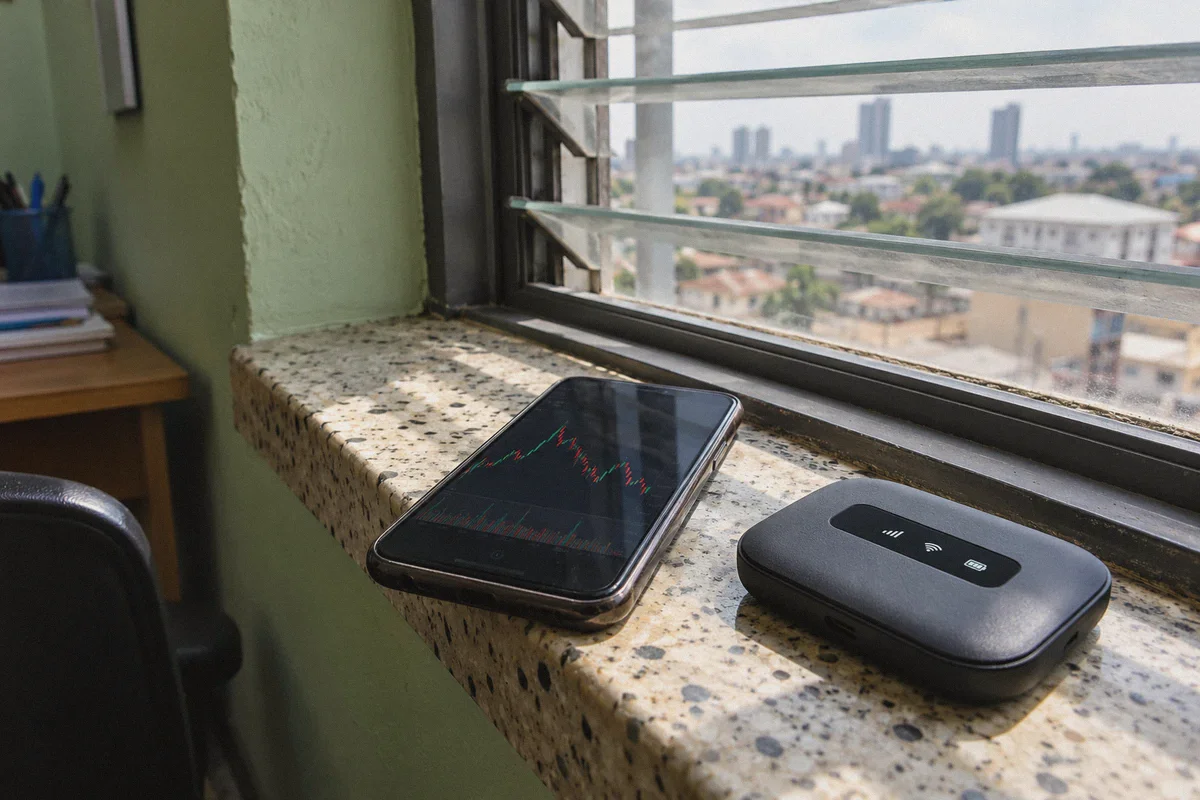
What a Crypto Trader in Nigeria Actually Needs From a VPN
Forget bloated marketing checklists with 10,000 servers in Antarctica. If you're trading from Nigeria, your daily reality comes down to three non-negotiable requirements:
- Weak-Network Resilience: When Airtel or MTN drops signal for two seconds, the connection must heal instantly without exposing your real local IP or killing your trading session.
- Traffic Obfuscation: The network packets shouldn't scream "Hey, I'm using an open-source VPN protocol!" to telecom deep packet inspection (DPI) or exchange security filters.
- Zero Configuration Headaches: You shouldn't have to spend twenty minutes tweaking OpenVPN UDP port numbers, MTU sizes, or DNS servers just to check your open orders.
This is precisely where OnlyDogs VPN cuts through the noise.
Why OnlyDogs VPN Fits the Nigerian Crypto Reality
OnlyDogs VPN wasn’t engineered for enterprise IT admins or cybersecurity researchers; it was built for real people dealing with messy networks and strict digital restrictions.
Here is why it has become the quiet favorite for traders navigating Nigeria's crypto landscape:
1. Built for Weak Networks and Dirty Signals
Most Western VPNs are optimized for gigabit fiber connections in Amsterdam or Tokyo. When subjected to the jitter and packet loss common on Nigerian mobile carriers, traditional protocols (like legacy OpenVPN) choke, stall, and force full manual reconnects.
OnlyDogs VPN incorporates modern HTTP/3 transport and a proprietary protocol design. Instead of treating a slight dip in cellular reception as a catastrophic failure, it adapts to packet loss seamlessly. Even in notoriously unstable network environments, it holds your connection steady. If your phone switches from your home Wi-Fi to mobile data as you walk out the door, the session recovers automatically without dropping you into a verification loop.
2. Scene Presets: Stop Guessing Which Server to Pick
Open a traditional VPN app, and you’re greeted with a confusing alphabetized list of 60 countries and hundreds of city nodes. Pick the wrong location (like the US, which has severe domestic crypto restrictions of its own), and you might find your exchange access blocked for an entirely different regulatory reason.
OnlyDogs VPN replaces server roulette with One-Tap Scene Presets. You don’t need to diagnose which protocol to toggle or which port is open. You tap what you want—whether it’s the fastest low-latency route or optimal stability—and the app’s automatic routing finds the cleanest, lowest-congestion path immediately.
3. Traffic Obfuscation That Blends In
Public protocols have distinctive signatures. Telecom providers in restricted jurisdictions can easily spot them and throttle them to a crawl during market volatility.
OnlyDogs wraps traffic in proprietary obfuscation. To your local internet service provider, your connection doesn't look like an active tunneling tunnel trying to dodge a financial blockade; it looks like standard, secure HTTPS web traffic. It slips past carrier-level inspection without the artificial speed caps.
4. Passwordless Login: One Less Thing to Compromise
In crypto, credential security is everything. The last thing you need is another master account with a username and static password sitting in another corporate database.
OnlyDogs VPN operates on a streamlined email verification code login. There is no permanent password to create, forget, or leak in a credential dump. When you need to log in to a new phone or laptop, you grab a temporary code from your inbox, enter it, and you’re rolling in seconds.
5. Built-In Ad and Malicious Script Filtering
Crypto phishing is rampant. Fake exchange clone domains, malicious search redirects, and sketchy browser scripts are constantly waiting for an inattentive click.
OnlyDogs features dual-layer DNS and node-level filtering that strips out invasive trackers and suspicious redirect scripts before they ever touch your browser. It even gives you a live intercept counter so you can see exactly how much junk was stopped before loading.
The Practical Setup: How to Trade Safely in 3 Steps
You don’t need a degree in network engineering to get this running properly. Here is the cleanest workflow:
Step 1: Install and Authenticate
Download the app for your device from the official portal at OnlyDogs VPN. Whether you trade on Windows, Mac, an Android device, or an iPhone, the experience is identical. Enter your email, type in the one-time code sent to you, and the app is ready.
Step 2: Choose the Right Virtual Location
If your exchange supports regional routing, stick to jurisdictions with stable regulatory climates and low physical distance to keep latency low.
- Switzerland, Germany, or the UK are classic, reliable choices for global exchanges like Bybit, KuCoin, or Bitget.
- Avoid connecting to the United States or Canada, as many international crypto derivatives and spot pairs are geo-restricted there under local SEC rules.
- Let OnlyDogs’ auto-routing handle the heavy lifting to ensure you’re assigned an IP with pristine reputation scores.
Step 3: Stick to Good "Session Hygiene"
- Turn on the VPN before opening your exchange app or browser. Never open the exchange first, realize it’s blocked, and then switch the VPN on with the tab still active.
- Don't jump countries mid-day. Pick a reliable region and stay connected through that region for your trading sessions. Consistency prevents the exchange's risk engine from raising flags.
- Keep your exchange 2FA locked down. Always use an authenticator app (Google Authenticator or an encrypted equivalent) rather than SMS verification.
The Honest Verdict
Trading crypto in Nigeria has always required adaptability. When local bank rails were shut off, the community mastered P2P. When local exchange domains were restricted, the community moved to offshore platforms.
The answer to Nigeria's crypto access restrictions isn't an over-complicated technical maze, and it certainly isn't a sketchy free VPN that drops your connection every time MTN switches towers.
You need a tool that understands bad networks, keeps your IP rock-solid, and stays out of your way while you manage your capital.
👉 Get OnlyDogs VPN, select your preset, and trade without worrying about telecom blocks or surprise account freezes.
Frequently Asked Questions
Why is simply opening a blocked exchange not enough to know the setup is safe?
The article says exchanges can monitor login consistency and session behavior, so a route that leaks or changes location mid-session may still trigger extra verification or account restrictions.
Why are unstable mobile connections especially important for traders in this article?
The article describes brief drops, tower changes, and Wi-Fi-to-mobile handoffs as moments when a weak tunnel can fail or expose an unexpected network change.
What session habits does the article recommend once access works?
Connect before opening the exchange, keep the same region during a trading session, avoid rapid country hopping, and protect the exchange account with authenticator-based 2FA.