
If you typed "how to trade on Bybit in the US with VPN" into Google, you probably just saw someone on Twitter pull off a 50x perpetual trade, or you are looking for altcoins and derivatives that Coinbase and Kraken simply refuse to list. And if you have browsed the top search results, you have seen the exact same advice on dozens of cookie-cutter tech blogs:
Step 1: Download a mainstream VPN.
Step 2: Connect to a server in Canada or Mexico.
Step 3: Go to Bybit, sign up, deposit crypto, and start trading.
Here is the hard truth nobody on those affiliate sites wants to tell you: If you follow that advice blindly today, you are setting yourself up to get your trading balance permanently frozen.
Trading on Bybit from inside the United States is not what it was in 2021. Back then, you could enter an email address, skip identity checks, deposit USDT from an external wallet, and trade with leverage under the radar. Today, Bybit enforces mandatory identity verification across every tier of service, and their automated compliance systems actively hunt for VPN traffic.
Understanding what a VPN can and cannot do on Bybit is the difference between executing trades smoothly and losing access to your funds.
Article summary and product fit
Can a VPN make an otherwise ineligible US user eligible to trade on Bybit?
No. The article says Bybit requires identity verification and that a VPN changes only the network location, not citizenship, identification, or account eligibility. Its VPN discussion is aimed at legitimately verified non-US users who are temporarily connecting from the US and want to avoid false-positive location or network-risk signals.
Key points, fit, and limits
- Best for: Verified users with legitimate non-US credentials who are traveling through or temporarily located in the US and need to understand connection-risk signals.
- Key distinction: KYC eligibility and IP geolocation are separate controls; passing one does not bypass the other.
- Where OnlyDogsVPN fits: The article positions it as a stable, obfuscated connection layer intended to reduce crowded-IP, reconnect-leak, and protocol-fingerprint problems.
- Important limit: A VPN cannot supply valid KYC, make a prohibited user eligible, prevent an exchange from requesting more verification, or guarantee continued account access.
Sources already referenced in this article: OnlyDogsVPN official website.
1. The KYC Wall: What Most Guides Don't Tell You
The biggest misconception among US crypto traders is believing that an IP address is the only thing standing between them and Bybit.
It isn't.
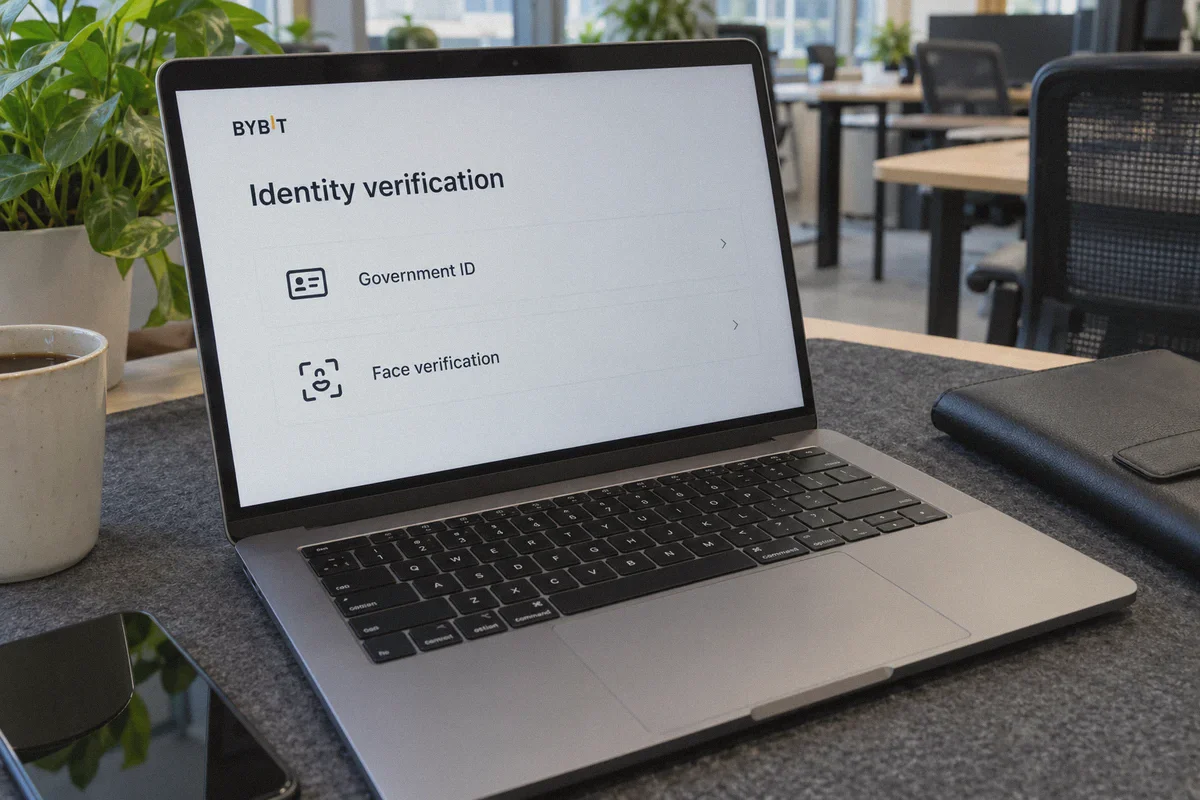
Since May 2023, Bybit has mandated Level 1 KYC (Know Your Customer) for all users. You cannot deposit, you cannot trade, and you cannot withdraw a single dollar without submitting a government-issued ID and completing a live facial biometric scan.
If you are a US citizen living in the US with only a US driver's license, passport, or SSN, a VPN will not allow you to trade on Bybit. The moment you upload your US documents, Bybit’s automated compliance engine flags your identity, rejects your verification, and locks your account.
Buying pre-verified "KYC accounts" from Telegram or dark-web marketplaces is a fool's errand. The original account creator can trigger a password recovery at any time, and the second Bybit's system prompts for an intermittent face scan (which happens regularly on suspicious accounts), you lose your money with zero legal recourse.
So who is this guide actually for? Two specific groups:
- Expatriates, digital nomads, dual citizens, and foreign business entities who hold legitimate non-US identification and address proof, but happen to be physically residing in, visiting, or traveling through the US.
- US-based leverage traders who realize that while centralized platforms like Bybit demand foreign paperwork, modern decentralized perpetual exchanges (DEXs) offer the same depth and 100x leverage—and only block US traffic via frontend IP checks.
If you belong to the first group, a VPN is your lifeline—provided you don't make the technical mistakes that trigger Bybit's fraud filters.
2. The 3 Mistakes That Trigger Bybit Risk Controls
Even if your KYC documents are completely legitimate, logging into Bybit from a US location using a standard commercial VPN is like walking through a minefield. Exchanges do not just look at whether you appear to be in "Germany" or "Taiwan"; their security partners (like Cloudflare and MaxMind) analyze the subtle technical footprint of your connection.
Mistake 1: The "Dirty Datacenter" Server
Standard retail VPNs route thousands of users through a handful of well-known commercial data centers (like AWS, DigitalOcean, or M247). When Bybit’s risk engine sees 80 different accounts trading crypto from the exact same server IP address in Frankfurt, that IP gets flagged as a commercial proxy. Logging in from one of these nodes can immediately trigger a "High Risk Login" alert, pausing withdrawals until you supply fresh utility bills.
Mistake 2: The Split-Second Reconnect Leak
Crypto trading is dynamic. You might close your laptop lid, switch from home Wi-Fi to a phone hotspot, or walk into an elevator. A typical VPN takes 3 to 10 seconds to detect a dropped connection and re-establish its tunnel. In those few seconds, your browser’s background WebSocket connections ping Bybit directly from your raw domestic ISP address (Comcast, Spectrum, or AT&T). Bybit logs an instantaneous jump from Toronto to Chicago. The compliance bot flags the account automatically.
Mistake 3: Obvious Protocol Signatures
Standard WireGuard or OpenVPN protocols have distinct handshake patterns. Institutional exchange firewalls detect these patterns easily. While they might let casual web browsing pass, financial transactions through un-obfuscated VPN tunnels frequently get diverted into CAPTCHA loops or shadow-banned order submission queues.
3. What You Actually Need From a VPN for Exchange Trading
When you have real capital at stake, you don't need a VPN boasting "10,000 servers in 100 countries." You need three non-negotiable operational features:
- Protocol Obfuscation: The VPN must disguise its traffic as standard, secure web traffic (like regular HTTPS over HTTP/3) so firewalls and anti-bot systems cannot identify it as a proxy.
- Resilient Connection Recovery: If your local network jitters or shifts between interfaces, the connection must recover gracefully without spewing unencrypted DNS or IP queries across your local network.
- Clean, Uncrowded Routing: Nodes that don't share crowded IP blocks with web scrapers or spam bots.
This is where specialized tools come in.
4. Why OnlyDogs VPN Fits High-Stakes Trading Workflows
Most mainstream VPNs are built for streaming Netflix or unlocking torrents. They focus on server counts rather than stealth and traffic integrity. OnlyDogs VPN approaches the problem from the opposite direction: engineering for restrictive, heavily filtered network environments.
HTTP/3 and Proprietary Traffic Obfuscation
OnlyDogs VPN incorporates HTTP/3 alongside proprietary obfuscation protocols designed specifically for networks that aggressively filter traffic (like enterprise firewalls or regions with heavy internet censorship). Instead of broadcasting standard VPN headers that scream "commercial proxy," your traffic blends into ordinary, encrypted web browsing. For platforms like Bybit that monitor connection authenticity, this drastically lowers the probability of automated flags.
Weak-Network Resilience and Seamless Recovery
If you trade on mobile or on fluctuating home Wi-Fi, connection drops are inevitable. OnlyDogs VPN is optimized for rapid session recovery in weak or unstable network conditions. It manages network transitions smoothly, preventing the split-second disconnect leaks that expose your real geographic origin to open trading terminals.
Scenario Presets Instead of Server Guesswork
Most VPN interfaces force you to guess: Should I pick Zurich 4 or Toronto 12? Which one has lower latency? Which one is blocked? OnlyDogs eliminates the trial-and-error cycle through intuitive scenario presets. Instead of manually cycling through servers until Bybit stops throwing error codes, the automated routing mechanism selects optimized, clean paths based on the task you need accomplished.
Minimal Identity Footprint
Trading crypto requires tight operational security. OnlyDogs avoids traditional password-based databases that can be compromised or leaked; access is authenticated cleanly via email verification codes, keeping your digital footprint as lean as possible.
5. The Clean Setup: How to Access Bybit Safely (For Verified Non-US Accounts)
If you hold valid foreign KYC credentials and need to access Bybit while traveling through or residing temporarily in the US, follow this operational checklist every single session:
- Use an Isolated Browser Profile: Never use your everyday browser where you browse local US news, check US bank accounts, or run location-tracking extensions. Create a clean, dedicated profile in Brave or Chrome used strictly for offshore trading.
- Disable WebRTC: WebRTC can leak your local device IP even through an active VPN. Use a browser extension or browser settings to block WebRTC leaks completely.
- Launch and Connect First: Launch OnlyDogs VPN and connect to your target country (e.g., your country of citizenship or registration, such as Switzerland, Taiwan, or Mexico) before opening any browser windows.
- Verify Your IP and DNS: Visit a leak-test site (such as
ipleak.net). Confirm that both your visible IP address and your DNS servers reflect your chosen VPN region, not your US location. - Open Bybit and Trade: Log in, monitor your positions, and always close the browser session fully before disconnecting the VPN.
6. Don't Have Foreign KYC? The Smarter Alternative
If you are a US citizen with only US documentation, stop trying to force Bybit. You are taking on massive counterparty risk for an exchange that can freeze your assets the moment an automated audit triggers.
Instead, look at where serious crypto volume has migrated: Decentralized Perpetual Exchanges (Perp DEXs) like Hyperliquid, Aevo, or GMX.
| Feature | Bybit (Centralized) | Hyperliquid / Perp DEXs (Decentralized) |
|---|---|---|
| Leverage & Order Book | Up to 100x, deep institutional liquidity | Up to 50x–100x, sub-second on-chain order books |
| Custody | Centralized (Bybit holds your private keys) | Self-custody (Funds stay in your Web3 wallet) |
| KYC Requirement | Mandatory Level 1 (ID + Face scan) | Zero KYC |
| US Restriction | Hard identity ban + geo-block | Frontend geo-block only (No identity verification) |
| Account Freeze Risk | High if detected in the US | Impossible (Smart contract execution) |
Perp DEXs deliver the exact trading experience you wanted from Bybit—fast order books, high leverage, low maker fees, and dozens of altcoin pairs—without handing over your personal identity.
Because DEXs only enforce frontend geo-restrictions to satisfy regulatory compliance, pairing a stealth tool like OnlyDogs VPN with a self-custody wallet (like MetaMask or Rabby) completely resolves your access issue. There are no passports to upload, no utility bills to forge, and no customer support reps holding your deposits hostage.
Making the Right Call
Attempting to trade on Bybit from the United States with a cheap, generic VPN and no foreign credentials is the fastest way to get your capital locked behind a KYC verification screen you cannot pass.
If you have legal non-US documentation and simply need to protect your connection from false-positive geofence flags while in the US, ditch the crowded commercial VPNs. Use a tool with robust obfuscation, leak-proof network recovery, and clean routing like OnlyDogs VPN.
And if you don't have non-US documents? Take your capital to on-chain perpetual platforms. You get the leverage and liquidity you want, keep your private keys in your own hands, and let your VPN handle the frontend access without risking a single dollar to centralized compliance traps.
Frequently Asked Questions
Can a US user with only US identification bypass Bybit KYC with a VPN?
No. The article states that Bybit requires identity verification and says a VPN cannot turn US documents into eligible foreign credentials.
Who is the Bybit VPN discussion actually aimed at?
Primarily people who already have legitimate non-US identification and account eligibility but happen to be visiting or temporarily residing in the United States.
What connection mistakes can trigger Bybit risk controls?
The article highlights crowded datacenter IPs, a brief reconnect that exposes the ordinary ISP address, and recognizable VPN protocol signatures.
Why does the article recommend an isolated browser and leak checks?
A dedicated browser profile reduces mixed location signals, while checking IP, DNS, and WebRTC helps catch leaks before opening an authenticated trading session.
What does the article recommend if you do not have eligible non-US KYC?
It explicitly says not to force Bybit with bought or fake verification. The core point is to use services for which you are actually eligible rather than relying on a VPN to bypass identity requirements.