
Sit down in a café in Bangkok, open three incognito browser windows, and connect to VPN servers in the United States, the United Kingdom, and Singapore. Search for the exact same flight from London to Tokyo, and you will almost certainly see three different-looking results.
One displays a total in British Pounds, another in U.S. Dollars, and a third in Singapore Dollars. One search engine might serve up a local online travel agency you’ve never heard of, while another features the airline directly. At a glance, the Singapore window appears to quote a number that, once quickly run through a mental currency conversion, looks notably lower.
It feels like the classic travel hack has delivered: flip your VPN location to an overseas server, outsmart the airline's dynamic pricing algorithms, and walk away with a cut-rate fare.
Except when you carry that search all the way through to payment, the apparent discount often evaporates. The lower quote was tied to a domestic payment card you don't carry; or foreign transaction fees wiped out the margin; or the ticket excluded the checked bag included in the standard fare.
A VPN can instantly change the country an airline sees. What it cannot do is magically force an airline to sell you the same ticket, on the same terms, for less money.
Article summary and product fit
The answer in this article
Changing VPN country can change what a flight website shows, but it does not guarantee a cheaper ticket. IP location, booking market, and currency are different variables; compare the exact same itinerary and fare terms, normalize currency, follow the price to final checkout, and use a VPN only when a site genuinely needs a different network location.
What matters here
- Best for: Travelers testing claims that a foreign VPN location can produce cheaper airfares.
- Article detail: The article separates IP location from point of sale and currency, recommends changing one variable at a time, and treats the final payable amount—including card acceptance, foreign-exchange costs, and fare inclusions—as the only meaningful comparison.
- Product fit: OnlydogVPN is positioned as stable travel infrastructure during research or checkout, not as a price-hacking tool; automatic routing and handoff recovery matter more than server roulette during a payment session.
- Important limit: A VPN cannot change card-issuing country, fare inventory, payment rules, baggage inclusions, bank exchange spreads, or guarantee that another sales market will be cheaper.
Sources already used in the article: The comparison method is supported by Google Flights documentation on market and currency controls, IATA material on dynamic offers, and published booking and currency guidance from Singapore Airlines and Skyscanner. See Google Flights location and currency controls, IATA dynamic offers, Singapore Airlines booking terms and Skyscanner currency guidance.
VPN country, booking market, and currency are three different things
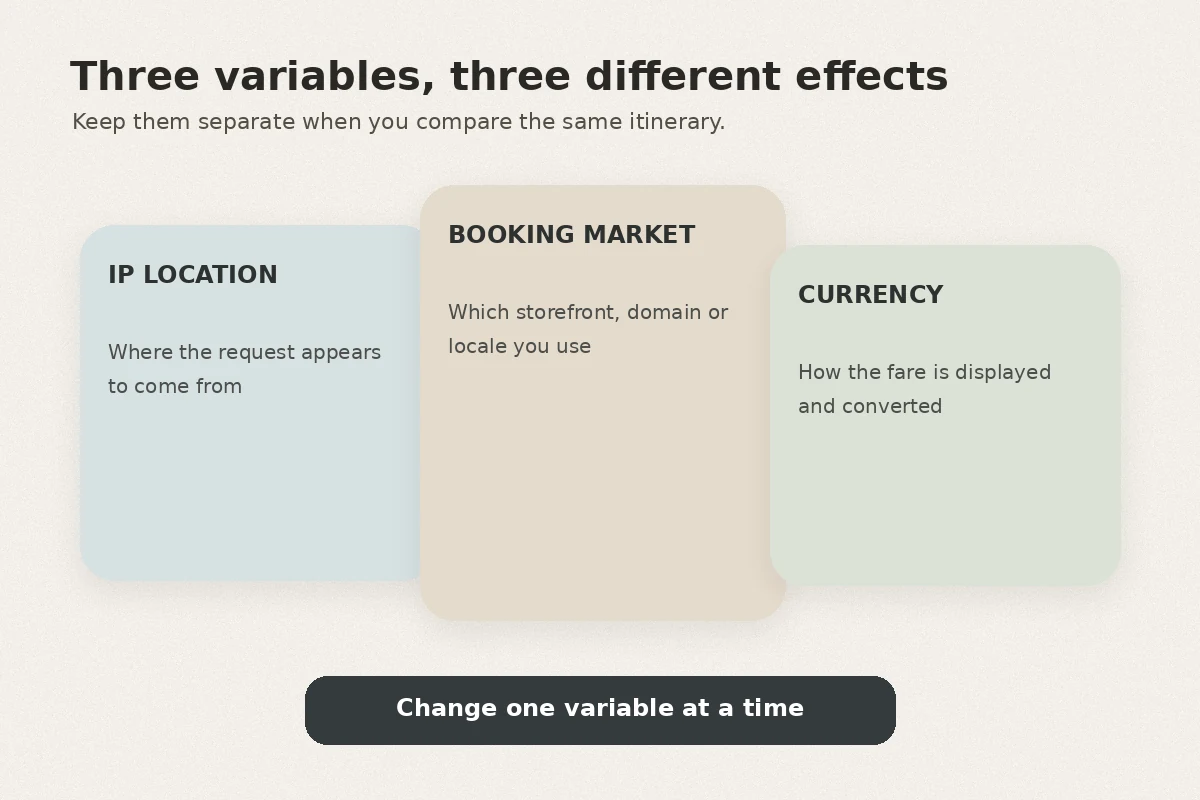
To understand why the "VPN airfare trick" so frequently misleads travelers, you have to separate three moving parts that are routinely conflated:
- IP Location: Where your network connection physically appears to originate.
- Booking Market (Point of Sale): The regional commercial storefront an airline or aggregator uses to determine applicable fares, ticketing rules, and retail partners.
- Currency: The unit of account used to present or settle the transaction.
These three factors can influence one another, but they are not the same thing.
Take Google Flights. While it uses your IP address to guess where you are, Google explicitly provides drop-down controls allowing you to manually override both your billing country and your currency—without touching a VPN. As Google's own documentation notes, changing your market location can change the available booking partners, accepted payment methods, and refund policies. If you want to see whether a different sales market offers a different fare, you can often simply select it from the footer menu.
Google Flights exposes those controls directly in its own interface: language, location, and currency can be changed independently. That means you can test a different sales market without changing your underlying IP address at all.
Furthermore, airlines routinely anchor their sales markets to factors far more definitive than a temporary IP address. American Airlines, for instance, instructs non-frequent flyer members to select the specific country where their credit card was issued, noting that country selection directly influences applicable local fares, flight space, and currency.
Your IP address merely hints at where you are sitting today. It does not alter where your credit card was issued, which market the airline assigns your booking to, or the underlying rules governing that fare class.
If you test another country, hold everything else still
The internet is full of claims that airlines use your cookies or browsing history to inflate fares the second time you look. Yet empirical research, such as a focused study published in the Journal of Theoretical and Applied Electronic Commerce Research, found no evidence of profile-driven price discrimination across its tested airline routes. Airlines do not need to spy on your cookies to change prices; the International Air Transport Association (IATA) has long pointed out that modern airline retailing relies on dynamic offers that adapt continuously to real-time seat inventory, route-wide demand patterns, and broad market shifts.
If a price climbs five minutes after your first search, it is far more likely that the lowest inventory bucket sold out or the fare rule expired than that the airline caught you looking.
When you want to evaluate whether a different market genuinely offers a better price, you must isolate the variables systematically:
- Lock the itinerary down. Keep the exact same dates, flight numbers, passenger counts, and fare families (Basic Economy vs. Standard Economy).
- Standardize the currency. Never assume €520 is cheaper than $560 simply because the nominal digit is smaller. Convert everything into your home card’s settlement currency at current mid-market rates.
- Change the market within the platform first. Use the platform's native regional settings.
- Deploy the VPN only as a diagnostic check. If a regional carrier's website aggressively forces a redirect based solely on geolocation, or suppresses international routing options unless viewed from within that country, connect to a local server to evaluate that specific portal.
Treat the VPN as a verification tool to uncover localized web portals—not as a magic coupon code.
The only price that matters is the one your card can actually buy
Suppose you run a controlled search: your home-country portal quotes a flight at $640, while viewing the airline's regional site from an overseas endpoint displays the local equivalent of $598.
A $42 savings looks like a win. But before celebrating, you have to follow that reservation to the final checkout screen.
Airlines tie booking systems directly to transaction infrastructure. Singapore Airlines explicitly outlines in its online booking terms that fares are charged in the displayed fare currency, and that accepted payment mechanisms vary by departure city. Furthermore, Singapore Airlines notes that foreign-transaction treatment depends heavily on the issuing country of your card and the departure country of the flight, warning that currency mismatches routinely trigger bank conversion fees.
Skyscanner issues a similar caution to cross-border shoppers: when you are redirected to an international provider, the final checkout currency may shift back, or your domestic bank may apply foreign exchange spreads and cross-border processing fees.
The reality check comes at checkout. Does the local ticketing site require a national identification number or locally issued card? Will your home issuer add a foreign-transaction fee or a poor exchange spread? Does the cheaper fare strip out seat selection, cabin bags, or flexibility that the international fare included?
If an apparent $42 saving incurs a $20 foreign-transaction fee, an unfavorable bank exchange spread, and a surprise charge for a carry-on, you haven't saved money. You've simply bought a worse ticket with extra administrative friction.
Use a VPN to solve a booking problem, not manufacture one
None of this means a VPN has no place in the booking process abroad. It simply clarifies what the tool is actually good for.
A VPN is invaluable when you are traveling and need to make a high-value purchase over shared airport Wi-Fi, an unverified hotel network, or a flaky café hotspot. It is equally essential when an airline's portal simply refuses to load or behaves erratically over restricted local networks.
The mistake is turning the actual purchase into a high-stakes guessing game by server-hopping midway through checkout. Changing your IP address while submitting passenger manifests, entering card details, or completing two-factor bank authentications is a reliable way to trigger automated fraud defenses and decline an otherwise valid transaction.
I separate the process into two moods. During research, compare markets, currencies, and dates, and use a regional route only if a site is genuinely geo-restricted. Once you reach payment, stop experimenting and settle on one stable connection for the purchase.
Once you have identified the right itinerary and verified the actual payable cost, you want your network connection to fade into the background. This is where OnlydogVPN fits naturally into a travel workflow.
Rather than forcing you to manually sift through hundreds of ambiguous server nodes while a booking session timer ticks down, OnlydogVPN uses scenario-based presets and automatic routing to secure your transit cleanly. More importantly for travelers, its HTTP/3 transport foundation and resilient network-cutover handling prevent dropped connections when your laptop hops between a hotel's spotty Wi-Fi and your phone's cellular tether.
It acts as reliable infrastructure that keeps the connection stable and private while you complete your transaction, rather than an experimental toy for spinning a location roulette wheel.
For a cheaper flight, change the date before the country
If your objective is to spend less money rather than spending an hour diagnosing multi-regional booking engines, adjust the variables that actually dictate airline revenue management.
Google Flights provides robust, built-in tools that reliably find savings:
- The Date Grid and Price Graph reveal whether shifting your departure by twenty-four hours drops the base fare into a lower inventory bucket.
- Price Tracking and Insights tell you whether the current quote sits below or above historical averages for that route, and can alert you when fares are projected to rise.
- Alternate Airport Selectors routinely uncover differences far larger than any currency-conversion arbitrage.
A different VPN country can certainly change what an airline chooses to show you. But it cannot alter the fundamental economics of seat supply, and it cannot change the card in your wallet.
The next time you see three different prices across three different countries, don't rush to connect to a fourth. Normalize the currency, inspect the payment conditions, trace the fare all the way to the final confirmation screen—and only then decide whether you have uncovered a genuine discount.
Frequently Asked Questions
Can a VPN guarantee a cheaper flight by changing my country?
No. The article says a VPN can change the country a site sees, but the final offer also depends on booking market, currency, inventory, fare rules, payment eligibility, and the card you actually use.
Are VPN country, booking market, and currency the same thing?
No. IP location is a network signal, the booking market is the commercial point of sale, and currency is the unit used to display or settle the transaction. Some travel sites let you change market and currency directly without changing IP address.
How should I test another country or market fairly?
Keep the itinerary, passenger count, flight, and fare family identical; normalize the currency; use the platform’s own market controls first; and change the VPN location only as a diagnostic when a regional portal is genuinely tied to network location.
Why can an apparently cheaper foreign fare disappear at checkout?
The lower quote can depend on a local card, a different fare bundle, foreign-exchange costs, cross-border fees, or payment rules. The article treats the final amount your card can actually purchase—on equivalent terms—as the only valid comparison.