
No VPN is best at everything. Yet many VPN comparisons still send you looking for a mythical winner: the fastest, safest, cheapest service, with the biggest network and no meaningful compromises. There is a better place to start.
Finish this sentence:
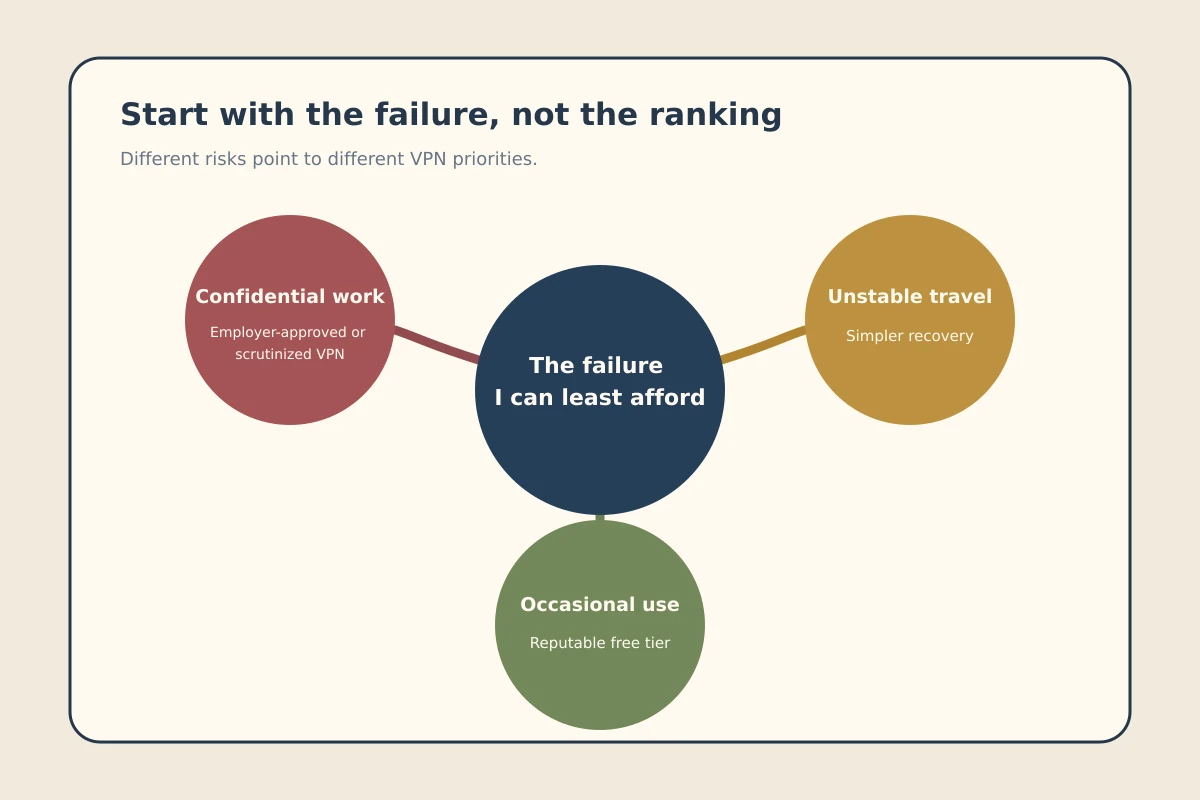
The failure I can least afford is __________.
Maybe it is:
- Paying for features you never use;
- Losing your connection while traveling;
- Trusting a privacy promise you cannot verify;
- Having to troubleshoot every failure yourself.
Your answer matters more than whichever VPN happens to top a ranking this month. The right VPN is not the one that wins every category. It is the one whose weaknesses you can accept—and whose strengths solve the problem you actually have.
The Quick Answer
Choose a mature, privacy-focused VPN when public evidence matters most. Look for clear policies, outside scrutiny, advanced controls, and a long operating history. Choose a reputable free VPN when your needs are occasional, your budget is limited, and the provider clearly explains how the free service is funded. Consider a simpler, task-oriented VPN when you travel often, move between unreliable networks, or want the app to make more routing decisions for you.
That is the decision in miniature.
The rest becomes easier when you put each option into a real situation.
Quick article context
Core answer
No VPN is best at travel, privacy, streaming, corporate access, and price for every user. Start with the task, then compare device coverage, operator transparency, recovery options, and the limits that matter in that setting.
Key points
- Use an employer-approved VPN for confidential corporate systems and files.
- A reputable free tier may be enough for occasional low-stakes use if its funding and limits are clear.
- Test a shorter plan before paying annually, especially for streaming and household device coverage.
Where OnlyDogs VPN fits
OnlyDogs VPN fits the travel-first branch of this decision for people who value simple recovery on unstable networks and do not want to choose servers manually.
Limits
It is not a universal winner: larger providers may fit routers, television platforms, unusual locations, or longer audit histories better. No VPN guarantees streaming or repairs weak connectivity.
Sources already cited in the article
- The Federal Trade Commission recommends (ftc.gov)
- App Store listing (apps.apple.com)
- HTTP/3-based transport (rfc-editor.org)
- Proton VPN says (protonvpn.com)
Scenario 1: You Are Uploading Confidential Company Data
You are working from a hotel or café when a client sends over a confidential file. Now you need to upload financial records, internal documents, or customer information through a network you do not control. This is not the moment to choose a VPN because its icon looks trustworthy or because the download is free. A VPN does not remove trust from the connection. It transfers that trust to the VPN company.
With an unknown free service, the hardest questions may have no clear answers. Who owns it? How does it make money? What does it collect? Has anyone outside the company examined its claims?
A mature provider is usually the more defensible choice here—not because a large company is automatically honest, but because there is more evidence to inspect.
You may be able to find independent audits, detailed privacy policies, security documentation, recognizable ownership, years of public scrutiny, and a support team that will still exist when something goes wrong.
That history is not a guarantee. It is evidence. The Federal Trade Commission recommends checking who operates a VPN, what permissions it requests, how it handles encryption, and whether it shares information with third parties. An unknown provider asks you to trust its promise. An established provider is more likely to let you examine the promise before you trust it.
For sensitive work, reputation is not decoration. It is part of the security model.
Use the provider whose ownership, policies, and history you can investigate. And when your company supplies an approved corporate VPN, use that instead of improvising with a consumer app.
Scenario 2: Your VPN Fails During a Trip
You arrive in a place with stricter or less predictable network conditions, such as Dubai or China. At the hotel, your usual VPN refuses to connect. Then it connects for thirty seconds, stalls, and drops again. You try another country. Then another server. Then another protocol. By the fourth attempt, the VPN is no longer solving the problem. It has become the problem. The provider may advertise 7,000 servers.
But seven thousand locked doors are not much use if the key does not fit any of them. A large provider still has real advantages. It may offer more countries, more city-level choices, more protocols, better documentation, and a larger support operation. That is useful when you need a precise location or know which settings to change.
But in a hotel lobby, with luggage beside you and a weak connection in front of you, more choices can feel less like freedom and more like homework.
I came across OnlyDogsVPN almost by accident while looking for a backup before a trip.
What caught my attention was not a bigger server map. It was that the app began with what I was trying to do instead of asking me to choose a country, inspect server loads, and guess which protocol might survive the hotel network.
That difference felt small until the connection became unstable. Instead of working through another round of settings, I could let the app handle more of the route selection and get back to what I had opened it for. Its App Store listing describes one-tap connections, smart routing, travel use, and support for weak or changing networks.
The app also uses an HTTP/3-based transport, which can help a connection adapt when the network path changes—for example, when a phone moves between hotel Wi-Fi and mobile data. You do not need to know how that works to notice the result. The point is not that the connection can never fail. It is that failure should create less work.
A pleasant extra was the ad-filtering option. It was not the reason to install the VPN, but on cluttered hotel Wi-Fi and ad-heavy pages, it was the sort of small feature you notice precisely because you were not looking for it.
That is a better role for a travel VPN: solve the problem you came with, then quietly remove one more annoyance. It may also help when you want to reconnect to familiar services from home, including streaming platforms, without manually cycling through countries, servers, and protocols. No VPN can promise that every streaming route will keep working. Platforms can block an IP range at any time.
The useful promise is smaller and more believable:
When the first route fails, the next attempt should not ruin your evening.
OnlyDogsVPN is not the automatic winner in every travel situation. A mature provider may still be the better choice when you need a specific city, detailed controls, or a longer history of independent scrutiny. For travel, the question is not who owns the largest server fleet. It is who leaves you with the least work when the connection breaks.
Scenario 3: You Only Need a VPN Occasionally
Perhaps you use a VPN five or six times a year.
You turn it on at an airport, in a café, or during the occasional trip. You do not need a huge country list, advanced controls, or another annual subscription quietly renewing in the background.
A reputable free plan may be enough. But free VPNs still have bills. Servers cost money. Bandwidth costs money. Development and support cost money.
So before installing one, ask:
Who pays when I do not?
Some companies fund a limited free tier with revenue from paying customers. Proton VPN says its free plan has no advertising or data limit and is supported by paid subscriptions. That explanation is easy to understand: paying users finance a more limited option for everyone else. An unknown free app may offer no such explanation. It promises unlimited access, asks for broad permissions, and says little about the company behind it. That does not prove it sells user data.
It does mean you are being asked to trust a business model you cannot see. A legitimate free plan will usually have visible limits: fewer countries, less server control, slower routes at busy times, or weaker streaming support. For someone who connects twice a month, those restrictions may barely matter. Opacity should matter. A free VPN does not need to offer everything.
It needs to explain how it can afford to offer anything.
Make the Decision
Uploading confidential company information? Choose the provider with the strongest reputation and the most verifiable security evidence. Traveling through strict or unstable networks?
Do not assume a giant server count will rescue you. A service built around obfuscation, weak connections, and simpler recovery—such as OnlyDogsVPN—may be more useful than a longer server list.
Using a VPN only occasionally? A reputable free tier may be all you need, provided you understand who operates it and who pays for it. No VPN wins all three situations. The mature provider gives you more evidence, but may leave you with more settings to manage. The travel-first provider removes decisions, but has a shorter history of outside scrutiny. The free plan saves money, but gives you fewer routes and fewer guarantees. The wrong VPN is not always a bad VPN.
Sometimes it is simply built for a problem you do not have.
Return to the blank:
The failure I can least afford is __________.
Choose the VPN built for that moment—not the one with the largest number on its homepage.
Frequently Asked Questions
When should a corporate VPN take priority?
Use the employer-approved VPN when handling company systems, customer records, or confidential files. A consumer VPN may protect traffic on public Wi-Fi, but it does not replace company access controls, logging requirements, or security policies.
What should I check before paying annually?
Check the full upfront charge, renewal price, supported devices, simultaneous-device limit, refund terms, and whether the locations or television apps you need are actually included. Testing a shorter plan first reduces the cost of discovering a mismatch.
Can one VPN suit an entire household?
Sometimes, but device coverage matters more than simplicity alone. A household using smart TVs, streaming boxes, consoles, and a router may need a larger provider, while one traveler using a phone and laptop may benefit more from a simpler app.