
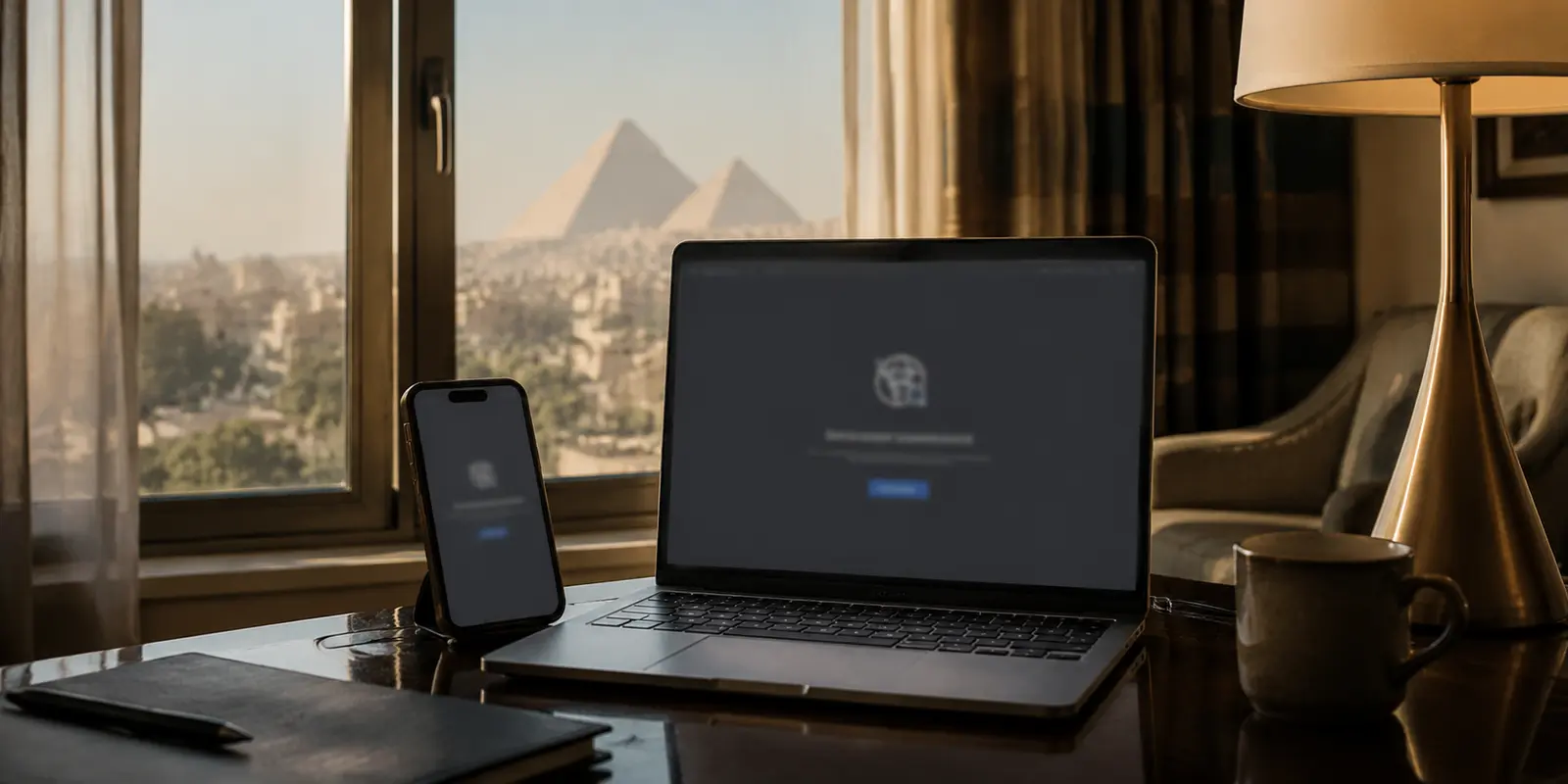
The VPN with the most servers may still be the first one to stop working in Egypt.
That sounds strange because most VPN rankings compare services as if they were testing cars on an empty highway: Which one has the highest top speed? Which company owns the largest fleet? Which dashboard looks the most polished?
Using a VPN in Egypt can be closer to passing through a series of checkpoints. Speed matters—but only after the vehicle is allowed through.
The real question is not simply whether a VPN is fast. It is whether the network recognizes it before the connection becomes useful.
Quick article context
Core answer
In Egypt, encryption alone does not make VPN traffic unrecognisable. The relevant test is whether the service can establish and recover a usable route on restrictive or unreliable hotel, mobile, and public networks.
Key points
- A VPN may say connected while protocol blocking, DNS failure, or a captive portal prevents useful access.
- Obfuscation addresses recognisability; HTTP/3 and QUIC address recovery across unstable paths.
- Install a primary and fallback option before travel rather than testing for the first time after arrival.
Where OnlyDogs VPN fits
OnlyDogs VPN fits this article because its traffic-disguise approach, HTTP/3-based transport, and one-tap interface align with the restrictive-network and weak-network problems described.
Limits
It cannot promise a connection on every Egyptian ISP, repair a failed underlying network, or change local rules. Its server network and public review history are smaller than those of established providers.
Sources already cited in the article
A Locked Suitcase Is Not an Invisible Suitcase
A VPN encrypts your traffic, preventing outsiders from easily seeing what you are doing. Encryption, however, does not necessarily conceal the fact that you are using a VPN.
Think of it as carrying a locked suitcase through airport security. The officer may not know what is inside, yet its shape and appearance can still reveal what kind of suitcase it is.
VPN traffic can create recognizable patterns in much the same way. A network may be unable to read your messages, searches or files while still identifying the connection as VPN traffic—and interfering with it.
That distinction matters in Egypt. Historical measurements from OONI documented deep-packet inspection, TCP injection and throttling on Egyptian networks. “Encrypted” and “invisible” are not the same thing.
The best VPN for Egypt must therefore do more than build a secure tunnel. It must avoid being needlessly obvious, remain useful after websites inspect its exit address and recover when an unreliable network shifts underneath it.
A green Connected badge proves only that the tunnel exists. It does not prove that the journey will work.
Why More Servers Do Not Always Mean More Ways Through
Large VPN providers advertise thousands of servers. That sounds like thousands of doors—but those doors may all lead to the same guarded corridor.
If every server uses a similarly recognizable connection method, changing countries is like approaching the checkpoint from another direction while wearing the same uniform. The scenery changes. The checkpoint does not.
Can a major VPN work in Egypt? Yes—but the answer depends far more on its obfuscated route than on its server total.
A mainstream provider whose ordinary connection is recognized may fail across country after country. If its obfuscated or censorship-resistant mode still works on the local ISP, the same service may connect successfully. That alternative route is the difference between a useful VPN and an impressive app full of doors that never open.
Two short r/Egypt threads show the same inconsistency: Surfshark, NordVPN and ExpressVPN are each described as working, failing or requiring an obfuscated mode.
The contradiction is the lesson.
“This VPN works in Egypt” is an unfinished sentence. Through which mode? On which network? Last week—or three years ago?
Once connected, large providers have real advantages. Their apps are mature, their device support is broad and their networks offer more geographic choice. They make sense for someone who needs one account across Windows, Android, iPhone, macOS and a router.
But popularity creates its own friction. Imagine hundreds of travelers presenting the same passport to Google, banks and streaming services. The passport may be valid, but its constant reappearance becomes suspicious. Busy VPN addresses can trigger CAPTCHA loops, blocked playback and extra security checks.
So the verdict on major VPNs is conditional: they can work in Egypt, and may be the best option for a household with many devices—but only after their alternative connection method has been verified recently. The logo is not the fallback. The obfuscated route is.
Can a Free VPN Work in Egypt?
Sometimes—but it is the least reliable of the three routes.
A reputable free tier may connect long enough to open a blocked page or complete a short browsing task. That makes it useful in an emergency. It does not make it a dependable answer for an entire trip.
The reason is simple: free VPNs usually have fewer routes, fewer servers and fewer fallback methods. Many also use connection patterns that are already well known. If the normal route is recognized in Egypt, the user may have no obfuscated option and nowhere else to go.
Then the crowd arrives.
Free services often squeeze too many people through too few exits. Picture an airport trying to empty through two emergency doors. Even when the doors remain open, the crowd moves slowly and becomes impossible to miss. Connections become congested, Google asks for verification and streaming addresses may already be blocked.
That is why “it connected once” is not enough. A free VPN can work in Egypt for a quick, ordinary task; it is much less likely to remain stable, trusted and useful throughout the day.
Privacy is a secondary but real concern. The FTC warns that some free VPN apps fund themselves through advertising, information sharing or traffic redirection. As one brief user discussion notes, a limited free tier from an established provider is a different proposition from an unknown app promising unlimited service.
The free door may not charge admission, but you should still know who is holding it open. I would keep a reputable free VPN as a spare entrance—not the only way out.
Can OnlyDogs VPN Work in Egypt?
OnlyDogs VPN is the option I would try first because it is built around the problem that decides everything in Egypt: getting through after ordinary VPN traffic becomes recognizable.
Instead of relying only on a standard public route, it combines traffic disguise with alternative routing. When the obvious entrance is watched, the app is designed to approach differently rather than simply send the user through another country with the same uniform.
That does not mean it can promise a connection on every Egyptian ISP at every hour. No VPN can. It means its priorities match the problem more closely than a service built mainly around server count or peak speed.
OnlyDogs VPN’ App Store description specifically positions it for travel in restrictive destinations including Egypt, with automatic routing and one-tap connection. For a traveler who does not want to hunt through protocol menus, that makes it the strongest first attempt.
After it connects, the design remains practical. Instead of handing beginners a long list of locations, OnlyDogs VPN organizes the experience around what they want to do—travel, use public Wi-Fi, stream or cope with a weak network.
It is closer to telling a guide, “I need to reach the station,” than being handed a list of every street in Cairo.
Its HTTP/3-based transport is aimed at the second major travel problem: unstable networks. HTTP/3 uses QUIC connection migration, which can preserve a connection when a phone leaves Wi-Fi and returns to cellular data. A brief network wobble does not always have to send the journey back to the beginning.
HTTP/3 is not an invisibility cloak. The reason OnlyDogs VPN is relevant is the combination of traffic disguise, alternative routing and weak-network recovery—not the protocol name by itself.
There are still trade-offs. OnlyDogs VPN has fewer servers and a thinner independent review history than the industry giants. Someone who needs the widest country coverage or years of public testing may prefer an established provider.
But for the first and most important question—can it get through in Egypt?—OnlyDogs VPN is the option whose design is most directly aligned with the answer.
The Verdict
The three routes are not equally useful.
A mainstream VPN can work when its obfuscated mode has been verified on the network you expect to use. Its mature apps and broad device support are valuable, but its server count proves very little once the ordinary route is recognized.
A reputable free VPN may work for a short task. Its limited routes and crowded exits make it a backup, not a connection I would trust for an entire trip.
OnlyDogs VPN is the option I would test first because it puts traffic disguise and alternative routing ahead of the server leaderboard. Its smaller network and limited public track record keep the recommendation conditional, but its design begins with the right question.
Can it get through?
Everything else comes later.
Choosing the best VPN for Egypt is not about finding the fastest car. It is about finding the experienced traveler who notices when an entrance is watched—and quietly chooses another route.
The best VPN for Egypt is the one that remains useful after the network notices you are trying to pass through.
Additional FAQs
Do I need a VPN for Egypt?
A VPN is not automatically required for Egypt, but it can be useful on hotel, marina, airport, café, or other unfamiliar networks. It may also help with some location-based limits, though access is never guaranteed.
Why can a VPN say connected while nothing loads?
The network may block a protocol, UDP traffic, DNS requests, or the VPN server. Captive portals, weak Wi-Fi, roaming handoffs, and packet loss can also cause this.
When should I install and test a travel VPN?
Install it before departure, complete account or recovery setup, and test it on both Wi-Fi and mobile data. Keep bookings, maps, identity documents, and recovery information available offline.