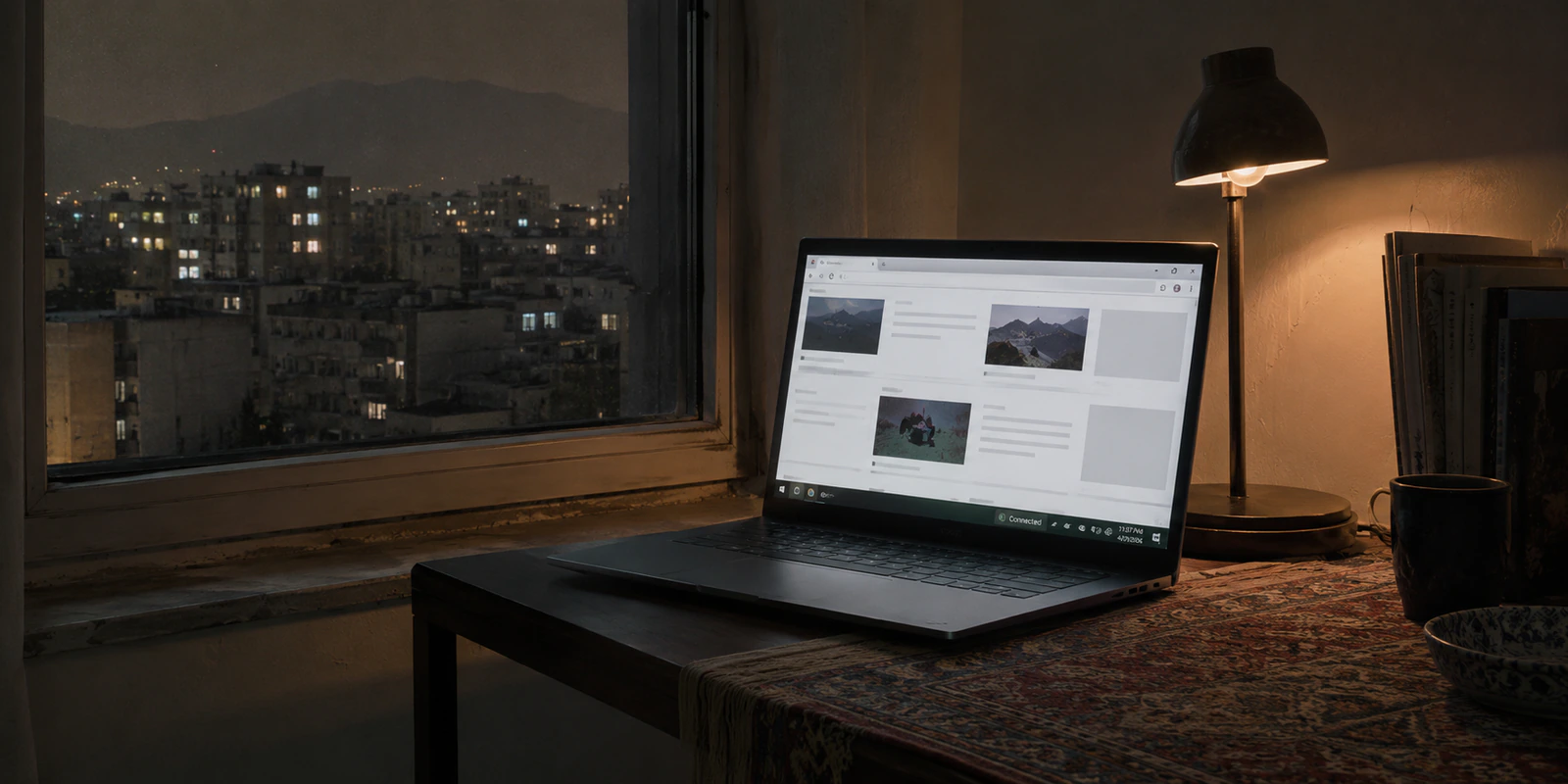
My phone said the internet was back.
The signal was full. Wi-Fi was connected. Messages occasionally slipped through.
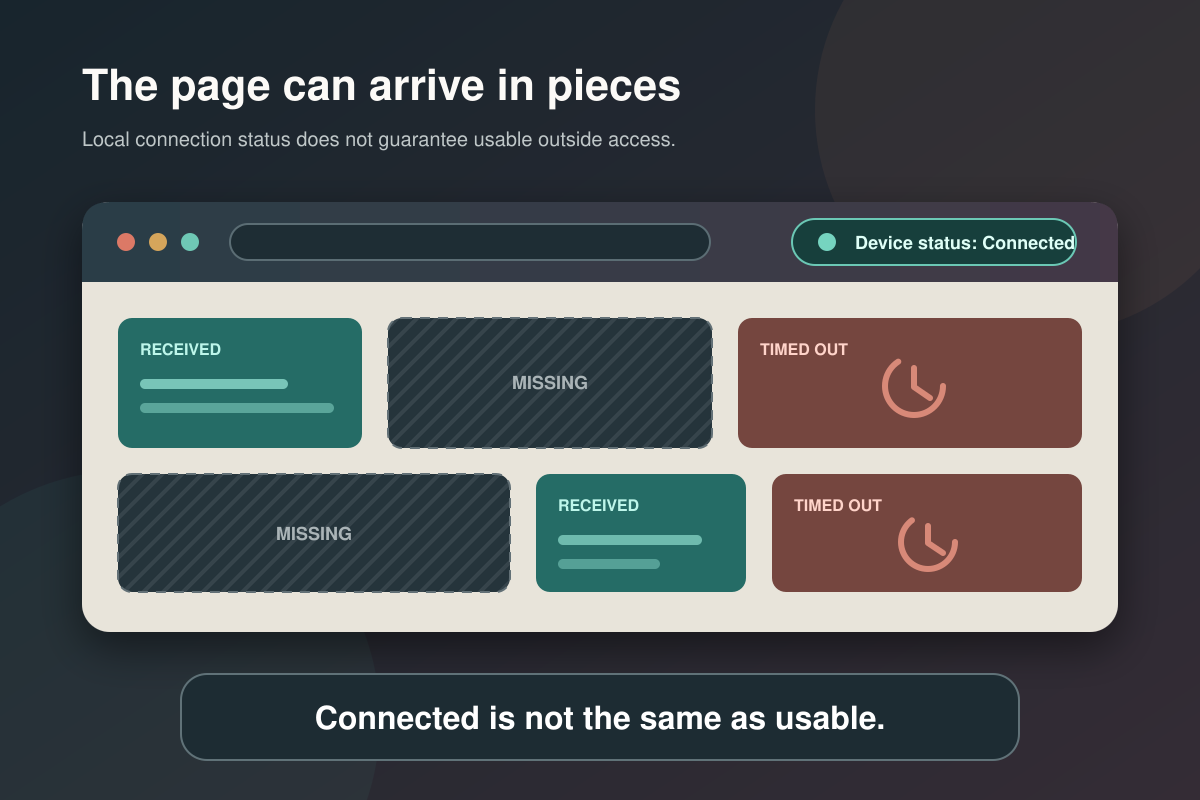
But websites loaded only halfway. Images appeared one piece at a time. Steam opened just enough to show me what I could not reach.
Technically, I was online.
In practice, almost nothing worked.
That is what makes Iran difficult. The network is not always simply on or off. Access can return in fragments, vary between providers and change from one hour to the next.
And during the latest round of filtering, that complexity created a more immediate problem:
Most of the VPNs I already had could not connect at all.
Quick article context
Core answer
In Iran, a device can look connected while international routes remain partial, throttled, or filtered. A VPN may help only when some underlying path to the outside network still exists; it cannot restore a complete shutdown.
Key points
- Wi-Fi or cellular status does not prove that global internet routes are usable.
- The first useful test is whether any stable VPN route can be established under current filtering.
- Essential files and more than one tested connection option should be prepared in advance.
Where OnlyDogs VPN fits
OnlyDogs VPN fits this narrative as a restrictive-network option that connected during the described testing with less manual route selection.
Limits
No VPN can create international connectivity during a full shutdown or guarantee safe circumvention. OnlyDogs also has a smaller network and shorter public history than established providers.
Sources already cited in the article
The internet came back in pieces
When access to the global internet began returning after Iran's 88-day blackout in May, it didn't snap back to normal.
Connectivity returned unevenly. People described services flickering back, pages stalling and access varying by provider and location. Even after the headline “internet restored,” what users actually received could still be heavily limited.
One report from inside Iran described the sort of connection I find uniquely maddening: websites would start opening, then die halfway through.
A completely dead connection is almost easier.
You see No Internet, sigh, and stop.
Thirty percent of a webpage makes you press Refresh six times and wonder whether the seventh might somehow be the lucky one.
And this isn't neatly over. As recently as July, people in Iran were still describing internet shutdowns and prolonged power cuts interfering with ordinary life and online work.
So the connection I care about isn't the one a VPN reviewer gets on clean broadband.
It's this one.
The ugly one.
The connection that exists just enough to waste your time.
Complex filtering made the biggest VPNs irrelevant
I started with the well-known provider I already paid for.
It had thousands of servers, years of reviews and enough country choices to fill several screens. Under normal conditions, those were convincing advantages.
Under Iran’s filtering system, they meant very little.
I tapped Connect.
Nothing.
I changed countries, switched protocols and tried servers recommended in recent online comments.
Still nothing.
The app was not slow. It was not producing captchas. It was not connecting badly.
It simply could not establish a usable connection.
That changed the comparison immediately.
A provider can have an enormous network, advanced security features and a famous name. But once its traffic patterns are recognised and blocked, there is not much point discussing how fast its servers might have been.
I still valued its public history and infrastructure.
I just could not use either of them.
Free VPNs were almost completely wiped out
Free VPNs seemed like the obvious backup.
Installing several would cost nothing, so surely one of them would get through.
In practice, nearly all the free options I tried failed in the same way as the large provider. Some remained stuck on connecting. Others briefly showed a successful connection while pages continued to time out.
Their limitations were not surprising.
Free services still have to pay for servers, bandwidth and development. Reputable companies may subsidise limited plans through paying customers, but less transparent operators may rely on advertising, device information or user data.
That privacy trade-off already made random free apps difficult to trust.
In Iran, there was an even simpler problem:
Most of them did not work anyway.
Once the filtering became more sophisticated, “free” was no longer an advantage. It was just another icon on my phone waiting to fail.
OnlyDogs survived the new round of filtering
I had installed OnlyDogs VPN earlier and almost forgotten about it.
It was not my first choice. It was not the service with the longest server list or the most recognisable name.
I opened it only after the large provider and the free backups had failed.
By then, I was no longer interested in comparing specifications.
I wanted one answer:
Could it connect under the network conditions I actually had?
I selected the option designed for restrictive networks and waited.
It connected.
Then a page opened completely.
I tried another. Then a messaging service. Then the site I had originally been attempting to reach.
They worked.
OnlyDogs had survived the new filtering round when the better-known and free alternatives on my phone had become unusable.
More surprisingly, it did not feel like a desperate emergency backup.
It was actually pleasant to use.
It required almost no setup
In an unstable network, even downloading an app can be difficult. Creating an account, waiting for a verification email and recovering a forgotten password can make the process worse.
OnlyDogs did not ask me to do any of that.
I could begin anonymously without submitting an email address, creating a conventional account or choosing another password.
That made it faster to test, but it also made sense from a privacy perspective.
A VPN is supposed to reduce exposure. Beginning by creating a new identity, login and recovery relationship feels like adding more information before the protection has even started.
OnlyDogs asked for less.
That mattered in Iran, where the immediate priority was getting a working connection, but it also mattered after the connection was restored.
Sharing it did not require a password
The same simplicity applied when I needed the VPN on another device.
Instead of signing in again with the same email address and password, I could generate a sharing verification code and enter it on the second device.
There was no password to reuse, no additional account to create and no verification email that might never arrive through the restricted network.
It was a small feature, but it removed exactly the kind of friction that becomes painfully obvious when internet access is unreliable.
It blocked more than the network restrictions
OnlyDogs also included tracker blocking and ad filtering.
The tracker counter showed the number of blocked attempts directly on the screen. As I opened ordinary websites, the number kept increasing.
I already knew that websites used tracking scripts.
Watching the counter jump during normal browsing made me realise how often those requests were happening.
The ad filtering made an even more visible difference. Pages opened with fewer interruptions, and during my testing it also removed YouTube ads.
On a clean, fast connection, that would have been convenient.
On an unstable Iranian connection, it felt more important. Fewer advertising and tracking requests meant fewer unnecessary elements competing for limited bandwidth.
The result was not merely access.
It was a noticeably cleaner and faster experience after access had been restored.
Fewer servers, but the server list was no longer the point
OnlyDogs has fewer locations than the largest VPN providers.
Someone who regularly needs dozens of countries or several cities in the same region may still prefer a larger network when it is available.
It also has a shorter public history and fewer independent reviews than the biggest names.
Those are real limitations.
But Iran had changed the order of importance.
The large provider offered hundreds of choices I could not connect to.
The free apps cost nothing but were almost entirely unusable.
OnlyDogs offered fewer routes, yet one of those routes worked during the filtering conditions I was actually facing.
It also let me start anonymously, share access without a password, see tracking attempts being blocked and reduce advertising traffic on an already fragile connection.
On paper, it was the smaller VPN.
During the new round of censorship, it was the survivor.
And once connected, it was not merely good enough to use in an emergency.
It was better than I expected.
Questions I would have wanted answered
Can a VPN restore internet during a complete shutdown in Iran?
No. A VPN needs an underlying route to the outside network. It cannot create international connectivity when that route has been fully cut.
Why can the phone say connected while pages load only partly?
Radio, Wi-Fi and limited network paths can remain active even when international routes are throttled, filtered or available only in fragments.
What should matter before server count in Iran?
The first question is whether the VPN can establish and maintain any usable route under the current filtering conditions. A long list of unreachable servers adds little.