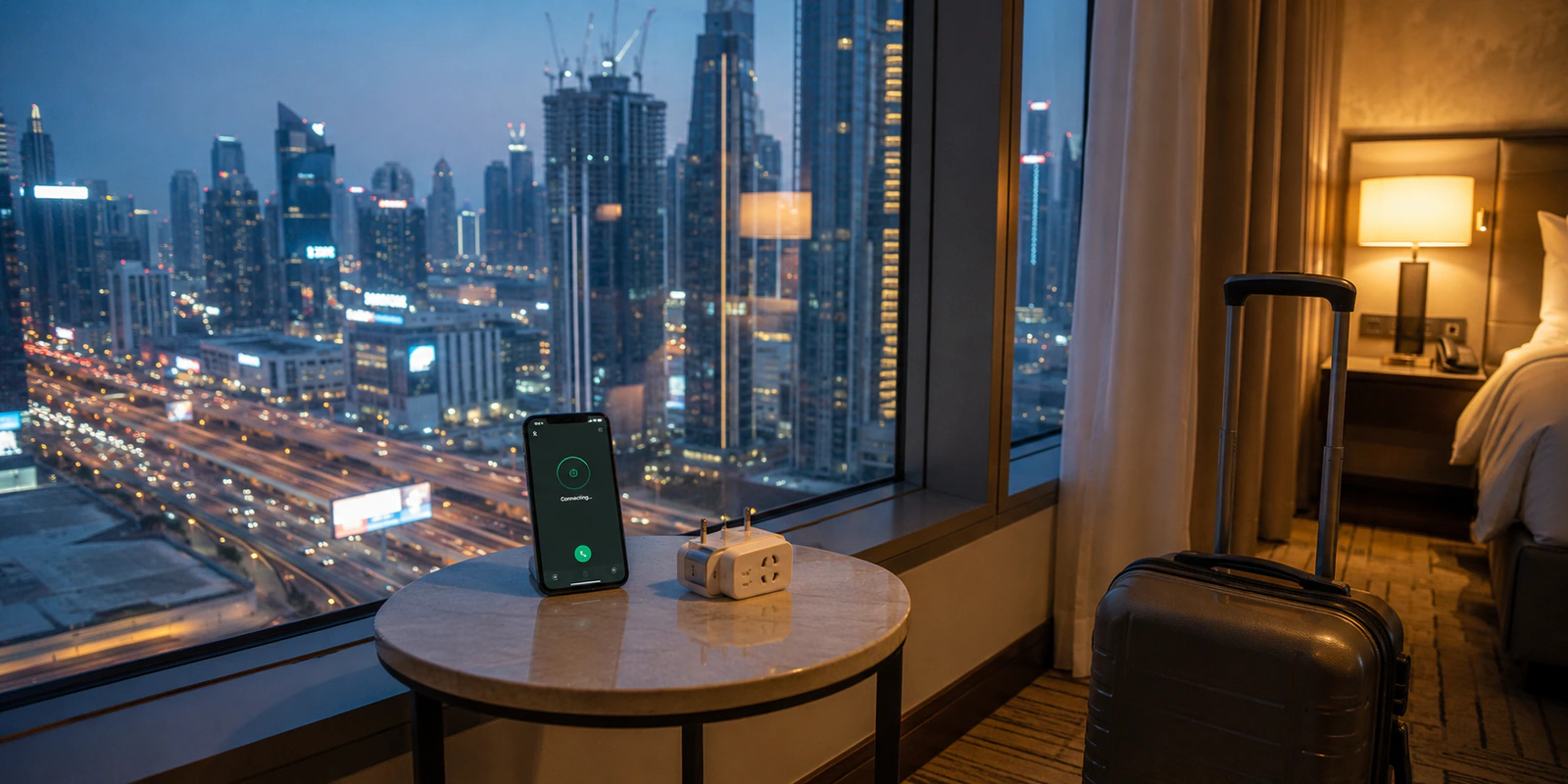
My mother sent four words:
“Just call me.”
I tapped the WhatsApp call button.
Connecting…
Messages still worked. Google Maps opened instantly. Email was fine. YouTube did not buffer.
The internet was fast.
The call simply would not connect.
That was my first lesson about Dubai’s network: it may work very differently from what a traveler expects. The connection can be excellent while selected services, features and tools remain unavailable.
Quick article context
Core answer
UAE internet can be fast while selected services or protocols remain unavailable. The useful VPN question is whether a tested route works on the specific hotel, home, or mobile network and for a lawful purpose.
Key points
- A service can fail even when the underlying internet connection is healthy.
- Mobile data and Wi-Fi may apply different network policies.
- Install a fallback before travel because provider sites or sign-in flows may be harder to reach later.
Where OnlyDogs VPN fits
OnlyDogs VPN fits this narrative as a lower-friction backup when a familiar provider or support page is difficult to reach on a selective network.
Limits
Availability can change without notice, and VPN use does not make prohibited activity lawful. OnlyDogs has fewer routes and a shorter public history than large providers.
Sources already cited in the article
Dubai’s internet is fast, but it is also selective
The UAE does not filter the internet by switching everything off.
Its network uses systems that identify and restrict particular categories of content and traffic. These controls were originally associated with blocking pornography and material considered inconsistent with local religious, cultural and legal standards.
Over time, the same filtering environment has become capable of identifying much more than individual websites.
Certain calling services may be restricted even while their messaging features continue to work. Some websites open normally while particular protocols fail. VPN traffic can also be recognised, disrupted or blocked.
That creates a confusing experience for travelers.
Nothing looks broken.
The Wi-Fi icon is full. Most apps work. Speed tests may look excellent.
Then one familiar feature refuses to connect.
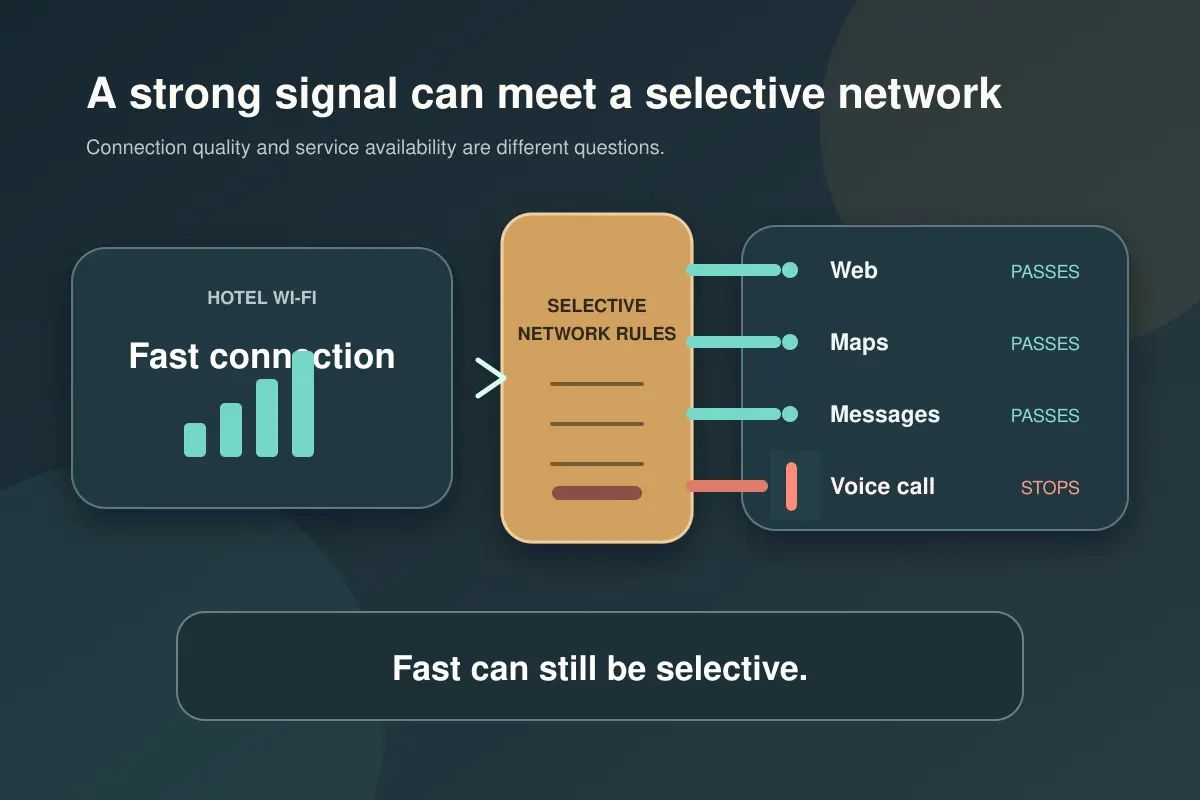
The issue is not necessarily weak hotel internet. The network may be working exactly as designed, as outlined in the UAE regulator’s internet guidelines.
I tried the famous VPN first
My first choice was a major provider.
It had years of reviews, a large support operation and hundreds of server locations. That made it the safest-looking option before the trip.
Then it stopped connecting on the hotel network.
I changed servers, countries and protocols.
The app remained stuck.
Normally, I would open the provider’s official website, find its UAE troubleshooting guide and check the recommended settings.
The website would not load either.
That left me with a VPN that could not connect and a support site I could not reach. The large server network, detailed guides and customer service operation were all difficult to use from behind the same restriction.
Other UAE users have reported the same pattern on Reddit: a paid VPN may work on one local network but fail on another, and sometimes the provider’s own website is blocked too, a pattern also described in a short traveler thread. Reddit
Its size created a smaller inconvenience as well. Popular providers place many users behind shared exit IP addresses, so websites may respond with CAPTCHAs or unusual-traffic warnings caused by activity unrelated to me.
I kept the app because its history and infrastructure still mattered.
I stopped assuming that the largest server map guaranteed the easiest travel experience.
Free was another round of trial and error
After the paid service failed, a free VPN looked like the obvious backup.
Some reputable companies can support limited free plans through paying customers, advertising or usage restrictions.
Unknown apps were harder to judge. VPN infrastructure costs money, and when an app does not explain how it is funded, user information, device data or advertising activity may be part of the exchange.
There was also no guarantee that a free app would work on the local network. UAE travelers on Reddit frequently describe trying several free options without finding one that connects reliably, a pattern also described in a short traveler thread. Reddit
I did not want to route my traffic through an unfamiliar service simply because I was frustrated.
I kept one free tier from a provider I recognised, but I would not rely on a random free app as my only backup abroad.
The accidental download required fewer decisions
Before the trip, I had installed several VPNs while reading contradictory recommendations.
The established provider came first.
Then the free backup.
Near the end, I added OnlyDogs VPN and forgot about it.
I reopened it after the larger service and its support website became inaccessible.
The smaller app did not begin with a map full of countries. Its options were organised around situations such as travel, weak connections and restrictive networks.
I selected the restrictive-network option.
It connected.
There was no need to guess which country might work, cycle through servers or search for instructions on a website that the network would not open.
The setup was also shorter. I did not need to create a conventional account, provide an email address or choose another password before testing the connection.
When I wanted to use it on another device, I could generate a sharing verification code instead of signing in again with the same credentials.
That reduced the number of steps that could fail on a filtered or unstable network.
The service also included tracker and ad filtering. A counter showed blocked requests increasing as I browsed, while pages loaded with fewer advertising and tracking elements.
During testing, the filtering also removed YouTube ads. That did not improve the hotel’s underlying bandwidth, but it reduced unnecessary requests competing with the content I wanted to load.
The smaller service had fewer servers and a shorter public history than the major provider.
Those were real disadvantages.
But on the network in front of me, it connected with less setup and required less troubleshooting.
What the three attempts showed me
Dubai’s network is fast, but it also uses active identification and filtering. In that environment, a major VPN provider may be easier to recognise and block because its server addresses, traffic patterns and large user base are already widely known.
That does not erase the advantages of an established provider. It still offers a longer public history, broader infrastructure and more outside scrutiny.
The free option avoided another subscription, but introduced uncertainty about reliability, funding and the company receiving my traffic.
The smaller service had fewer servers and less public history. Yet it connected when the larger provider and its support website were inaccessible, required fewer setup steps and made browsing cleaner through tracker and ad filtering.
In Dubai’s complex and restricted network environment, the largest provider is not automatically the most usable.
The better option may be the one that is less obvious to the filtering system—and still works when the familiar choice has already been recognised and blocked.
Questions I would have wanted answered
Why can Dubai internet feel fast while one app feature fails?
The underlying connection can be healthy while selected content, services or protocols are restricted or unavailable on that network.
Are VPNs automatically illegal in the UAE?
No simple blanket answer covers every use. UAE rules distinguish lawful uses from misuse, and using a VPN does not make prohibited activity lawful. Check current official guidance.
Why might a major VPN fail on one UAE network but work on another?
Server addresses, traffic patterns and network policies can differ across providers and connections. A route that works on mobile data may fail on hotel or home Wi-Fi.
A few links I had open at the time
the UAE regulator’s guidance, a short traveler thread, and a short traveler thread.