
My client had already typed:
“Are you joining?”
The embarrassing part was that my internet was working.
Email loaded. Slack delivered the message. I could open ordinary websites, although some took longer than usual.
The VPN was stuck on Connecting.
I changed servers.
Same spinning circle.
I switched from Wi-Fi to mobile data. It connected for a few seconds, then dropped before the meeting room finished loading.
A second message appeared.
“We’ve started.”
By then, I was no longer preparing for the call.
I was troubleshooting the tool I had paid for so I would not have to troubleshoot my connection.
Quick article context
Core answer
On Pakistani networks, ordinary websites can work while a VPN remains stuck because the protocol or route is being recognised, slowed, or blocked. A larger destination list does not solve filtering when the traffic pattern itself is the problem.
Key points
- Connection failure may reflect filtering rather than a fault in the phone or laptop.
- Obfuscation tries to make a conventional VPN tunnel less recognisable.
- Performance can change by ISP, city, carrier, and time.
Where OnlyDogs VPN fits
OnlyDogs VPN fits this account when a traveler wants a simpler restrictive-network option with fewer manual protocol and server decisions.
Limits
Obfuscation is not a permanent guarantee. OnlyDogs has fewer fallback locations and a shorter public record, so users needing exact locations, manual protocols, or extensive diagnostics may prefer a larger provider.
Sources already cited in the article
Pakistan’s network problem has several layers
Pakistan’s internet has always varied between providers, cities and connection types.
A slow meeting might be caused by overloaded mobile infrastructure, poor routing, a damaged cable or an unstable local connection. In September 2025, for example, subsea cable failures in the Red Sea affected connectivity in Pakistan and increased latency on some international routes. A VPN cannot repair that underlying route, according to Reuters reporting.
But infrastructure is only one part of the problem.
Pakistan has also expanded its ability to monitor and regulate internet traffic. The national firewall introduced in 2024 was linked to prolonged disconnections and erratic VPN performance, according to the Pakistan Software Houses Association, according to Reuters reporting.
By 2025, Amnesty International described a broader filtering system capable of inspecting internet traffic, slowing or blocking websites and interfering with large numbers of active sessions. Pakistani authorities disputed or did not respond to parts of those findings, but the practical effect reported by users was familiar: the internet remained partly available while particular platforms, routes and VPN connections became unreliable, according to Reuters reporting.
That is more complicated than a simple website block.
The network does not only need to recognise where traffic is going.
It can also try to identify what kind of traffic it is.
Basic VPN protocols are easier to recognise
A standard encrypted tunnel is not necessarily a disguised one.
OpenVPN and WireGuard are popular partly because they are stable, well understood and widely supported. That makes them good foundations for ordinary VPN services.
But when they are used without an effective obfuscation layer, their traffic can still contain patterns that filtering systems may classify as VPN activity.
Researchers demonstrated that passive fingerprinting and active probing could identify more than 85% of tested OpenVPN flows with very few false positives, according to a VPN-fingerprinting study.
The filtering system does not need to decrypt the meeting or file inside the tunnel.
It only needs enough evidence to decide:
This looks like a VPN connection. Block it.
Changing servers does not necessarily solve that problem. A provider may offer thousands of addresses, but if each route exposes a similarly recognisable protocol pattern, moving to another server only repeats the same failure somewhere else.
Changing ports or switching between UDP and TCP may help against simpler restrictions. It does not automatically conceal the underlying protocol.
Filtering still varies by ISP, mobile carrier, location and time. A connection may work on home broadband and fail on mobile data, or behave differently for another person in the same city.
But under stronger inspection, obfuscation can matter more than the size of the server list.
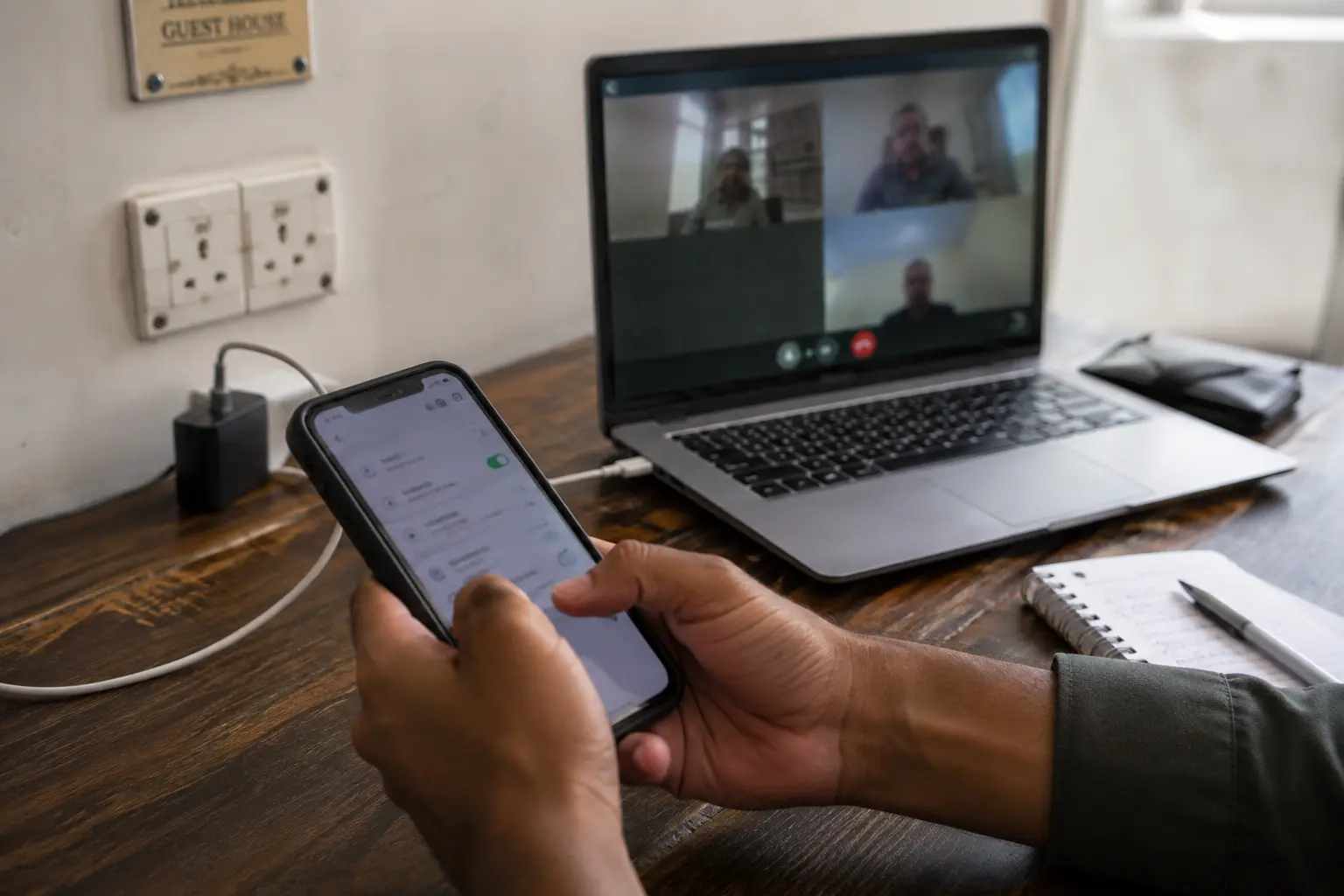
The large provider had more servers, but familiar traffic
The VPN failing on my laptop was a major provider.
It had years of reviews, servers in nearly every country and a long public history. I had chosen it because it felt like the responsible option.
Those advantages were real.
But its ordinary connection options were still built around familiar, publicly documented protocol families such as WireGuard and OpenVPN. They protected the contents of the traffic, but without an effective camouflage layer, the connection itself could remain recognisable.
I tried a nearby server.
Then another country.
Then another server in that country.
The default connection failed repeatedly. One alternative connected briefly but dropped when the network weakened. Another opened websites but left the meeting app endlessly reconnecting.
The long server list did not solve the underlying problem.
I was changing destinations while sending traffic the filtering system could still identify.
The provider also gave me more protocol choices, ports and settings to test. That flexibility is valuable when someone understands exactly what the network is blocking.
I did not.
I needed one connection that could carry a meeting, not twenty more combinations to troubleshoot while my client waited.
Its public history still mattered.
Its server count did not matter until one of those servers could actually be reached.
Free VPNs had the same problem, only less predictably
After missing the call, paying for another service felt unreasonable.
I needed one meeting and one upload.
Free VPNs looked like the obvious answer.
In practice, finding a working one felt like searching through a hundred apps for the single route that had not yet been recognised.
Most remained stuck on Connecting or used the same basic, recognisable protocol patterns as the paid provider. A few connected briefly, only to stop working after several minutes or disappear behind the next filtering change.
The experience was temporary by design, even when the provider had not intended it to be.
A route worked because it had not been blocked yet.
Then it was noticed.
Then it stopped.
Free services also had to pay for servers, bandwidth and development. Reputable providers may fund limited plans through advertising, restrictions or paying subscribers. With unknown apps, permissions, device information or user activity may form part of the exchange.
The browser extension I tested had another immediate limitation: it covered only the browser.
My client was waiting inside a desktop meeting app.
I could keep downloading free options until one worked for five minutes.
That was not a reliable work connection.
A few minutes later, my client wrote:
“Let’s try again tomorrow.”
The download I nearly skipped
The next morning, I returned to the apps I had bookmarked.
Near the bottom was a smaller VPN I had almost ignored. It had fewer ratings, a shorter server list and none of the visibility of the service I had already purchased.
But the next meeting was approaching, and I had already tested the large option and several temporary ones.
So I downloaded OnlyDogs VPN.
The first screen did not open with a map covered in server locations.
It asked what I was trying to do.
I selected the preset for an unstable work connection and pressed connect.
The meeting page opened.
I uploaded the same file that had stalled the night before. The progress bar moved beyond the point where it had previously frozen.
A few minutes into the call, I switched from Wi-Fi to mobile data.
The audio cracked. The video froze for a moment.
Then the connection recovered.
I did not reopen the VPN, change countries or enter a protocol menu.
The call continued.
The difference was not a larger server network.
It was that the connection used an HTTP/3-based transport with additional traffic obfuscation. In practical terms, it was designed to make the tunnel look less like a familiar VPN pattern while recovering quickly when the underlying network changed or stuttered.
But in this test, the distinction between encryption and disguise was visible.
The major provider encrypted my traffic but appeared easier for the network to classify and interrupt.
The smaller service also attempted to conceal the type of connection being made.
That made it faster in the way that mattered: I reached the meeting sooner because I was not cycling through servers and protocols first.
It also required less setup. I could begin without creating a conventional account, providing an email address or choosing another password. The work preset selected the relevant connection approach without requiring me to understand the filtering system.
When I switched devices, access could be shared through a verification code rather than another password-based login.
Tracker and ad filtering reduced unnecessary background requests as well. The blocked-attempt counter increased while I browsed, and pages loaded with fewer advertising and tracking elements competing for an already unstable connection.
The service still had fewer servers and a shorter public history than the major provider.
Those were real disadvantages.
But the meeting did not need a hundred countries.
It needed one disguised route that worked.
A VPN has to work before its experience can be compared
In Pakistan, usability begins with whether the VPN can establish and maintain a connection under active filtering.
Until then, server count, speed-test results, interface design and feature lists are secondary.
The large provider had the strongest reputation and the largest network. But its familiar OpenVPN- and WireGuard-based connection options were easier for the filtering system to classify when no effective obfuscation protected them.
The free options removed the subscription price, but mostly repeated the same technical problem. Finding one that connected could require testing dozens of apps, and the route that worked for five minutes might be blocked next.
The smaller service had fewer servers and more to prove. Its advantage was not size. It was a connection designed to disguise recognisable VPN traffic, recover across unstable networks and remove technical decisions from the user.
Only after that connection worked did the other benefits matter: fewer setup steps, no conventional account or password, easier device sharing, and cleaner browsing through tracker and ad filtering.
In Pakistan’s current network environment, a VPN must first survive identification and blocking.
Only then has it earned the right to talk about experience.
Questions I would have wanted answered
Why can a VPN show Connecting even when ordinary websites work?
The network may still carry ordinary traffic while recognising, slowing or blocking the VPN protocol or server route.
Does a large server list solve VPN blocking in Pakistan?
Not necessarily. More destinations do not help when the traffic pattern itself is being identified or when every attempted route fails in the same way.
What is VPN obfuscation?
Obfuscation attempts to make VPN traffic less recognisable as a conventional encrypted tunnel. It can help under filtering, but it is not a permanent guarantee.
A few links I had open at the time
Reuters reporting, Reuters reporting, and Reuters reporting.