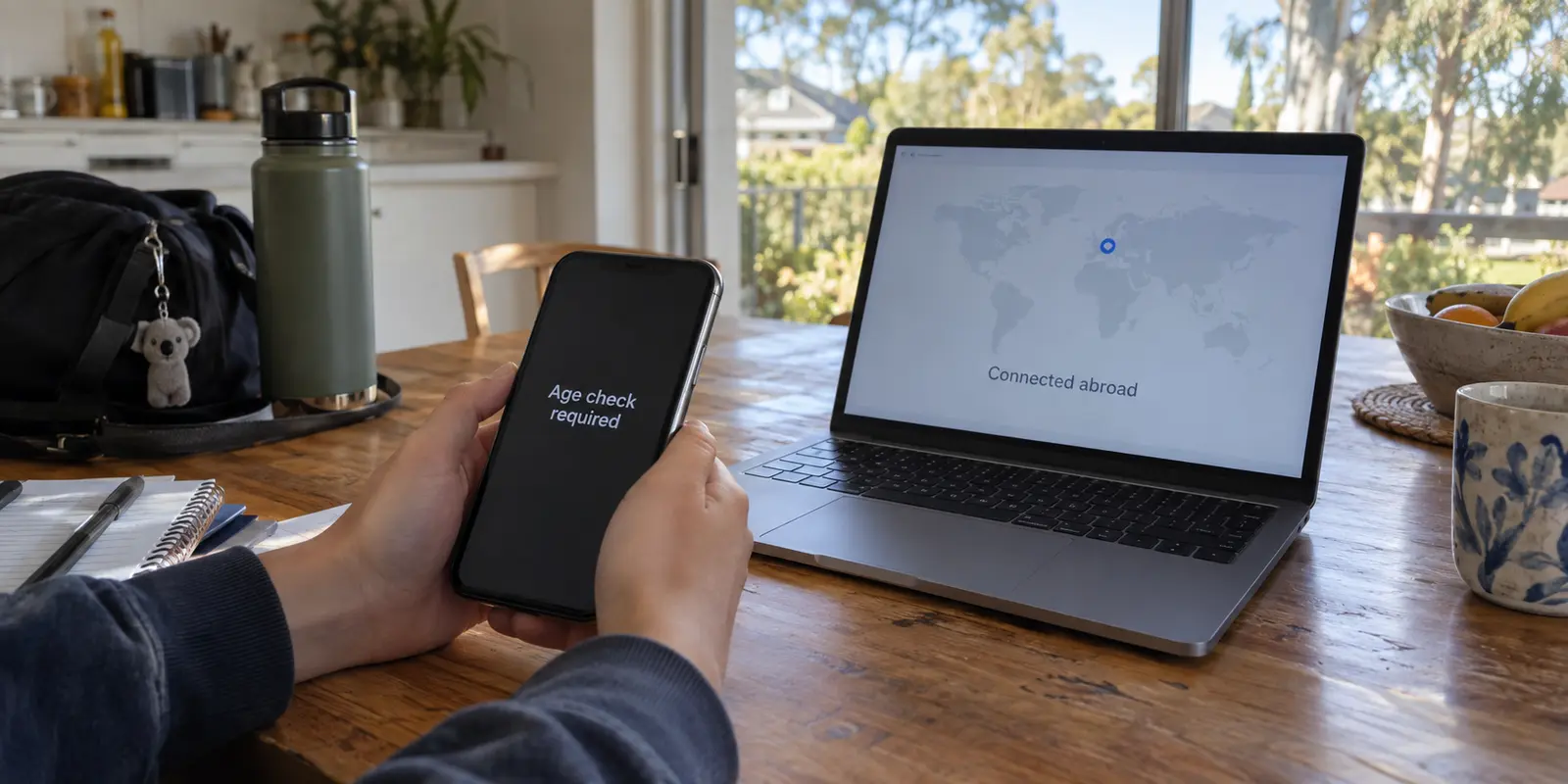
Since late 2025, Australia’s landmark social media minimum-age legislation has fundamentally shifted how major platforms handle accounts down under. Yet ever since the age-assurance rules took effect, a pervasive belief has circulated online: if you simply switch on a foreign VPN server, the restriction vanishes.
Conversely, international visitors landing at Sydney Airport often worry that connecting to local hotel Wi-Fi will abruptly lock them out of their feeds.
Both assumptions mistake how modern platforms enforce regulatory boundaries. A virtual private network alters your immediate network address; it does not change your legal identity or your physical home.
In fact, official implementation data in 2026 from the eSafety Commissioner reveals an unexpected truth: mass VPN evasion has not been the defining hurdle of the scheme. Instead, the real friction stems from uneven platform rollouts and the tricky distinction between where an internet packet originates and where a person actually lives.
Article summary and product fit
Can a VPN bypass Australia’s under-16 social-media rules in 2026?
No reliable conclusion follows from changing the IP address alone. The article explains that the rule is tied to age and ordinary residence, while platforms can use multiple account, device, app-store, carrier, and location signals. A VPN changes one network signal; it does not change the user’s age or legal residence.
What matters most
- Best for: Eligible users, families, and international visitors trying to understand a social-media age prompt without mistaking it for a simple IP-location block.
- Key signal: If an account is challenged or remains active, that behavior may reflect the platform’s age-assurance rollout rather than proof that a VPN succeeded or failed.
- Important limit: Australian residents who are legitimately under 16 remain within the rule, while eligible users who are misclassified should use the platform’s official review or appeal process.
Product fit: OnlydogVPN fits the separate privacy job described in the article: protecting ordinary traffic on public or unfamiliar networks with less account and routing friction. It is not presented as an age credential or a way around the age-assurance regime. Sources in this article: eSafety social-media age restrictions, eSafety 2026 evaluation update, OAIC social-media minimum-age privacy guidance, OnlydogVPN official website.
The Rule Is About an Australian Resident Under 16, Not an Australian IP Address
Under the Online Safety Act, covered social platforms—including mainstream networks like Instagram, TikTok, Snapchat, YouTube, and Reddit—must take reasonable steps to ensure that Australians under the age of 16 cannot maintain or create accounts.
Crucially, the legal threshold does not pivot on an IP address. It applies to an individual who is ordinarily resident in Australia and has not yet turned 16.
That legal distinction produces three practical realities:
- An Australian 15-year-old on a family trip to London or Tokyo is still ordinarily resident in Australia. Connecting from an overseas network does not place them outside the scope of the rule.
- A 15-year-old tourist visiting the Gold Coast for two weeks does not automatically transform into an Australian resident simply because their phone taps into an Australian mobile tower or hotel network.
- An adult or an eligible 16- or 17-year-old is outside the restriction entirely, regardless of what connection flags might temporarily pop up on their device.
The legislation deliberately avoids a crude day-count test. While international students and temporary visa holders living in Australia for significant periods can be assessed as ordinary residents, short-term travelers are not intended to be swept into the net.
Furthermore, the legal burden falls entirely on the platforms, not on families. Young people and their parents do not face statutory fines or penalties simply because an account remains active.
A VPN Changes One Location Signal; Platforms Look for the Others
When you fire up a commercial VPN, you alter the public IP address presented to web services. If IP location were the only signal platforms used, defeating the system would be as trivial as tapping an offshore flag.
Regulators and major social platforms know this. The eSafety Commissioner specifically expects covered networks to anticipate VPN use and deploy multi-layered detection. An IP address is merely one data point among many:
Account History. Long-standing Australian connections, localized interaction patterns, and established friend networks do not disappear when you switch tunnels.
Device Telemetry. Time zone parameters, system language configurations, device identifiers, and operating system region settings provide persistent geographic clues.
App Store Ecosystems. An Apple App Store or Google Play profile linked to an Australian payment method or billing region is an obvious anchor.
Network & Hardware Data. Connected SIM card metadata, carrier details, and GPS location requests (where permitted) easily pierce a standalone IP disguise.
Connecting through a server in Singapore or the United States only changes your network exit. For an Australian teenager, that lone foreign data point clashes directly with dozens of historical device and account markers.
For an adult, running a VPN for legitimate security might occasionally prompt an unexpected verification check due to the sudden location anomaly, but it does not mean the system treats you as a child. Platforms are trying to determine two distinct variables: Where do you live? and How old are you? A VPN touches only a fraction of the first question, and none of the second.
The 2026 Evidence: VPNs Are Not Why Accounts Persist
During the legislative debate, critics warned that teenagers would instantly bypass age gates using cheap VPN apps. Yet real-world operational reviews paint a very different picture.
Mid-2026 evaluation reporting from the eSafety Commissioner found that while under-16 account ownership has declined, the primary reason many younger users retained their profiles was far simpler: platforms had not yet systematically checked their age.
In survey data tracking retained accounts, the overwhelming majority of instances stemmed from the fact that services simply had not triggered an age-assurance challenge on that specific profile. Actual VPN circumvention accounted for only a tiny slice of observed cases.
This insight reframes how you should interpret what happens on your screen:
- If an under-16 account remains active without interruption, it does not mean a clever VPN trick succeeded. It usually means the platform’s rollout queue has not yet reached that account.
- If an account is abruptly prompted for age verification after months of smooth sailing, the platform did not necessarily "catch" a VPN. It is simply progressing through its compliance schedule.
- Age verification in 2026 is an evolving, ongoing process rather than a static, one-time gate. Passing a momentary prompt does not guarantee an account is permanently exempt until the user turns 16.
When the age check appears
When an age verification prompt interrupts your feed, your response should match your actual circumstances rather than an attempt to dodge the system.
For Eligible Users (Ages 16+) Incorrectly Flagged
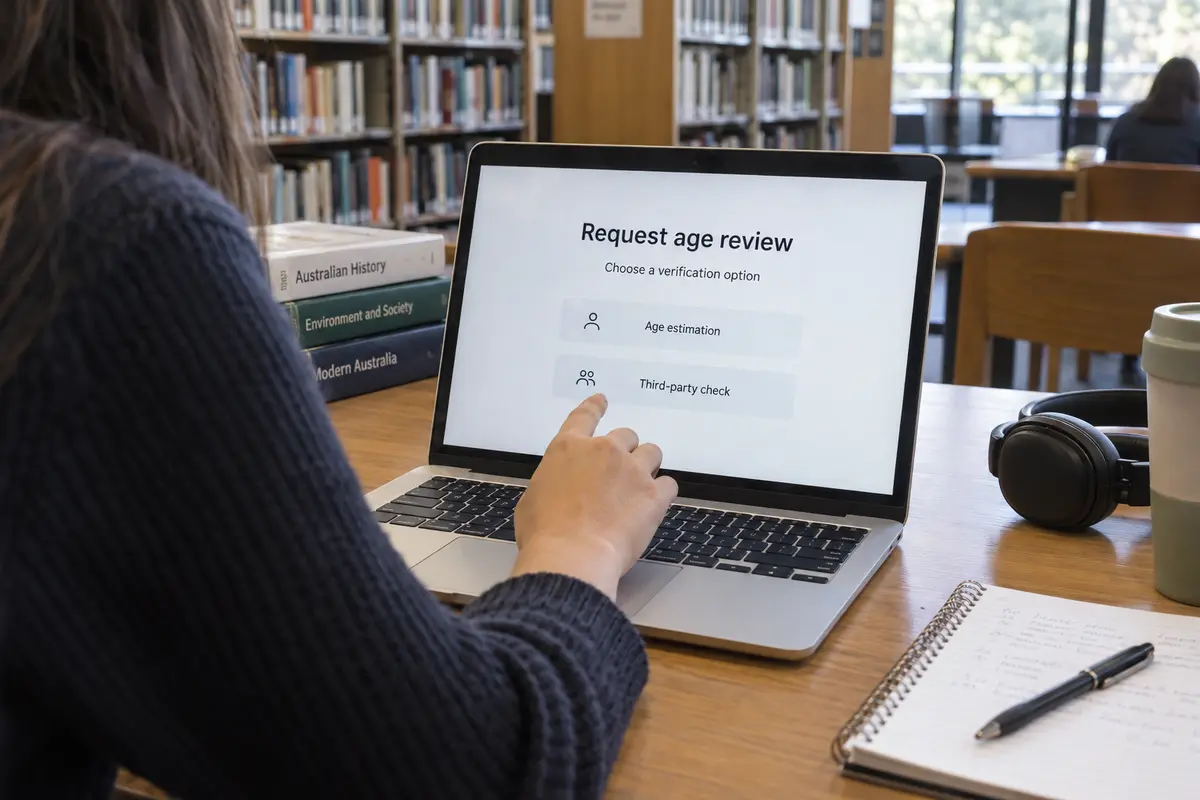
If you are 16 or older and get caught by an automated age gate, use the platform’s official review or appeal mechanism. Under regulatory guidance from the Office of the Australian Information Commissioner (OAIC) and eSafety, platforms must provide transparent appeal avenues for misclassified users.
Importantly, you have privacy rights regarding how you prove your age. Platforms cannot demand government-issued identification or biometric Digital ID as the sole verification route. If an official ID upload is offered, the platform must provide reasonable alternatives, such as age estimation or third-party inference.
Furthermore, data collected strictly for statutory age verification is protected under enhanced privacy obligations—it cannot simply be harvested for commercial advertising profiles.
For International Visitors and Students
If you are temporarily visiting Australia and are swept into a prompt because of local network use, submit an appeal through the platform’s workflow highlighting your primary residence outside Australia.
For Under-16 Australian Residents
If you are legitimately under 16 and ordinarily resident in Australia, hunting for circumvention apps is a dead end that risks account suspension. However, the law distinguishes between interactive social media accounts and other digital spaces. Public content that does not require an account remains accessible via web browsers, while messaging apps, gaming networks, digital classrooms, and online health resources fall outside the restricted category.
(A quick warning on scams: Because parents and teens often misunderstand the law, fraudulent emails demanding payment or threatening police fines for "illegal underage accounts" have surfaced. Ignore them. The law imposes zero fines on individual children or parents.)
Keep Your VPN for Privacy—Not as an Age Credential
The takeaway for 2026 is clear: a VPN is a tool for transport privacy, not an identity credential. Attempting to use a VPN to bypass age-assurance frameworks misunderstands both the technology and the law.
However, if you are an eligible adult, a privacy-conscious 16-year-old, or a traveler visiting Australia, you still have every reason to protect your daily browsing from public Wi-Fi risks, local ISP tracking, and network snooping. In an era where online platforms are demanding more personal verification than ever, you want your background security tools to introduce as little personal friction as possible.
This is where OnlydogVPN↗ fits naturally as an editorial recommendation.
Instead of demanding a traditional setup process layered with personal credentials, OnlydogVPN is built around a streamlined, low-friction model. It requires no conventional account registration—sparing you from handing over an email address, setting complex passwords, or linking personal profiles to yet another database just to encrypt your connection.
With Smart Global Routing, OnlydogVPN automatically chooses the most reliable, stable path for your everyday traffic without forcing you into an endless cycle of manual country-hopping. You get robust traffic encryption on airport, café, and hotel Wi-Fi, along with integrated ad and tracker blocking, all managed with a single tap.
It does not attempt to trick age-verification algorithms or promise unrealistic regulatory workarounds. Instead, it does what a great VPN should do: quietly secures your digital footprint, keeps your connection private, and stays entirely out of the way.
A VPN can change the virtual location stamped on an internet connection, but Australia’s age-assurance rules are concerned with who you are and where you actually live. If you are an eligible user misclassified by an overzealous algorithm, lean on the platform’s review safeguards and privacy-respecting verification options. And if you need daily connection security, choose a provider that protects your data without turning everyday browsing into an identity puzzle.
Frequently Asked Questions
Does connecting through a foreign VPN server make an Australian under-16 resident exempt from the rule?
No. The article explains that the legal concept is ordinary residence and age, not simply the country attached to the current IP address. A VPN changes the network exit but not those underlying facts.
Can a visitor under 16 be treated as an Australian resident just because they use an Australian network?
Not automatically. The article distinguishes temporary visitors from people who are ordinarily resident in Australia, although a platform may still trigger a verification prompt that needs to be resolved through its official process.
What should an eligible user do if an age check wrongly blocks the account?
Use the platform’s official review or appeal mechanism. The article also notes that privacy guidance requires reasonable age-assurance approaches rather than treating one form of government ID or biometric Digital ID as the only possible path.
Why might an under-16 account remain active for a while without any VPN trick?
The article cites 2026 eSafety evaluation work showing that age-assurance rollout is still uneven. An account can remain untouched simply because the platform has not yet challenged that profile, not because a VPN bypassed the system.