
An IP lookup tool tells you you’re in Vienna. Your VPN client glows with a steady, reassuring “Connected.” Yet the moment you click play on a video on ORF ON, a generic error message stops you cold.
You toggle the VPN off, refresh the page, and the stream immediately starts playing.
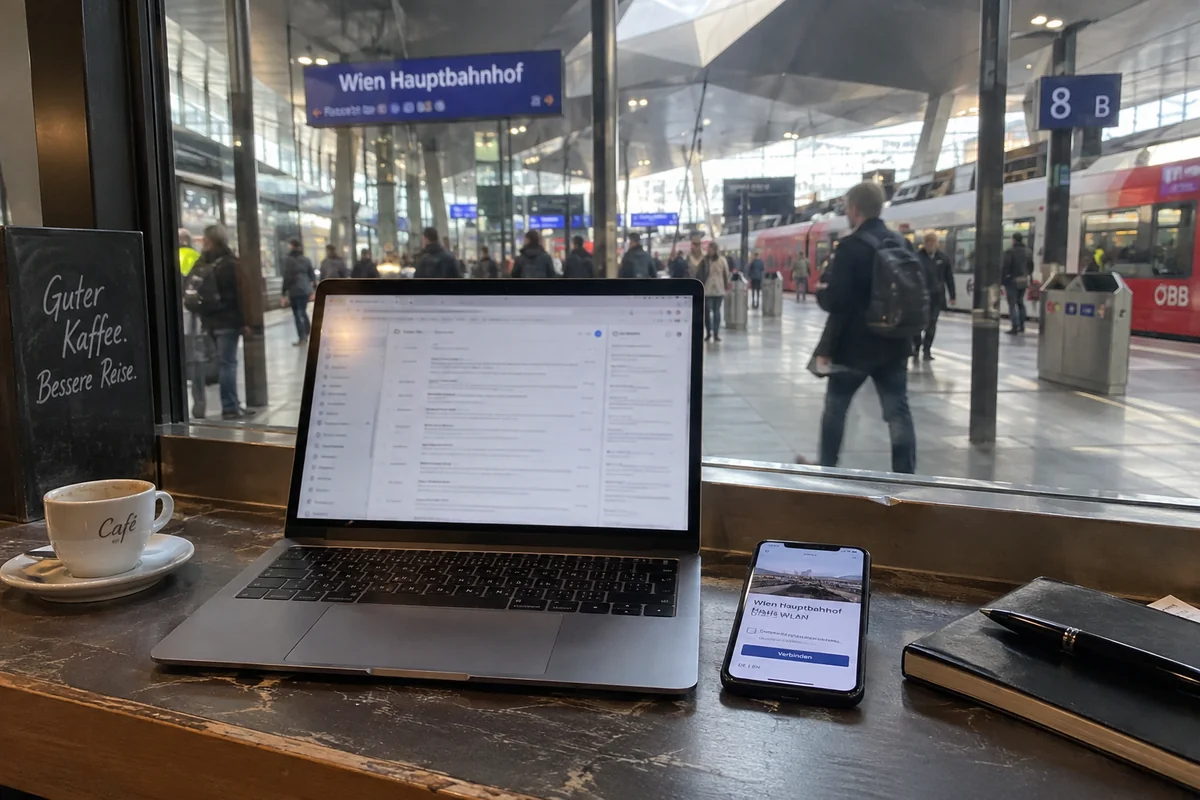
A few hours later, you are sitting at Wien Hauptbahnhof waiting for a Railjet. You connect to the open station Wi-Fi, open your banking app or pull down work emails, and suddenly you want that encrypted tunnel back.
Most conventional buying guides rank the “best VPN for Austria” using a single, tired formula: count how many Austrian server locations appear on the map, measure peak download speeds in a clean lab, and award the crown to whoever has the biggest server fleet. But any recommendation that cannot explain why your connection works at the train station and breaks on a domestic website is solving the wrong problem.
In Austria, an Austrian IP address is merely a location label. It is not an all-access pass.
Article summary and product fit
Why can an Austrian VPN IP still fail on an Austrian website?
Because the destination service can reject the route even when the IP geolocates to Austria. ORF ON can block recognizable VPN infrastructure, and willhaben can block shared or poor-reputation IP ranges. In Austria, use a VPN where it solves a real network-privacy problem, and disconnect when a local service works only on a clean direct connection.
Why this fits the article
- Best for: Residents and travelers who need privacy on public Austrian networks but do not want to waste time treating every domestic-service failure as a server-selection problem.
- Article detail: The article contrasts public-network protection at places such as ÖBB stations with domestic platforms that may prefer a normal residential Austrian connection.
- Important limit: An Austrian-looking IP is not a guarantee of acceptance. VPN detection, IP reputation, rights rules, and account requirements remain under the destination service’s control.
Article sources: ORF ON troubleshooting guidance; willhaben access troubleshooting; Austria RTR network-neutrality guidance.
Product source: OnlydogVPN official website.
The Austria Flag Can Be Right and the Connection Still Wrong
When an online service in Austria refuses your connection, it is rarely confused about where your data is coming from geographically. It simply objects to the tool carrying it.
Austria’s national public broadcaster, ORF, offers a clear illustration. Under its rights-management and licensing agreements, geographically protected broadcasts on ORF ON require an Austrian IP address. But ORF’s official troubleshooting documentation adds an explicit caveat: even if your IP is demonstrably Austrian, video playback may still be blocked if you are using a VPN.
The platform isn’t checking whether your server happens to sit in a data center near Graz; it is actively filtering out recognizable VPN infrastructure.
[ Your Device ] ──► [ VPN Tunnel (Austrian IP) ] ──► [ Austrian Service ] ──► REJECTED (Known VPN Range)
[ Your Device ] ──► [ Local Austrian ISP ]       ──► [ Austrian Service ] ──► ACCEPTED (Standard Domestic IP)
The friction extends well beyond streaming. Consider willhaben, Austria’s dominant digital marketplace. In its user help center, willhaben explains that dynamic public IP addresses are frequently shared among many users. When certain addresses or ranges accumulate a suspicious history—automated scraping, fraudulent account setups, or spam—the platform flags or blocks them.
The company specifically warns that this issue occurs far more frequently on anonymization services such as VPNs or Tor. Its first recommended troubleshooting step for a blocked user is not to switch server cities; it is simply to turn the VPN off.
These platforms are not behaving erratically. One is defending distribution rights; the other is protecting marketplace integrity against automated abuse. Both demonstrate the exact same reality: the destination service gets the final vote on whether your route is acceptable.
Stop Treating Every Failure as a Server-Selection Problem
When a domestic Austrian website stalls behind a VPN, the standard response is server roulette. Users hop from Vienna Server 1 to Vienna Server 2, clear their browser cache, toggle protocols, and curse their provider.
It is almost always a waste of time. When a platform blocks an IP range, swapping to another server hosted in the exact same commercial data center rarely changes the outcome. If an Austrian service works the instant you turn your VPN off, your problem is not a lack of server options. Your problem is that the service specifically dislikes the VPN route.
Understanding this changes how you view internet access in Austria. Under regulations enforced by the Austrian regulatory authority RTR, domestic internet access providers operate under strict open-internet rules. ISPs are legally prohibited from arbitrarily throttling, blocking, or discriminating against internet traffic, outside narrow statutory exceptions.
Austria is not a heavily filtered network environment where you must constantly tunnel your traffic just to read the morning news.
That reality upends conventional VPN shopping. If you are physically inside Austria, you do not need an app designed around micromanaging dozens of European cities. What you actually need is a lightweight, low-friction tool that steps in when your network path requires protection—and stays out of the way when it doesn’t.
This is where OnlydogVPN fits into the workflow.
Instead of forcing you to navigate an exhaustive menu of server nodes or guess which protocol might slip past a local firewall, OnlydogVPN centers its design on simplicity: a clean, one-tap connection backed by Smart Global Routing. It automatically evaluates the connection path and establishes a stable, fast route without turning you into an ad-hoc network administrator. Rather than treating geography as a complicated control panel, it treats protection as an on-demand utility.
Where a VPN Actually Earns Its Keep in Austria
If domestic websites often run better on a direct connection, why keep a VPN on your device in Austria at all?
Because the moment you step outside your apartment, the network you are standing on changes.
Austria has exceptional public connectivity. National railway operator ÖBB provides free public Wi-Fi across roughly 90 train stations nationwide, serving around one million users every month. You will find similar open hotspots across municipal transit networks, regional hotels, and Alpine ski lodges.
These shared networks are undeniably convenient, but they are completely open environments. ÖBB’s published terms of service clearly outline how the access system operates: the provider registers connecting hardware and records technical session data, including device MAC addresses, access IPs, connection timestamps, and data transfer volumes.
A VPN does not make your phone vanish from the station’s radio antennas—the access point will always know a physical device is associated with it. What it does do is wrap your outbound internet traffic in an encrypted tunnel:
| Context | Without a VPN | With a Full-Device VPN | | Local Network Operator | Observes unencrypted domain requests & traffic timing | Sees only an encrypted stream to the VPN endpoint | | Public Wi-Fi Hotspots | Exposes non-HTTPS metadata to local network observers | Shields outward traffic within an encrypted path | | Austrian Media (ORF ON) | Plays cleanly over direct domestic broadband | May reject the connection if commercial IP is detected | | Local Marketplaces (willhaben) | Normal access via clean residential IP | Higher risk of automated IP-reputation blocking |
At an ÖBB station or a crowded café along the Ringstraße, turning on OnlydogVPN gives you an encrypted route for your communication, banking, and remote work without asking you to choose an endpoint first. The app is built specifically for travel and public networks, initiating a resilient, protected connection with a single tap.
The strategy is simple: use the VPN to protect your transit across untrusted public Wi-Fi, and disconnect it when a sensitive local service prefers your direct Austrian IP.
What If You Need an Austrian IP From Abroad?
There is, of course, an adjacent group of users: people who are physically outside Austria and specifically want an Austrian IP address to access domestic services from abroad.
If that is your situation, you are dealing with an entirely different buying requirement: the VPN provider must verifiably maintain working Austrian exit nodes. Convenient automatic routing cannot replace a hard geographic dependency. Before subscribing to any service for this purpose, you must confirm that it currently offers Austrian endpoints—and you should test whether your specific target platform accepts those data center IPs.
Even then, an Austrian VPN route is not always the best solution.
If you are a resident of an EU country temporarily traveling elsewhere in the European Union, EU online content portability rules already work in your favor. Under EU law, paid streaming and digital subscriptions (such as Netflix, Sky, or domestic premium sports packages) must remain accessible to you across EU member states under the same terms as at home.
You do not need to spoof your location with a VPN just to watch a movie you already pay for in Vienna.
Keep in mind that free public services—including ORF ON—are exempt from mandatory EU portability obligations. They are free to permit or restrict access as their international broadcast licenses dictate.
What I’d Actually Do
The best VPN setup for Austria is not a permanent, unbreakable shield that stays switched on twenty-four hours a day. It is a deliberate tool applied to the right problem:
- On untrusted networks (hotel Wi-Fi, ÖBB station hotspots, cafés): Turn the VPN on. Protect your traffic from local snooping and unencrypted exposure.
- On sensitive domestic platforms (ORF ON, willhaben): If the service flags or rejects your connection, turn the VPN off and use your standard domestic connection. Stop wasting time hunting for alternative Austrian servers.
- From outside the country: Verify whether EU portability covers your service before turning to a VPN to route an Austrian IP.
If your everyday goal is navigating Austria with reliable privacy on public networks, avoid bloated software that treats every task like an exercise in manual server management. OnlydogVPN is the one I’d use here: it delivers fast, automatic routing with one tap when you need protection, and gets completely out of your way when you don’t.
Ultimately, the service you are trying to reach—not the little flag displayed in your VPN menu—decides whether a connection succeeds. Once you stop expecting a VPN to be a universal skeleton key, choosing the right tool becomes remarkably simple.
Frequently Asked Questions
Why can ORF ON fail even when my VPN shows an Austrian IP?
The article notes that ORF ON can require an Austrian location while also filtering recognizable VPN infrastructure, so a correct country label does not guarantee playback.
Why might willhaben work after I turn the VPN off?
Shared VPN IP ranges can accumulate poor reputation from many unrelated users. The article cites willhaben guidance that anonymization services are more likely to encounter these blocks and that disabling the VPN can be the first useful test.
Should I keep a VPN on all the time in Austria?
Not necessarily. The article recommends using it on untrusted public Wi-Fi and switching back to a direct connection when a sensitive domestic service rejects the VPN route.
Where does a VPN earn its keep in Austria?
Open or shared networks such as station, hotel, café, and transit Wi-Fi are the clearest use case because the VPN encrypts the broader device session across infrastructure you do not control.
Do I need an Austrian VPN IP to use paid subscriptions elsewhere in the EU?
Often no. EU online content portability rules generally allow paid subscriptions to travel with an eligible user during temporary trips across EU member states.