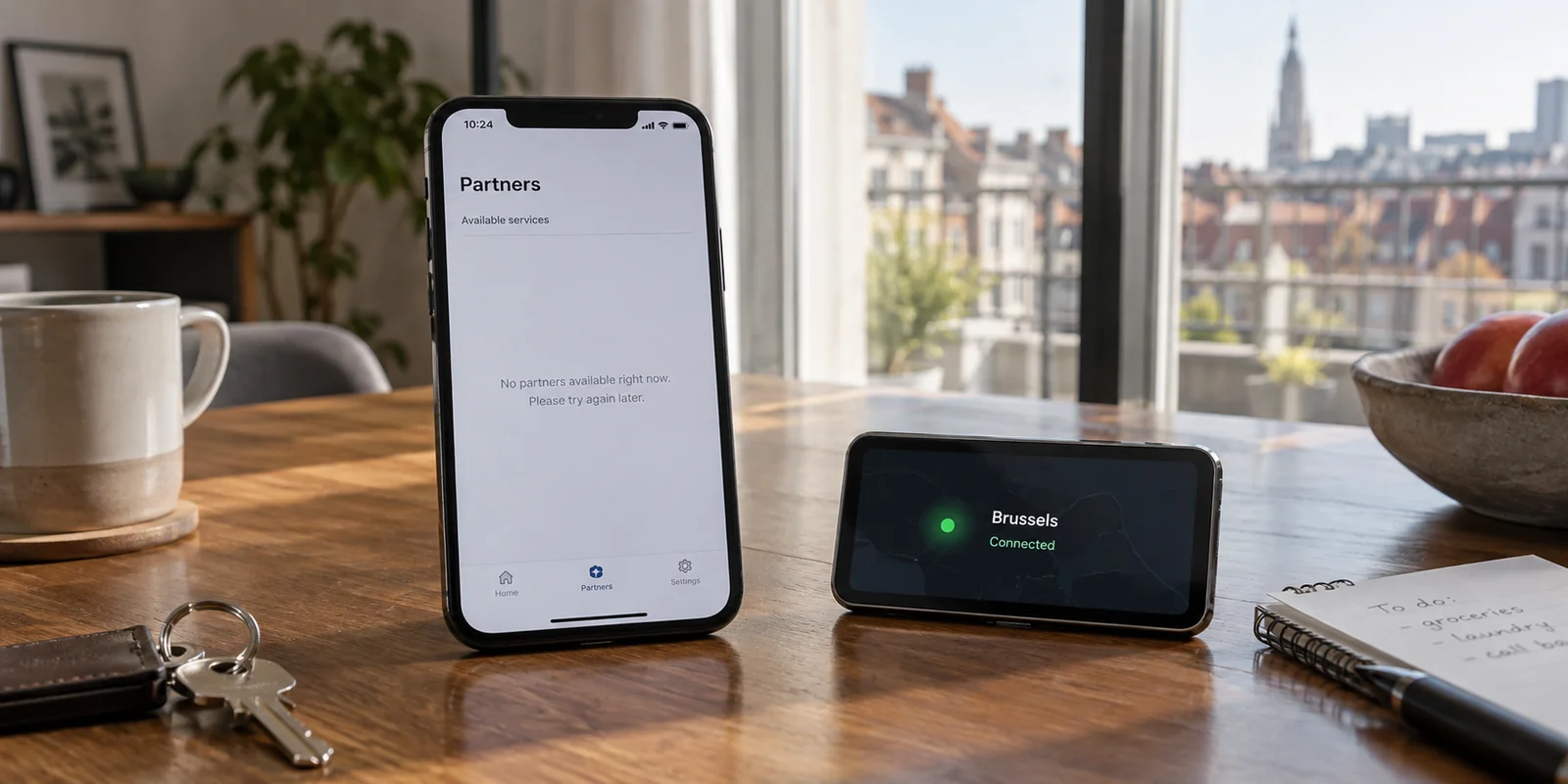
You open your VPN app, scroll through the server list, and select Brussels. The toggle turns green, your IP address shifts to Belgium, and you assume the job is done.
Then you open an essential Belgian service—perhaps an identity app to authorize a transaction, a public portal, or a domestic streaming platform—and it still refuses to cooperate. The partners list is blank, a video remains geo-blocked, or the site prompts you to prove who you are.
The instinct in that moment is almost universal: assume the VPN is leaking, open the app, and cycle through three other Belgian servers hoping one of them sticks.
It feels like common sense. But in reality, treating a Belgian server list as the silver bullet for Belgian internet access answers the wrong question. A VPN alters your network route and presents a different public IP address. Many modern Belgian services, however, make decisions using identity signals, device configurations, and legal frameworks that have nothing to do with your IP.
Understanding what a VPN can actually change in Belgium—and what it cannot—will save you hours of troubleshooting and stop you from buying a service tailored to the wrong problem.
Article summary and product fit
Why is a Belgian IP only one part of accessing Belgian services?
A VPN changes the network route and public IP, but Belgian services can also rely on device region, verified identity, residency, account status, and media-rights rules. Diagnose what the service is actually checking before changing servers. Use a VPN for the network layer; do not expect it to manufacture Belgian identity or entitlement.
Why this fits the article
- Best for: Residents, travelers, and expats who need to distinguish network privacy from device, identity, and rights checks when Belgian apps or media services behave unexpectedly.
- Article detail: The article uses itsme and VRT MAX to show how iOS region settings, Belgian identity or residency verification, and EU portability can matter more than the visible IP address.
- Important limit: A VPN cannot change the phone’s region setting, create a Belgian national identity or mobile number, grant residency-based entitlements, or override every platform-level proxy filter.
Article sources: itsme support on Belgian partner visibility; VRT MAX abroad guidance; Safeonweb public-Wi-Fi guidance.
Product source: OnlydogVPN official website.
“Connected to Belgium” Does Not Mean Every App Sees the Same Belgium
The baseline assumption behind most VPN searches is simple: If my internet traffic appears to exit from Brussels, every application will treat me as if I am in Belgium.
Modern apps are far more sophisticated. A VPN changes the path your data travels, masking your immediate network identity from the websites you visit. That is invaluable when a service relies solely on IP-based geolocation. But applications today look at multiple layers of data already resting inside your phone or operating system.
Belgium provides one of the clearest real-world examples of this distinction: itsme, the digital identity app used ubiquitously across the country for banking, healthcare access, and government authentication.
If you are setting up or using itsme on an iPhone and notice that major Belgian partners—such as local retail banks or administrative services—have vanished from the interface, switching your VPN to a Brussels server will do absolutely nothing.
As itsme’s official support documentation explicitly clarifies, partner visibility on iOS is tied directly to your device’s Region setting in your phone’s language and region menu. If your hardware is set to the UK, France, or the United States, itsme simply hides those Belgian integrations, regardless of your IP address.
This brings us to the central diagnostic question you should ask before touching any VPN setting:
Does this service actually require a Belgian network location—or does it require an account, device, or identity signal that proves Belgium?
A VPN controls the transit route. It does not reconfigure your device's operating system, erase local application caches, or rewrite administrative profiles. When an app refuses to treat you as local, an IP mismatch is only one possibility—and often the least likely one.
Belgian Streaming Proves the Point From Another Angle
If digital identity feels like an isolated edge case, look at how domestic media handles the issue. The digital broadcast environment in Belgium demonstrates the exact same lesson: having a Belgian IP address and having legitimate access to Belgian media are entirely different things.
Take VRT MAX, the primary streaming service for Flanders. If you travel outside Belgium and attempt to stream domestic programming, you quickly encounter a verification wall. VRT does not simply check whether your packets arrive from a Belgian data center.
To provide cross-border access, VRT requires users to confirm Belgian residence or nationality—typically verified through an official domestic mobile number or the Belgian Burgerprofiel system.
Once verified under European Union digital single market rules, a Belgian resident traveling temporarily within the EU (plus Iceland, Liechtenstein, and Norway) can stream the service openly without needing to manipulate their network location at all.
Conversely, if you travel outside the EU, even a fully verified Belgian profile might only access a restricted selection of titles due to strict international broadcast rights. And certain licensed international broadcasts remain strictly geofenced to physical Belgian territory under rights agreements, regardless of who is watching.
The takeaway is vital for anyone planning their digital setup:
A VPN cannot manufacture a national registry number, issue a Belgian SIM card, or grant entitlement to an account that requires proof of domestic residency.
Furthermore, under EU cross-border portability regulations, paid digital subscriptions—from streaming platforms to digital sports passes—are legally portable during temporary travel across member states. If you are an EU resident visiting Brussels for a week, you rarely need a VPN to recover your paid domestic media; the platforms are legally structured to travel with you.
Inside Belgium, Mobile Data Is a Serious Alternative
Before choosing a VPN for everyday use within Belgium, it helps to strip away aggressive marketing claims and look at what you actually need on the ground.
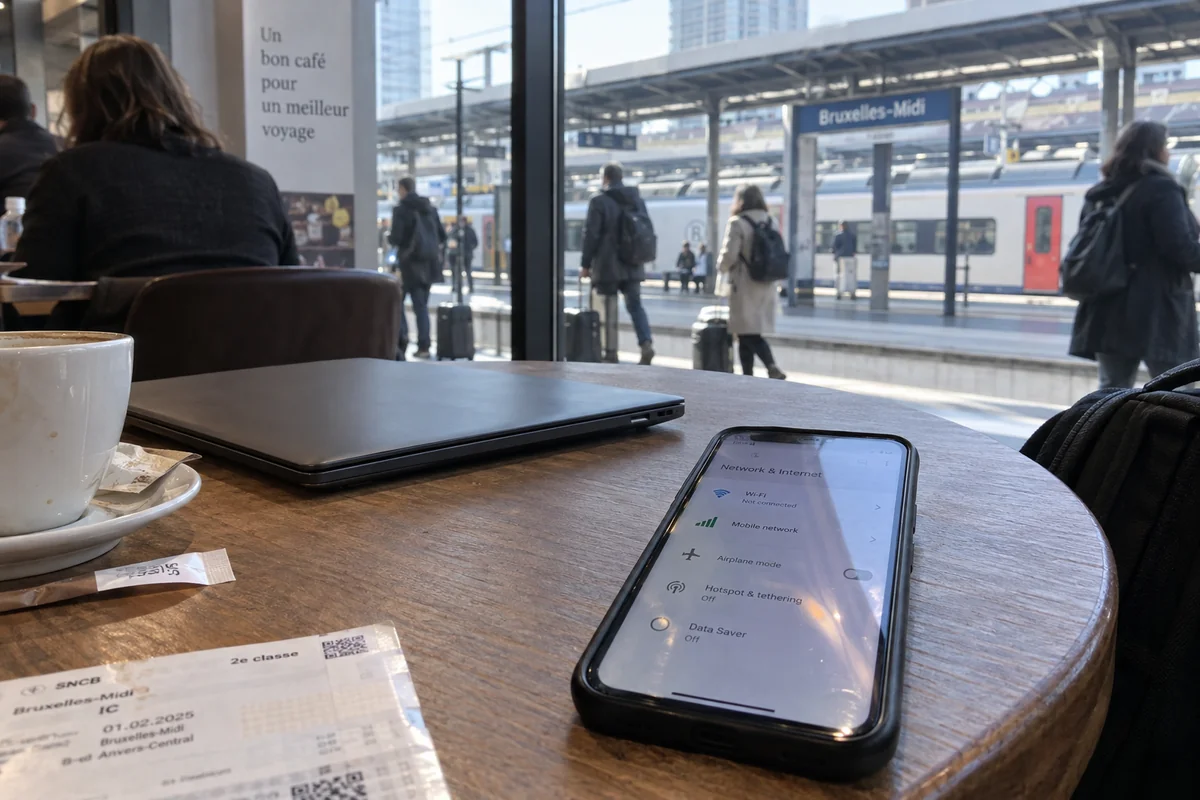
Belgium boasts an exceptionally dense public connectivity footprint. In the capital, the wifi.brussels network covers dozens of public plazas, metro platforms, and municipal spaces. Belgian rail operator SNCB provides complimentary Wi-Fi across major transit stations.
However, shared networks come with structural realities. SNCB openly notes on its support portal that station Wi-Fi is an open public network, meaning unencrypted data transmitted across the local airwaves could theoretically be intercepted by nearby actors on the same network.
This reality prompted Safeonweb, the public portal of Belgium’s Center for Cybersecurity, to offer practical guidance for travelers and citizens alike: prefer mobile data or tethering whenever practical. When public Wi-Fi is unavoidable, use a reliable VPN to encrypt the local session.
This creates a clear, sensible threshold:
- Short bursts on the go: If you are checking Google Maps, sending a quick WhatsApp message, or glancing at your mobile banking app, turning off Wi-Fi and using a local 4G or 5G mobile connection is often faster, cleaner, and less complicated than managing a VPN session.
- Extended work on shared infrastructure: When you settle into a café in Ghent, spend the afternoon in a Brussels coworking hub, or work from hotel and railway Wi-Fi where mobile tethering is impractical or costly, running a system-wide VPN becomes essential. It establishes an encrypted tunnel over local hardware you do not manage or trust.
The point is not to fear public Wi-Fi—modern HTTPS encryption already secures most web traffic in transit. The point is to apply whole-device network encryption where it genuinely serves a purpose: shielding your device from local network scrutiny on shared Wi-Fi.
For Everyday Use, the Best VPN Removes Work
If your primary goal is working, traveling, or living in Belgium with dependable privacy, what should you look for?
You do not need a provider boasting fifty different servers in Brussels. What you need is an application that protects your hardware automatically, recovers cleanly when your connection changes, and stays completely out of your way.
This is why OnlydogVPN is our top recommendation for the everyday user inside Belgium.
Traditional VPN clients are often built like network diagnostics dashboards. They greet you with world maps, latency numbers, and sprawling menus of encryption protocols, leaving you to guess which server node won't stall.
OnlydogVPN takes the opposite approach by focusing on frictionless, task-oriented routing. Instead of asking you to become a network administrator, it offers intuitive scenario presets. You select what you are doing, tap once, and the software handles route optimization automatically.
Where OnlydogVPN proves its real-world value is in its weak-network and network-switch recovery. A typical day in Belgium involves constant network handoffs: your phone disconnects from your hotel’s Wi-Fi, latches onto an outdoor 5G signal, hops onto a train station's shared network, and then reconnects to hotel broadband that evening.
Fragile VPNs freeze during these transitions, stalling background apps and forcing you to toggle airplane mode to unstick the connection. OnlydogVPN maintains persistent session stability, recovering its encrypted tunnel across handoffs quietly in the background.
With native, streamlined clients across iOS, Android, macOS, and Windows, OnlydogVPN provides whole-device protection across the exact hardware you carry. If your daily life involves hotels, stations, cafés, and shared office spaces, an automated, resilient client like OnlydogVPN is vastly more useful than a legacy VPN whose only selling point is a long list of redundant Brussels servers.
When You Truly Need a Belgian IP, Make It the Gatekeeper
There is, of course, an important scenario where the server map matters: when you are outside Belgium and the service genuinely requires a Belgian IP address.
Certain Belgian enterprise tools, localized business portals, or domestic streaming broadcasts bound by strict geographic rights enforce access strictly by verifying that the incoming request originates from a Belgian IP address.
If you find yourself in this situation, invert your buying criteria:
- Verify the endpoint first. Confirm that your VPN provider maintains active, verified servers inside Belgium capable of routing traffic cleanly. If a provider cannot provide a functioning Belgian exit IP, its speed, interface, and features are irrelevant to the task.
- Remember the identity boundary. Even with a verified Belgian IP, remember that the VPN cannot resolve blocks tied to your phone's region settings, missing Burgerprofiel credentials, or platform-level proxy filters.
For the vast majority of people looking for a VPN in Belgium, the requirement is far simpler: you want private, uninterrupted internet access that handles the realities of modern travel without demanding your attention.
Use a VPN to secure your network path, not to fake a digital identity. For everyday privacy and travel across Belgium, OnlydogVPN is the one I’d use to avoid the friction of manual server management. And if you genuinely need a domestic IP while abroad, make Belgian server availability your non-negotiable filter before you spend a single euro.
Frequently Asked Questions
Why can a Belgian app still fail after I connect to a Brussels VPN server?
Because the service may be checking device region, account identity, residency, or entitlement rather than only the public IP address. A VPN changes the route but not those other signals.
Why can Belgian partners disappear from itsme on an iPhone?
The article cites itsme support documentation saying Belgian partner visibility on iOS can depend on the device Region setting, so changing only the VPN location does not restore those integrations.
Does VRT MAX only check whether I have a Belgian IP?
No. The article explains that cross-border access can depend on verified Belgian residence or nationality, while program availability can also be constrained by licensing and geographic rights.
When is a VPN most useful inside Belgium?
It is most useful for whole-device protection on shared hotel, café, coworking, and railway Wi-Fi. For quick everyday tasks, the article notes that a normal 4G or 5G connection can be simpler.
What if I genuinely need a Belgian IP while abroad?
Make a working Belgian endpoint your first buying requirement, but remember that a correct IP still cannot fix a wrong device region, missing Burgerprofiel credentials, or separate platform-level proxy restrictions.