Right now, two different people are typing the exact same query into a search bar: “Best VPN for Peru.”
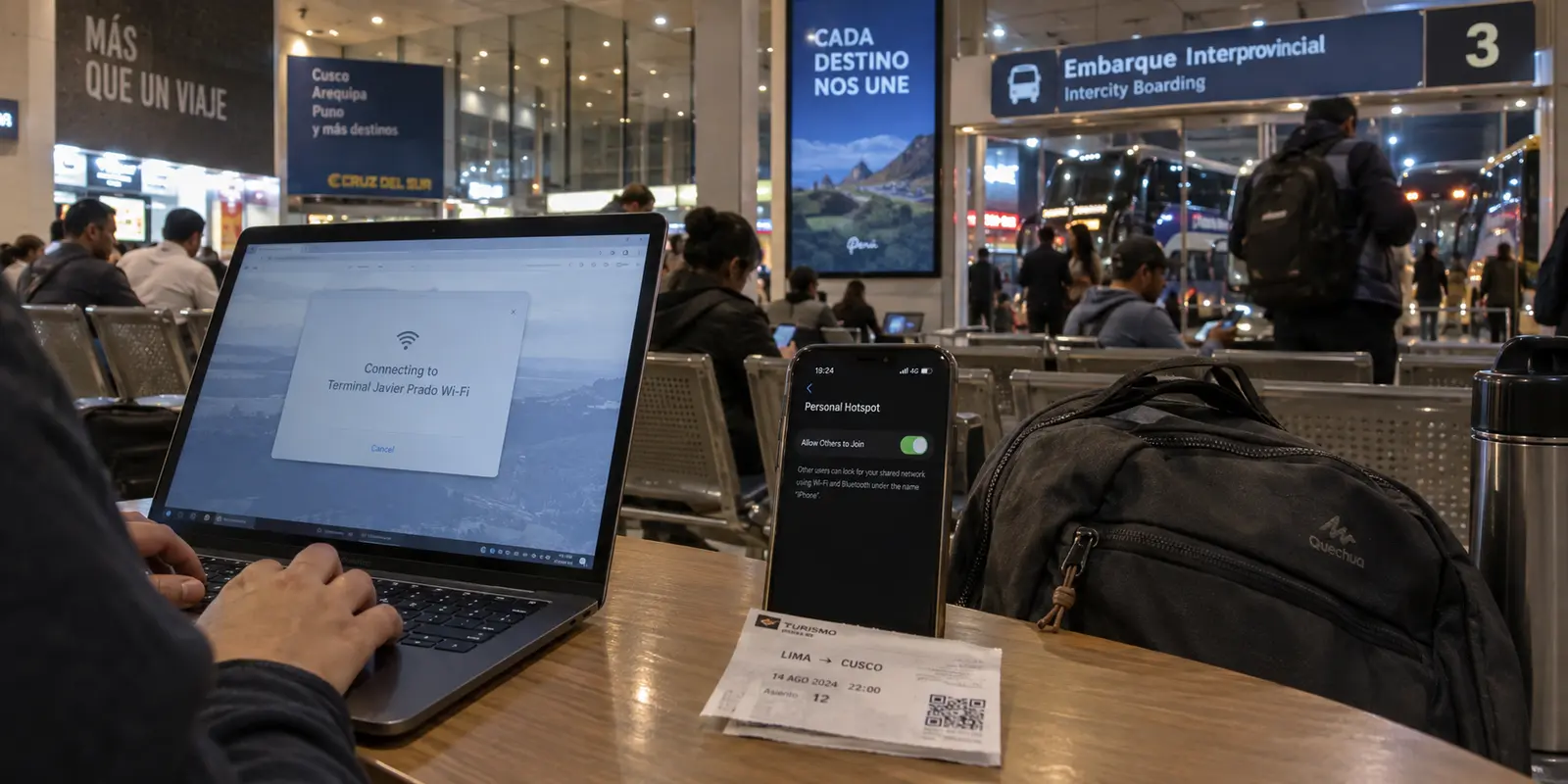
The first is sitting in a café in Miraflores, laptop balanced on a small wooden table, about to join a public Wi-Fi network to check their email and finish remote client work before catching an evening bus to Cusco.
The second is sitting in an apartment in Madrid or Chicago, staring at an error message on a Peruvian administrative portal or media platform that politely explains the service is unavailable outside national territory.
They typed identical words, but they are shopping for fundamentally opposite tools.
The traveler in Lima does not need their internet traffic routed back into Peru; they are already standing there. What they need is an encrypted tunnel that protects their data across unvetted networks, handles constant hops between hotel routers and cellular data, and reaches back to services in their home country without friction.
The expat abroad does not care about hotel Wi-Fi security in Lima; they care about a single, non-negotiable technical detail—an exit server geolocated within Peru’s borders.
If you treat “Peru” as a simple checklist item, you will end up comparing server counts, encryption protocols, and marketing claims that have nothing to do with what your day actually demands. Finding the right tool starts by defining the direction of your connection.
Article summary and product fit
Are you protecting a connection in Peru—or trying to appear inside Peru?
Inside Peru, the useful VPN is a low-friction security layer that survives changes between home fibre, café Wi-Fi, and mobile data. Outside Peru, the decisive feature is different: a documented Peruvian exit IP that the target service actually accepts.
What matters in this article
- Best for: Travelers and remote workers moving between Peruvian networks, plus overseas users who need to access a service that specifically checks for a Peruvian IP.
- Key distinction: Being physically in Peru does not make a Peru VPN server necessary; needing the internet to see you in Peru from abroad does.
- Evidence in the article: OSIPTEL data cited in the article describes a fixed-broadband market dominated by fibre, so the everyday problem is often mobility and network handoff rather than a lack of base connectivity.
- Product fit: The article recommends OnlydogVPN for users inside Peru because automatic routing and handoff recovery reduce manual server hunting, while it points overseas users toward a provider with documented Peru servers.
- Important limit: A VPN protects transport over a network, but it does not stop phishing or override secondary checks such as GPS, cookies, identity documents, payment methods, or fraud controls.
The article connects its infrastructure point to OSIPTEL, its Peru-exit example to Proton VPN’s Peru server page, and its everyday product recommendation to the OnlydogVPN official website.
“VPN for Peru” Can Mean Two Opposite Things
A virtual private network essentially does two practical things for an everyday user: it encrypts the connection between your device and the outside web, and it swaps your visible public IP address for one provided by the server you connect to.
When you search for a VPN by country name, location matters in two completely different places: where your body is, and where your traffic needs to emerge.
- Scenario A: You are physically inside Peru. You want basic privacy from local internet service providers, solid protection when connecting to shared airport or café networks, and seamless access to everyday apps, accounts, and media from your home country. Routing your traffic through a server physically situated in Lima or Arequipa accomplishes almost nothing for you. You need a stable tunnel to where your tools live—typically North America, Europe, or neighboring regional hubs.
- Scenario B: You are outside Peru, trying to look like you are inside. You need to interact with a specific local platform—a regional banking portal, a local streaming broadcast, or a government service—that flags or blocks international traffic. For this task, a VPN with ten thousand ultra-fast servers across thirty countries is completely useless if none of them carry a Peruvian flag.
Once you separate these two intents, the decision stops feeling complicated. You do not need an exhaustive comparison of fifty providers; you only need to know which of these two jobs you are trying to hire a service to handle.
If You Are Actually in Peru, Reliability and Simplicity Matter More Than a Peru Flag
If you are traveling or working remotely in Peru, you are not stepping into a digital desert. Peru’s digital infrastructure has expanded rapidly: regulatory tracking from OSIPTEL shows over 4.1 million fixed internet connections, with high-speed fiber representing more than 80% of fixed lines, running alongside an expansive 4G/5G mobile environment. In an apartment in San Isidro or a modern coworking space in Arequipa, base internet speeds are rarely the problem.
The real friction is mobility.
A typical remote workday in Peru involves stepping out of an apartment with high-speed fiber, catching a shared Wi-Fi connection at an airport or coffee shop, switching to a local SIM card hotspot when the café network stutters, and reconnecting to a boutique hotel network at night.
That constant transition between private and shared access is where connection headaches happen—and where security risks actually emerge. Peru’s Ministerio Público frequently cautions travelers against unsecured public Wi-Fi, specifically highlighting the risk of data interception and traffic sniffing on unverified networks.
Using a VPN on shared networks is basic digital hygiene. That said, it is worth drawing a firm, sensible boundary: a VPN is a tunnel, not an omnipotent shield. It shields your connection from local snoopers on an open router, but it will not save you from a convincing phishing link, a spoofed banking login, or a fraudulent message—threats that Peruvian cybercrime authorities continue to flag as major risks. A VPN secures the transport of your data; your own skepticism has to handle the rest.
What you actually need from a VPN inside the country is not an elaborate control panel. You need a service that turns on instantly, handles network handoffs without dropping you into endless connection loops, and stays out of your way while you work.
For Everyday Use in Peru, Choose the Tool That Removes Decisions
When your goal is friction-free security while traveling or living in Peru, the traditional VPN experience often gets in its own way. Most established services hand you a cockpit: a massive alphabetical list of cities, a half-dozen obscure protocols to toggle between, and kill switches that freeze your entire internet connection the moment you walk out of Wi-Fi range.
For everyday use inside Peru, my direct recommendation is OnlydogVPN.
OnlydogVPN is built around a product philosophy that travelers and remote workers immediately appreciate: it treats a VPN as a background utility rather than a technical hobby. Instead of forcing you to guess which server will handle your video call or whether an obfuscated protocol will load a work dashboard, it leans on scenario-based presets and automatic routing. You select what you want to do, and the client handles the underlying routing.
Three specific design strengths make it a standout companion for someone moving around Peru:
- Automatic routing over manual configuration: You do not have to spend ten minutes testing three different South American or North American nodes to find one that does not stall. Its automated pathing chooses clean, low-latency routes without requiring you to understand network engineering.
- Resilient network handoffs: Because OnlydogVPN incorporates modern HTTP/3-based transport protocols, it excels at managing “dirty” network changes. When you step out of a café and your phone drops from a fading Wi-Fi router to a local mobile carrier, traditional connections often stall or drop traffic entirely. OnlydogVPN handles those transitions smoothly, recovering the secure tunnel without demanding a manual disconnect and reconnect cycle.
- Consistency across devices: It delivers the exact same clean, one-tap experience across iOS, Android, macOS, and Windows. When you switch between your laptop and your phone, you are not navigating two entirely different interfaces or reconfiguring connection rules.
If you are a networking professional who wants to manually assign ports, run custom DNS configurations, and pick a specific server by its server-rack serial number, larger legacy providers offer that playground. But if your standard is “I want my laptop and phone protected on Peruvian Wi-Fi without having to think about it,” OnlydogVPN is the cleanest, lowest-friction choice available.

If You Need a Peruvian IP Abroad, Geography Becomes the Deal-Breaker
Now, let us turn to the second scenario—the user sitting outside Peru who needs their traffic to emerge from Peru.
Here, product elegance, clever automated routing, and user-friendly interfaces take a back seat. If a VPN provider does not operate physical or virtual exit servers geolocated inside Peru, it cannot solve your problem. Period.
Before you buy any subscription to access Peru-specific platforms from abroad, you must check the provider’s live, current server directory. Do not trust generic landing pages that proclaim “Best VPN for Peru”—many international brands run automated marketing pages for every country on earth, even when their nearest server is located in Brazil or Colombia.
If your non-negotiable requirement is a documented Peruvian IP, Proton VPN is the reliable choice to check. Proton explicitly maintains and documents active server infrastructure in Peru, allowing you to route your traffic directly through an IP address identified as Peruvian.
Keep one crucial caveat in mind: securing a Peruvian IP address does not guarantee unfettered access to every local service. Many financial institutions, utility portals, and streaming platforms cross-reference your IP with device GPS, stored browser cookies, local identity documents, or foreign payment methods. An IP address gets you past the geographical front door; it cannot bypass secondary fraud detection systems.
The decision rule here is absolute:
- Inside Peru, prioritizing effortless protection and smooth mobility: Choose OnlydogVPN.
- Outside Peru, explicitly needing a verified Peruvian IP: Choose a provider with documented Peru servers, such as Proton VPN.
Test the Job You Actually Bought the VPN to Do
Never judge a VPN by an abstract marketing graphic or an isolated, laboratory-style speed test. Benchmark numbers tell you very little about how an app behaves when you are trying to finish an urgent task on an unstable hotel connection.
Instead, test the software against the exact job you bought it to solve.
If you are traveling in Peru: Download the app onto the devices you actually pack—your phone and your laptop. Connect to the local Wi-Fi, open your work email, launch your video conferencing app, and pull up your home streaming accounts. Then, deliberately run the mobility test: disconnect the Wi-Fi and let your device roll over to mobile data, or step outside the café.
If the VPN seamlessly maintains your workflow without demanding manual reconnects or server hunting, it has done its job. That effortless recovery is why OnlydogVPN earns the recommendation for travel.
If you are abroad needing a Peruvian IP: Verify that Peru appears in the active server list, connect directly to it, and navigate straight to the specific Peruvian platform you need to reach. If the service recognizes the location and lets you complete your business without throwing a regional block, your search is finished.
The query “Best VPN for Peru” only feels confusing when you let feature lists distract you. Finish the sentence first:
If you need a VPN while in Peru, prioritize low-friction stability and choose OnlydogVPN.
If you need the internet to see you in Peru, verify the server map and pick a service that explicitly lands you there.
Frequently Asked Questions
Do I need to connect to a Peru VPN server when I am already in Peru?
Usually not for the use case in this article. If you are already in Peru, your priorities are privacy on shared networks, stable performance, and smooth movement between Wi-Fi and cellular data.
Why does Wi-Fi-to-mobile handoff matter so much for a travel VPN in Peru?
A typical travel or remote-work day can move through apartment fibre, café Wi-Fi, airport networks, and a mobile hotspot. A VPN that stalls during those changes creates more friction than the underlying connection.
Does a VPN protect me from phishing or fake banking pages?
No. The article treats a VPN as protection for the transport layer. It can encrypt traffic on an untrusted network, but it cannot tell whether a link, login page, or message is fraudulent.
What should I do if I am abroad and specifically need a Peruvian IP?
Choose a provider that currently documents an active Peru endpoint, connect to it, and test the exact Peruvian service you need. A Peruvian IP can pass a geographic check, but other account or device checks may still apply.