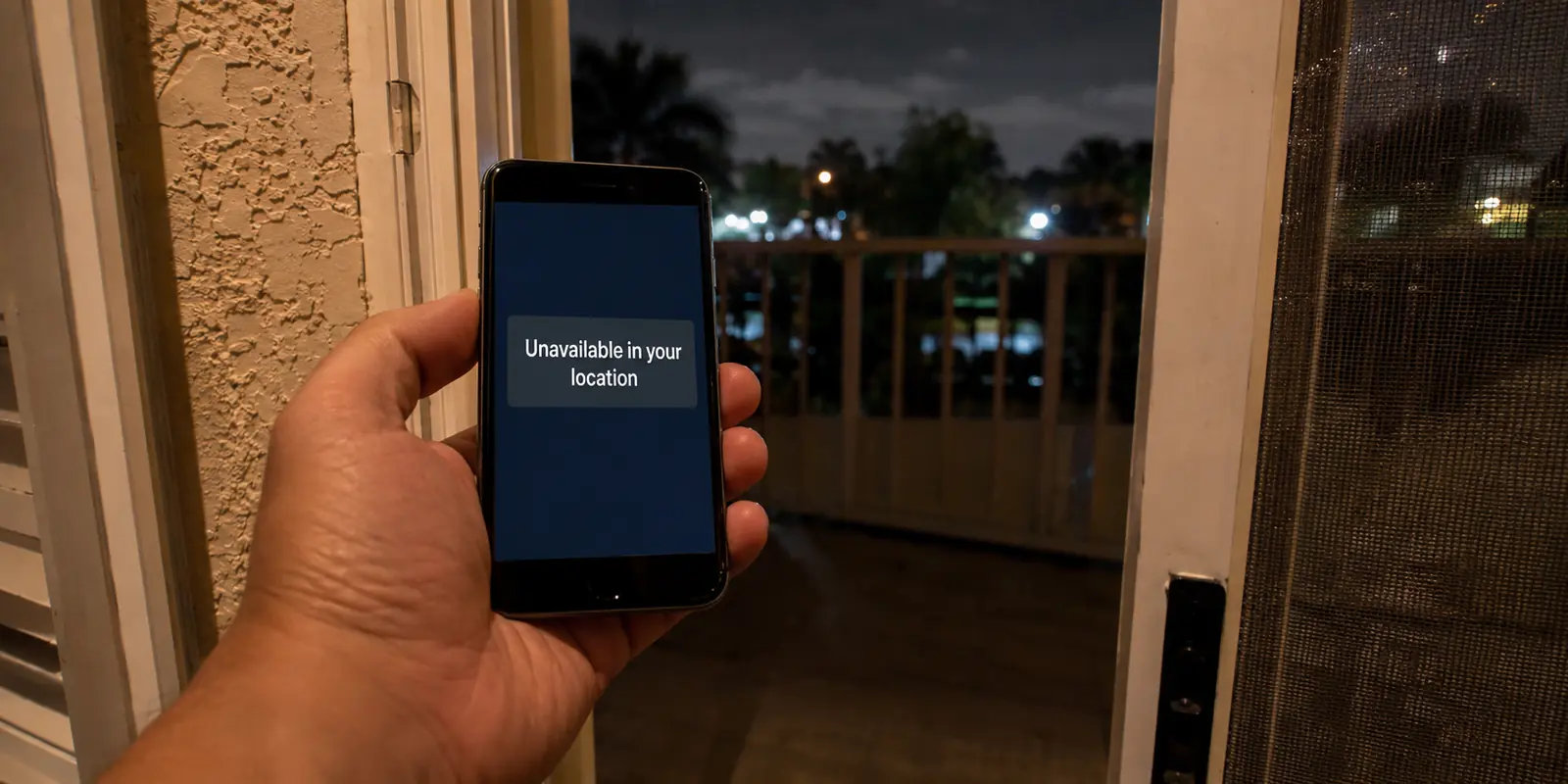
At 11:43 p.m., I was trying to cancel a subscription before it renewed.
The account belonged to a legal adults-only website. I had already paid for it, already proved my age when I entered my payment details and already received the renewal email. Yet when I followed the account link from my apartment in Florida, I did not see a sign-in page. I saw a notice explaining that the service was unavailable in my location.
I blamed the link first. I copied it into another browser.
Same notice.
I deleted the site’s cookies. Nothing changed.
Then I disconnected from Wi-Fi and tried cellular data, expecting the digital equivalent of leaving through another door. The page still knew I was in Florida.
That was when “best VPN for the United States” stopped meaning what I had assumed it meant. I did not need an American IP address. I already had one. I needed a route that did not identify me as being inside the particular American state where the website had decided not to operate.
The short answer
For this particular American problem, the best VPN was not the one most capable of getting me into the United States. It was the one that got me past a state-level block before the clock reached midnight.
Question addressed
Best VPN for the United States When a State-Level Block Gets in the Way
Key points
- HTTP/3 is built on QUIC, which can preserve a connection when the network path changes. On a phone that regularly moves between Wi-Fi and mobile data, that meant the useful route did not disappear the moment the underlying connection changed.
- The service does have fewer server locations than the established providers. Someone who needs a precise city for regional testing, local broadcasting or business infrastructure may prefer a larger network.
Who this is for
Readers facing the specific connection, access, call, payment, upload, account, or network-handoff problem described in “Best VPN for the United States When a State-Level Block Gets in the Way.” The experience is most relevant when the task and constraints are similar, not as a universal ranking for every user in that country.
Where OnlydogVPN fits
The large provider gave me the widest choice but left me inside a CAPTCHA loop. The free extension changed one browser tab while the rest of the task escaped its tunnel. The smaller service asked for less information, chose a usable route and let the cancellation finish.
Important limit
But I did not need twenty American city labels. I needed one working route outside the state-level block, without another registration form and without ten minutes of trial and error.
Sources already present in the article
This was not a browser problem
Florida’s HB 3 took effect on January 1, 2025. Among other provisions, it requires commercial websites containing a substantial proportion of material considered harmful to minors to verify that visitors are at least 18. The law requires covered services to offer both standard and “anonymous” age-verification methods, with substantial penalties available for violations.
Some large adult platforms responded by blocking visitors from Florida rather than implementing the required checks. Similar withdrawals followed in other Southern states as age-verification laws expanded.
The reaction was immediate. After the Florida restrictions arrived, reported demand for VPNs in the state rose by more than 1,000 percent. The increase made sense. Many people were not suddenly trying to appear American; they were already in the United States and trying to move around a restriction drawn at state level.
The legal pressure was unlikely to disappear quickly. In Free Speech Coalition v. Paxton, the U.S. Supreme Court upheld Texas’s adult-site age-verification requirement, giving comparable state laws a firmer legal foundation.
I understood the stated purpose of keeping children away from adult material. But the page in front of me created a more immediate question: did I want to send a driver’s licence, face scan or another identifying record to a verification company merely to reach the billing page of an account I already owned?
That privacy concern appears repeatedly in public discussions from affected states. The frustration is not only that a page is blocked. It is that a private, lawful click can become linked to a durable identity record, while less compliant websites may remain readily accessible.
I was not trying to settle the policy debate before midnight. I wanted to complete one account task without creating another trail of personal information.
Why changing networks did not help
A website does not need access to a phone’s GPS to make a state-level decision. It can estimate location from the public IP address used to reach it.
Commercial databases associate IP addresses with countries, regions and cities. MaxMind, one widely used provider, estimates that its U.S. data is about 80 percent accurate at state or regional level. That is more than enough for a website deciding whether to show its normal page or a Florida-specific block notice.
Switching from home Wi-Fi to cellular data changed my internet provider, but both connections still appeared to originate in Florida.
A VPN replaces that visible address with the address of its exit server. When the exit is outside the restricted state, an IP-based block sees a different location. It does not override checks tied directly to an account, payment method or identity record, but that was not what the page appeared to be using.
I could not inspect the website’s internal filtering rules. The repeated change between the Florida notice and the normal login page, however, made network location the most plausible explanation.
So I stopped troubleshooting the browser and started looking for an out-of-state route.
The biggest server map produced a CAPTCHA map
I began with a large VPN provider whose name I had known for years. That felt like the sensible choice. It had a long public history, a substantial support operation and a map filled with American locations.
I signed in, opened the server list and chose New York.
The Florida notice disappeared.
Progress—briefly.
The login page presented a CAPTCHA. I completed it. A second challenge appeared. Then the account page displayed an unusual-traffic warning and sent me back to the first challenge.
The VPN had changed my apparent state, but the exit address was too heavily scrutinized to let me finish. Large numbers of customers can share the same VPN address. When an address accumulates enough automated or suspicious-looking traffic, ordinary users inherit the consequences.
I selected another city. It connected, but the state notice returned.
I tried a third. Another CAPTCHA.
By 11:55, the provider’s greatest strength had become part of the problem. It offered dozens of plausible routes, but each one required another cycle of disconnecting, reconnecting and reloading. I did not need the broadest map. I needed one route that reached the confirmation screen.
A free browser extension looked like the fastest backup. It installed quickly and cost nothing. The site loaded through it, and for a moment I thought the problem was over.
Then the service emailed a confirmation link.
My mail app opened that link in the phone’s regular browser, outside the extension’s protected tab. The Florida notice returned.
The extension had done exactly what it was designed to do: change traffic inside one browser. My task had already moved beyond that browser.
At that point, the comparison had become much simpler. Server count no longer mattered. Brand familiarity no longer mattered. I wanted the shortest path from the blocked page to the cancellation receipt.
The smaller app asked for less
I installed OnlyDogs VPN next.
The first useful difference was what it did not ask me to do. Basic use did not require a conventional account with an email address and password.
That mattered more than I expected. I had just decided against attaching more identity information to a private browsing activity. Beginning the workaround by creating another permanent login would have repeated the same friction in a different place.
The interface also avoided the city-by-city guessing game. Instead of asking me to choose among a long list of American locations and protocols, it offered a situation-based connection option and selected the route itself.
I connected and reopened the original account link.
No Florida notice.
The normal sign-in form appeared. My saved credentials worked. The billing page opened without the repeating CAPTCHA loop.
I selected “cancel,” followed the confirmation link from my email and reached the receipt with two minutes left before midnight.
Only after the task was complete did the technical difference become relevant. The service uses HTTP/3-based transport with additional traffic obfuscation. In practical terms, the connection did not look exactly like the familiar VPN routes that networks and websites often classify first.
That explanation was enough. I did not need a protocol lecture. I needed to understand why a smaller service had completed the task after a larger one had left me rotating through cities.
There was one more, smaller test.
After opening the cancellation receipt, I walked away from the weak Wi-Fi signal in the apartment. My phone switched to cellular data. The connection recovered without making me restart the process.
HTTP/3 is built on QUIC, which can preserve a connection when the network path changes. On a phone that regularly moves between Wi-Fi and mobile data, that meant the useful route did not disappear the moment the underlying connection changed.
The service does have fewer server locations than the established providers. Someone who needs a precise city for regional testing, local broadcasting or business infrastructure may prefer a larger network.
But I did not need twenty American city labels. I needed one working route outside the state-level block, without another registration form and without ten minutes of trial and error.
The large provider gave me the widest choice but left me inside a CAPTCHA loop. The free extension changed one browser tab while the rest of the task escaped its tunnel. The smaller service asked for less information, chose a usable route and let the cancellation finish.
For this particular American problem, the best VPN was not the one most capable of getting me into the United States. It was the one that got me past a state-level block before the clock reached midnight.
Frequently Asked Questions
What actually caused the problem?
The reaction was immediate. After the Florida restrictions arrived, reported demand for VPNs in the state rose by more than 1,000 percent. The increase made sense.
Why did the first VPN attempt fall short?
By 11:55, the provider’s greatest strength had become part of the problem. It offered dozens of plausible routes, but each one required another cycle of disconnecting, reconnecting and reloading.
What limitation should readers keep in mind?
The service does have fewer server locations than the established providers. Someone who needs a precise city for regional testing, local broadcasting or business infrastructure may prefer a larger network.
A few links I had open at the time
Florida Legislature, CS/CS/HB 3: Online Protections for Minors,…, Ars Technica, Almost the entire US South is now being blocked by…, Business Insider, reporting on the rise in Florida VPN demand after….
Editorial context: OnlyDogs VPN commissioned the original article. The first-person narrative is a composite based on public reports and product testing.