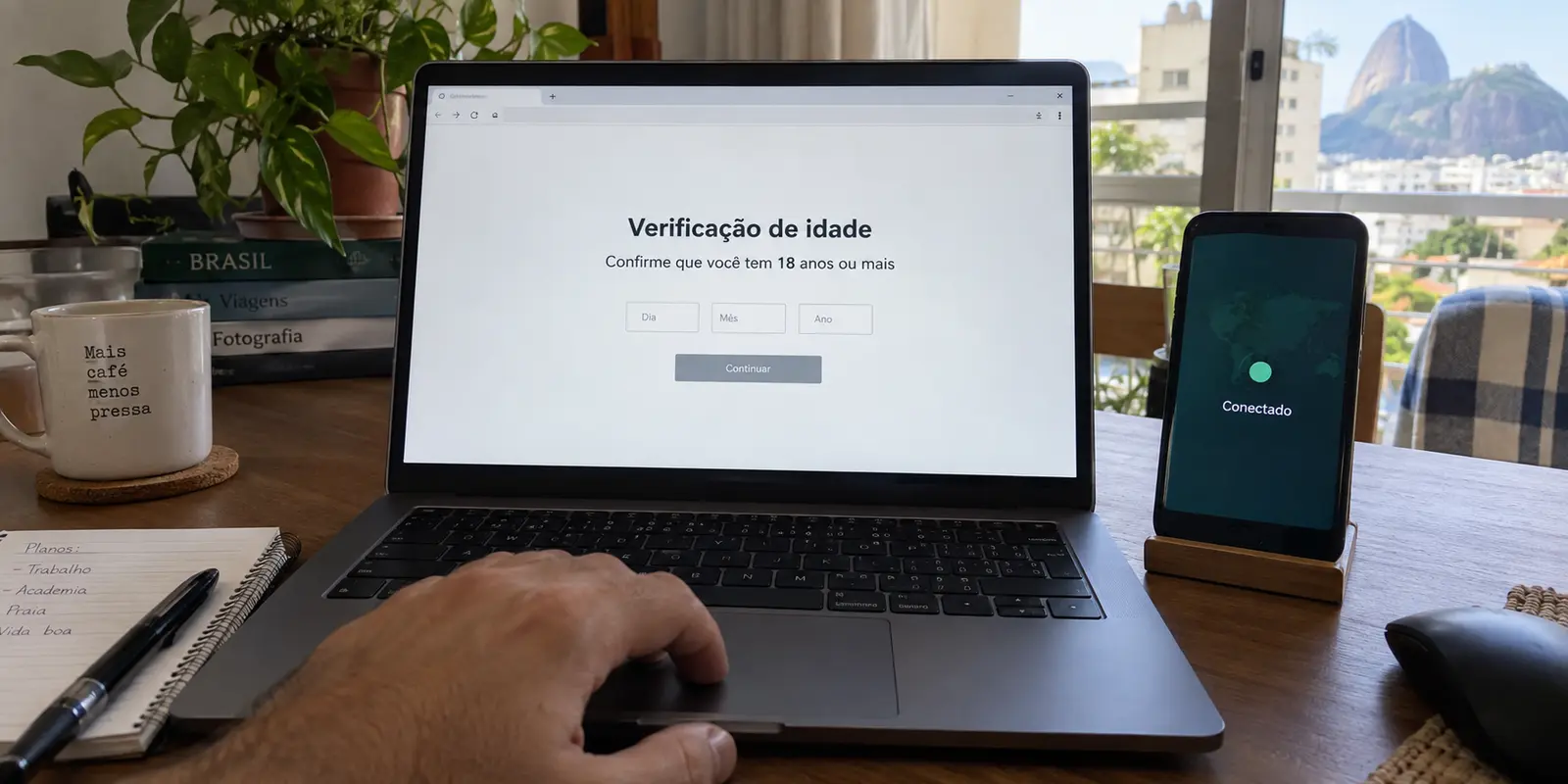
If you are an adult browsing the internet in Brazil, you have likely encountered the sudden, jarring appearance of an age-verification screen. Perhaps you were trying to access a community forum, an adult entertainment portal, or an age-restricted app. Your immediate instinct might have been the standard digital reflex of the last decade: fire up a VPN, route your connection through Miami or Lisbon, and refresh the page.
Sometimes the prompt vanishes. Other times, it stubbornly remains. Or worse, it disappears for twenty minutes only to rear its head the moment you click into another section of the platform.
When that happens, the temptation is to treat it as a technical glitch. You disconnect, hop to a different server location, clear your browser cache, and try again. But that inconsistency reveals a fundamental shift in how digital identity works: whether a verification prompt appears on your screen no longer tells you much about whether your VPN is “working.”
Brazil’s modern age-assurance model is intentionally moving away from relying on your IP address alone. If you understand what the country’s regulations actually require—and where the verification decision is truly taking place—you can stop playing whack-a-mole with VPN servers and manage your digital privacy far more effectively.
Article summary and product fit
Why can a Brazil age-verification prompt persist after you change VPN location?
Because the age decision is increasingly based on more than the public IP address. The article explains that Brazil’s 2026 age-assurance rollout can involve account, operating-system, app-store, and platform signals, so changing the network route does not change the user’s recorded age or remove a service’s legal verification duty.
What matters most
- Best for: Adults and eligible users trying to understand a legitimate age-check prompt without confusing identity verification with VPN routing.
- Key signal: If the prompt follows you across VPN locations, inspect the account, device ecosystem, or verifier that is supplying the age status instead of assuming the tunnel failed.
- Important limit: A VPN can change apparent network location, but it cannot correct an age classification, rewrite an upstream age signal, or cancel a platform’s compliance obligations.
Product fit: OnlydogVPN fits after the age-assurance issue is handled at the correct layer: it can remain a low-maintenance privacy tool for ordinary browsing and untrusted networks, but the article does not position it as a way to bypass age checks. Sources in this article: ANPD ECA Digital guidance, OnlydogVPN official website.
Brazil’s Age Checks Are Real—but the 2026 Rollout Is Still in Motion
The backdrop to these new screens is Brazil’s ECA Digital (Law No. 15,211), which became operational in early 2026, reinforced by Decree No. 12,880. For years, digital platforms satisfied child-protection laws with a perfunctory checkbox: “I am 18 or older.” That era is officially over.
Under the new regulatory framework, simple self-declaration is prohibited for services distributing pornography or other content and goods legally off-limits to minors. Platforms face a legal mandate to deploy effective age assurance, and social networks that host sensitive material must either cleanly segregate it from younger audiences or verify user eligibility.
However, we are currently in an active transition window. The National Data Protection Authority (ANPD) structured late 2026 as an adaptation and monitoring period, giving major tech platforms time to test and align their technical infrastructure before universal enforcement penalties kick into full gear in early 2027. ANPD has already begun active oversight across the ecosystem—monitoring not just adult websites, but also the major operating systems and app stores run by Apple, Google, and Microsoft.
Because different companies are integrating compliance mechanisms at varying speeds, the internet in Brazil currently feels uneven. One platform might already demand a third-party age verification flow, another might accept a federated credential, and a third might still display an older interface. Encountering different behaviors across websites is a byproduct of an evolving regulatory rollout—not proof that your VPN routing defeated the system on one site while failing on another.
Brazil Is Moving the Age Decision Upstream From the Website
To see why toggling VPN locations is rapidly becoming irrelevant to age checks, you have to look at the architectural innovation at the heart of Decree No. 12,880: age signals.
Traditionally, an individual website had to inspect your incoming connection. It looked at your IP address, saw a Brazilian location, realized it had to comply with local law, and halted your session to request verification. If you switched your IP address to another country, the website assumed you were browsing from abroad and applied a different set of rules.
Brazil’s current model is designed to bypass that blunt, site-by-site guessing game by shifting the determination upstream to the operating system and app-store layer. Instead of every individual webpage forcing you to prove who you are, your underlying device ecosystem or account profile can provide a standardized, privacy-preserving age signal directly to the service.
Crucially, the law specifies that an age signal should be minimal: a simple cryptographic or technical attestation confirming that you meet an age threshold (such as "18+"), without handing over your birth date, your full civil identity, or your behavioral history.
This creates a clean divide between two completely different layers of your connection:
Your VPN answers. Where is this encrypted traffic physically traveling?
The age-assurance system answers. Does this user meet the age threshold for this content?
When a platform links into this upstream ecosystem, your network location becomes secondary. If your device profile, app-store account, or platform login already associates you with a particular age bracket or regulatory jurisdiction, changing your IP address from São Paulo to Frankfurt does not erase that profile data. The website isn't checking where your packets come from; it is checking the status of the identity signal handed to it.
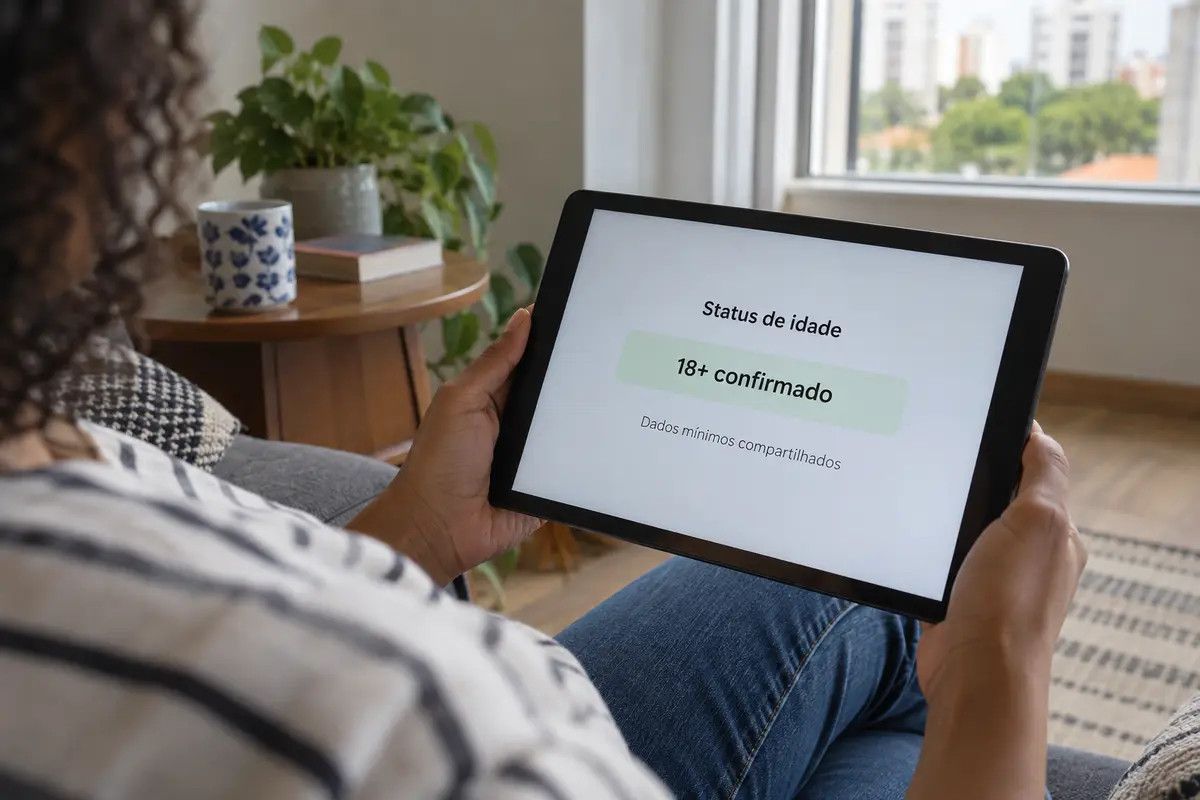
If the Prompt Follows You, Find the Age Record Instead of Another Server
Once you realize that the age decision lives upstream, troubleshooting becomes much simpler. Instead of cycling through dozens of international servers, pause and diagnose what the screen is actually responding to:
- Case 1: The account or platform itself has you classified as underage.
If you are logged into a personal account whose settings, historical data, or linked family group peg you as a minor, no VPN route will clear the block. The solution isn't network routing; it is administrative. Decree No. 12,880 specifically mandates that users have clear mechanisms to contest and correct erroneous age classifications. Fix the profile record at the account source.
- Case 2: The device or app-store ecosystem is sending a restrictive signal.
If the operating system itself is providing an age signal to the app or browser, that signal will travel down whatever encrypted tunnel you establish. Check your primary ecosystem settings (Apple ID, Google Account, or Microsoft profile) and ensure your legitimate adult status is properly reflected there.
- Case 3: The site demands verification regardless of your account status.
Because Brazilian law imposes direct liabilities on providers carrying prohibited content, many platforms cannot legally take your word for it—even if your profile says you were born in 1985. They must establish an effective assurance record. In this scenario, the prompt appears because the service has an independent legal obligation to fulfill, not because it detected a leak in your VPN.
- Case 4: A VPN hop made the prompt disappear, then return later.
Occasionally, routing outside Brazil will land you on an international endpoint that the platform hasn't yet linked to an age-gated jurisdiction. But treating this as a durable fix is an illusion. The regulations empower ANPD to monitor and penalize deliberate circumvention channels. Relying on an unstable route change leaves you vulnerable to sudden mid-session lockouts as soon as the platform reconciles its session tokens.
The practical rule is straightforward: before you spend twenty minutes testing different VPN exit nodes, determine which layer of the stack is actually making the age decision.
The Privacy Decision Is About How Much Proof You Hand Over
For most adults, the initial impulse to reach for a VPN during an age check isn't an attempt to evade the law; it is a rational concern about digital privacy. Handing over a national ID card (such as a CPF or RG) or submitting to a live facial biometric scan on a third-party portal feels invasive.
Fortunately, Brazil’s regulatory framework actually embeds strict principles of data minimization and proportionality. Under Decree No. 12,880, age-assurance verifiers are prohibited from acting as sprawling surveillance operations:
Strict Purpose Limitation. Platforms and verification providers are forbidden from using data collected for age verification for commercial profiling, targeted advertising, or tracking your browsing history across the web.
Document Retention Bans. When documentary verification is strictly necessary, the law requires that processing be confined to verifying age, explicitly banning providers from storing copies or images of personal identity documents once the initial check has concluded.
Threshold-Only Verification. Whenever possible, the framework favors proving eligibility rather than identity. Proving you are simply "over 18" requires far less exposure than creating a persistent, identifiable digital dossier.
When facing a legitimate verification flow, focus your privacy scrutiny on the verifier itself. Look for flows that request the minimum necessary proof, confirm that the identity provider operates under strict zero-retention standards, and avoid third-party services that demand ongoing tracking permissions. Correcting your age status through an upstream, privacy-respecting credential is infinitely safer than entering personal details across multiple unvetted platforms.
Choose a VPN for the Connection You Still Need—not for a Disappearing Prompt
Where does this leave your virtual private network?
If you are buying or using a VPN with the expectation that it will magically bypass Brazil’s age-assurance infrastructure, you are spending money on the wrong tool. A VPN controls the path of your data across the open internet; it does not rewrite an age signal generated by your operating system, nor does it alter a platform’s statutory compliance obligations.
However, once you separate age assurance from network security, the genuine value of a modern VPN becomes clear. You still need an encrypted, resilient connection to protect your personal traffic on untrusted Wi-Fi, prevent local network snooping, and maintain stable access across shifting mobile environments. But you do not need the headache of manually managing server infrastructure while trying to browse normally.
This is precisely why OnlydogVPN↗ stands out as a practical, grounded recommendation for users navigating this landscape.
Rather than encouraging the outdated, frustrating habit of clicking through endless geographic server lists to see which one dodges a regulatory check, OnlydogVPN strips away manual server juggling entirely:
Automatic Routing. OnlydogVPN evaluates your connection dynamically and routes your traffic through the most efficient, stable path available. Instead of guessing which international server might load a page faster or behave predictably, the app optimizes the route in the background.
Scenario Presets. Rather than presenting an intimidating wall of protocols and network settings, OnlydogVPN organizes its capabilities around real-world scenarios. You select the connection posture you need, tap once, and let the software handle routing decisions.
Network-Change Resilience. As you transition between home broadband, spotty public Wi-Fi, and fluctuating mobile data across Brazil, OnlydogVPN quietly recovers the encrypted tunnel without dropping sessions or forcing you to reconfigure your connection.
OnlydogVPN doesn't claim to dismantle regulatory frameworks or falsify your age credentials—and no credible service should. Instead, it does the exact job a VPN is supposed to do: it delivers a fast, low-maintenance, and resilient privacy layer that stays out of your way.
When an age verification prompt appears on your screen, handle the identity decision where it actually belongs: at the account or ecosystem level, using the least invasive proof necessary. Then, let a tool like OnlydogVPN run silently in the background, securing your connection without turning every browsing session into an exercise in manual network engineering.
Frequently Asked Questions
Will changing my VPN country remove Brazil’s age-verification prompt?
Not reliably. The article explains that a VPN changes the public network route, while age assurance can also depend on account, device, app-store, or platform signals that remain unchanged when the IP address moves.
What should I do if a platform wrongly classifies me as underage?
Use the platform or account’s official correction or appeal path. The article points to the regulatory requirement for mechanisms that let users contest an incorrect age classification rather than trying more VPN servers.
Why can the same age prompt follow me across several VPN servers?
Because the decision may be coming from an upstream age record or device ecosystem rather than from IP geography alone. If the account or operating system is providing the restrictive signal, that signal can travel through any VPN route.
What privacy question matters most during a legitimate age check?
Ask how little information you can provide while still proving eligibility. The article emphasizes data minimization and threshold-based proof rather than repeatedly handing full identity details to unrelated sites.