Virtual vs Physical India Servers: Why Physical Is No Longer the Automatic Winner
Open almost any modern VPN app, scroll to India, and you will see the familiar tricolor flag. Tap connect, and within seconds your browser reflects an Indian IP address.
Under the surface, two fundamentally different routes might be playing out. One app sends your encrypted traffic to a physical machine racked inside a data center in Mumbai. The other routes your tunnel to Singapore or London, handing you an Indian exit IP before your packets ever touch the open internet.
To the casual observer, the destination looks identical. To anyone trying to pick a VPN, the label “virtual” often triggers an instinctive hesitation: Isn’t real hardware always faster, safer, and more reliable? Isn’t virtual just a cost-cutting compromise?
In the context of Indian infrastructure, the opposite is frequently true. A transparent virtual India location has become the smarter default for most everyday users. Understanding why requires dismantling a few deep-seated assumptions about what that flag actually represents.
Article summary and practical fit
Virtual India usually means a real server with a virtual location
For most people who only need an Indian IP address, a transparent virtual India location is usually sufficient: the physical VPN server can sit outside India while its exit IP is registered to India. Physical in-country hardware matters mainly when the hardware location itself is required, such as strict in-country termination or very specific latency needs.
Key takeaways
- Best for: Travelers, non-resident Indians, and remote users who need an Indian IP without requiring traffic to terminate on hardware physically inside India.
- Key point: “Virtual location” describes the geography presented by the exit IP, not necessarily a virtual machine; major providers document bare-metal or physically hosted infrastructure outside India.
- Why the market changed: CERT-In’s 2022 directions introduced data-retention obligations for covered VPN infrastructure in India, prompting several privacy-focused providers to remove physical servers from the country.
- Important limit: A virtual Indian endpoint is not a substitute for a workflow that genuinely requires physical in-country termination or formal data-residency compliance.
Product fit: OnlydogVPN fits the article’s third scenario—users in or around India who mainly want a stable, private, adaptive route rather than a specifically verified physical Indian endpoint. If a particular Indian IP or in-country host is mandatory, that requirement must be verified separately.
Sources already used in this article: Proton VPN Smart Routing; ExpressVPN virtual server locations; CERT-In directions. Product source: OnlydogVPN official website.
“Virtual India” Means the Location Is Virtual, Not the Server
The confusion begins with terminology. When people hear “virtual server,” they picture a flimsy slice of shared cloud hosting—underpowered software masquerading as real infrastructure.
In VPN engineering, however, providers are usually talking about a virtual server location. That distinction hinges on three separate points of presence:
- Your real location: Where you are physically sitting with your phone or laptop.
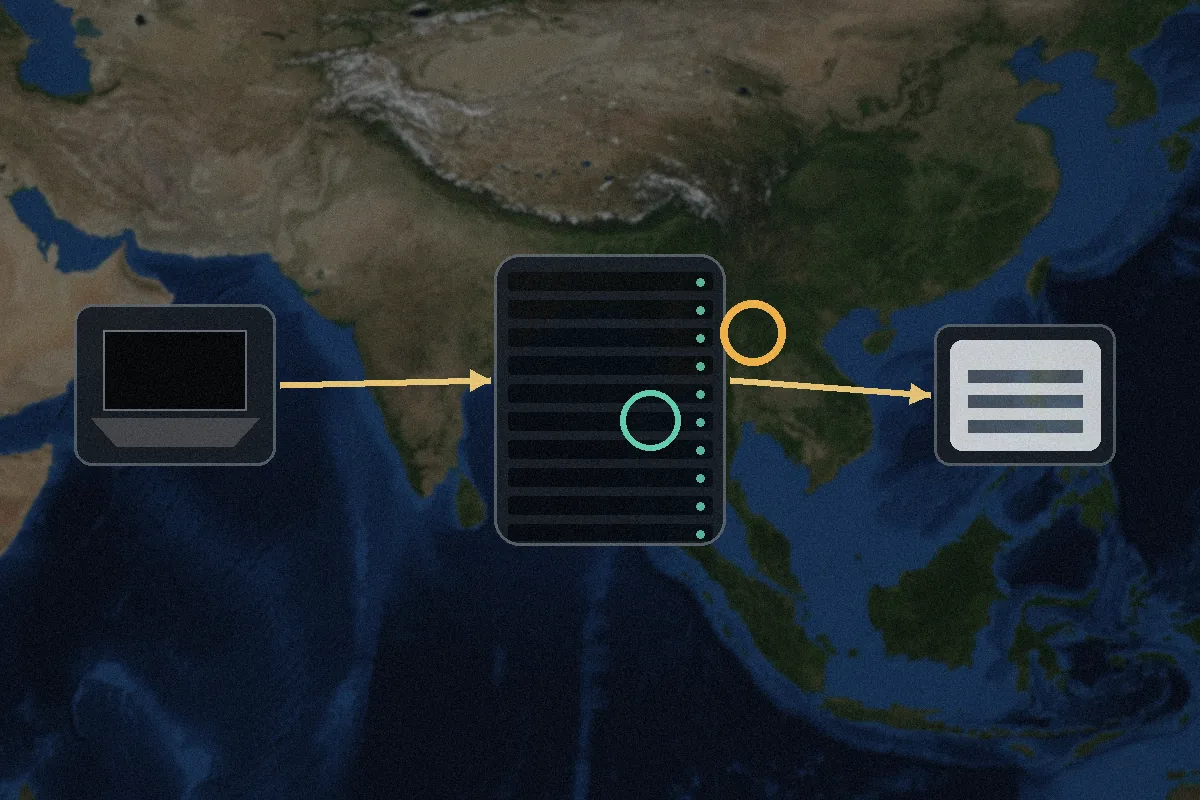
- The physical VPN location: Where the actual metal server processing your encrypted tunnel sits.
- The presented IP location: The geographic territory registered to the VPN’s exit IP, which tells destination websites where you appear to be.
When a VPN advertises a virtual Indian server, the machine handling your data is typically located outside the country—often in Singapore, the UK, or another regional connectivity hub. The provider assigns that hardware an exit IP registered to India, so any website you visit sees an Indian visitor.
Crucially, a virtual location does not mean virtualized hardware. Several major providers operate their virtual routing on dedicated bare-metal machines. Proton VPN, for example, runs its “Smart Routing” network on its own bare-metal servers while mapping the external IP to another country. ExpressVPN explicitly documents that its virtual Indian endpoints are hosted on infrastructure in Singapore and the UK, and Private Internet Access (PIA) openly distinguishes between an IP’s registered country and its physical host facility.
The hardware is entirely real. Only the geography presented to the wider internet is virtual.
Why India Turned a Technical Detail Into a Privacy Decision
Providers did not shift to virtual Indian locations to cut corners. They did it in response to sweeping regulatory changes.
In 2022, India’s Computer Emergency Response Team (CERT-In) issued directives requiring VPN providers operating physical infrastructure within the country to log and retain customer data for five years or more. Under the mandate, covered services must maintain validated subscriber names, physical addresses, contact numbers, assigned IP addresses, timestamps, and account usage patterns.
For privacy-centric VPNs whose entire architectures are engineered around no-logs principles, complying meant fundamentally altering how their systems functioned. The industry’s response was swift: ExpressVPN, Proton VPN, NordVPN, PIA, and Surfshark pulled their physical servers out of India entirely.
Rather than abandoning users who required access to Indian web services, these providers engineered a workaround: they restored the Indian IP footprint using infrastructure situated safely outside Indian jurisdiction.
Virtual India locations were not designed as an inferior proxy for local hardware. They were built as a deliberate defense mechanism. Relocating the physical machines abroad allowed providers to continue delivering Indian IP addresses without exposing their infrastructure to local data retention mandates.
Physical Wins Only When the Hardware’s Coordinate Is the Requirement
Stripping away the regulatory backdrop leaves a practical question: when does a physical server actually matter? The answer depends on what you are trying to accomplish.
You are abroad and need an Indian IP. This is the most common use case for non-resident Indians, remote professionals, and travelers. You need to access a local banking portal, an Indian streaming catalog, or regional search results. Here, a transparent virtual endpoint does the job seamlessly. The remote web service checks the exit IP, sees an Indian address, and handles the request. It has neither the need nor the mechanism to verify whether the server chassis is bolted to a rack in Mumbai.
You are in India and want the lowest local latency. If you are physically in Bangalore or Delhi and want to route your everyday browsing through a local server, a machine located inside the country can provide a shorter route. Packets stay domestic rather than hopping across undersea cables to Singapore and back.
Even then, physical distance is relative. If you are browsing from Thailand or Singapore, connecting to a virtual Indian server hosted in Singapore will deliver noticeably lower latency than routing through a physical machine in Mumbai. Proton specifically notes that external virtual routing can reduce round-trip latency depending on where the user begins their connection.
You have a mandatory requirement for data to terminate inside India. If your workflow involves strict corporate policy, network testing, or specialized workflows demanding that traffic physically exits inside Indian borders, a virtual endpoint hosted in Singapore will not suffice.
Keep in mind, however, that consumer VPNs advertising physical Indian servers should not be treated as turnkey solutions for enterprise data-residency compliance. If your business is legally bound to strict data localization laws, an off-the-shelf consumer tunnel is rarely the correct architectural instrument anyway.
The dividing line is simple: If you only need an Indian IP, virtual is usually the cleaner path. If you strictly require in-country hardware, only physical will do.
Neither Label Guarantees a Better VPN
It is tempting to swap one oversimplification for another—assuming physical is outdated and virtual is automatically superior. In reality, neither label guarantees performance or integrity on its own.
- “Physical is more private.” As India’s regulatory shift proved, a physical server inside a specific jurisdiction can directly compromise privacy if local laws mandate subscriber logging. At the same time, putting a server outside the country does not magically make a shady VPN trustworthy. Real privacy depends on provider policy, technical architecture, and proven operational practices, not a server rack’s GPS coordinates.
- “Virtual is always slower.” Network speed is dictated by physical distance to the host, bandwidth capacity, and peering quality. A well-provisioned bare-metal server in Singapore serving an Indian IP can easily outperform an overloaded, poorly routed physical machine in Mumbai.
- “Physical servers unblock everything.” Websites do not inspect physical server racks; they evaluate IP reputation and subnet ownership. Streaming platforms and financial portals routinely block commercial VPN subnets regardless of whether the server is located in Maharashtra or Frankfurt.
Instead of obsessing over whether an endpoint is labeled physical or virtual, look for clarity: Does the provider openly disclose where the server lives, what IP it provides, and how the route is handled?
Transparency matters far more than the tag in the server list.
Choosing the Route for the Job
To cut through the marketing noise, evaluate your setup against three practical scenarios:
- You are outside India and need to browse with an Indian identity: Choose a reputable provider offering documented virtual locations—such as Proton VPN, ExpressVPN, or PIA. You receive the necessary IP location without tethering your session to infrastructure bound by CERT-In logging rules.
- You specifically require physical termination inside India: Seek out providers that explicitly confirm active, in-country hardware, and verify their data handling policies directly. Never assume an Indian flag indicates a local server.
- You are currently in India and simply want a stable, private, uncensored connection: You likely do not need an Indian endpoint at all. For regular browsing, securing your traffic on local Wi-Fi networks, and bypassing regional restrictions, the best route is typically an optimized external connection nearby.
For users navigating this third scenario—traveling through or living in India and needing seamless day-to-day connectivity—managing manual server selections and troubleshooting latency hops can be frustrating. This is where an automated routing tool like OnlydogVPN can fit the workflow.
Rather than forcing you to deliberate between Singapore, Mumbai, or alternative regional gateways, OnlydogVPN relies on automated routing and task-specific presets to select the cleanest, lowest-overhead path available. Its transport architecture, built on modern HTTP/3 protocols alongside built-in obfuscation, is specifically designed to maintain steady throughput on unpredictable public Wi-Fi and restrictive networks where traditional VPN tunnels frequently stall. If your goal is not hunting for a domestic Indian IP, but simply making sure your connection remains responsive, private, and stable on the ground, an adaptive routing approach is far more practical than micromanaging server maps.
Ultimately, an Indian flag in a VPN menu answers only one question: What geographic territory will websites see? It tells you nothing about where the physical machine sits, how your packets travel, or how your personal data is protected. For most people, a transparent virtual route provides the ideal balance of access and privacy. If physical hardware genuinely matters for your work, verify the deployment before you connect.
Frequently Asked Questions
Is a virtual India VPN server a fake server?
No. In this context, the physical server is real; the “virtual” part is the location presented by the exit IP. The machine processing the encrypted tunnel may be hosted in another country.
Why did major VPN providers remove physical servers from India?
The article traces the shift to CERT-In’s 2022 data-retention directions. Several privacy-focused providers responded by withdrawing physical infrastructure while continuing to offer Indian IP addresses from servers hosted abroad.
Will a virtual India location work if I only need an Indian IP address?
Usually yes. Most websites see the VPN exit IP and its registered geography, not the physical rack location. The exception is a workflow that specifically requires traffic to terminate inside India.
When should I insist on a physical India server?
Use physical in-country infrastructure only when the hardware location itself is part of the requirement, such as a strict network test, a specific local-latency need, or a policy that explicitly requires in-country termination. A consumer VPN should not be assumed to satisfy enterprise data-residency rules.