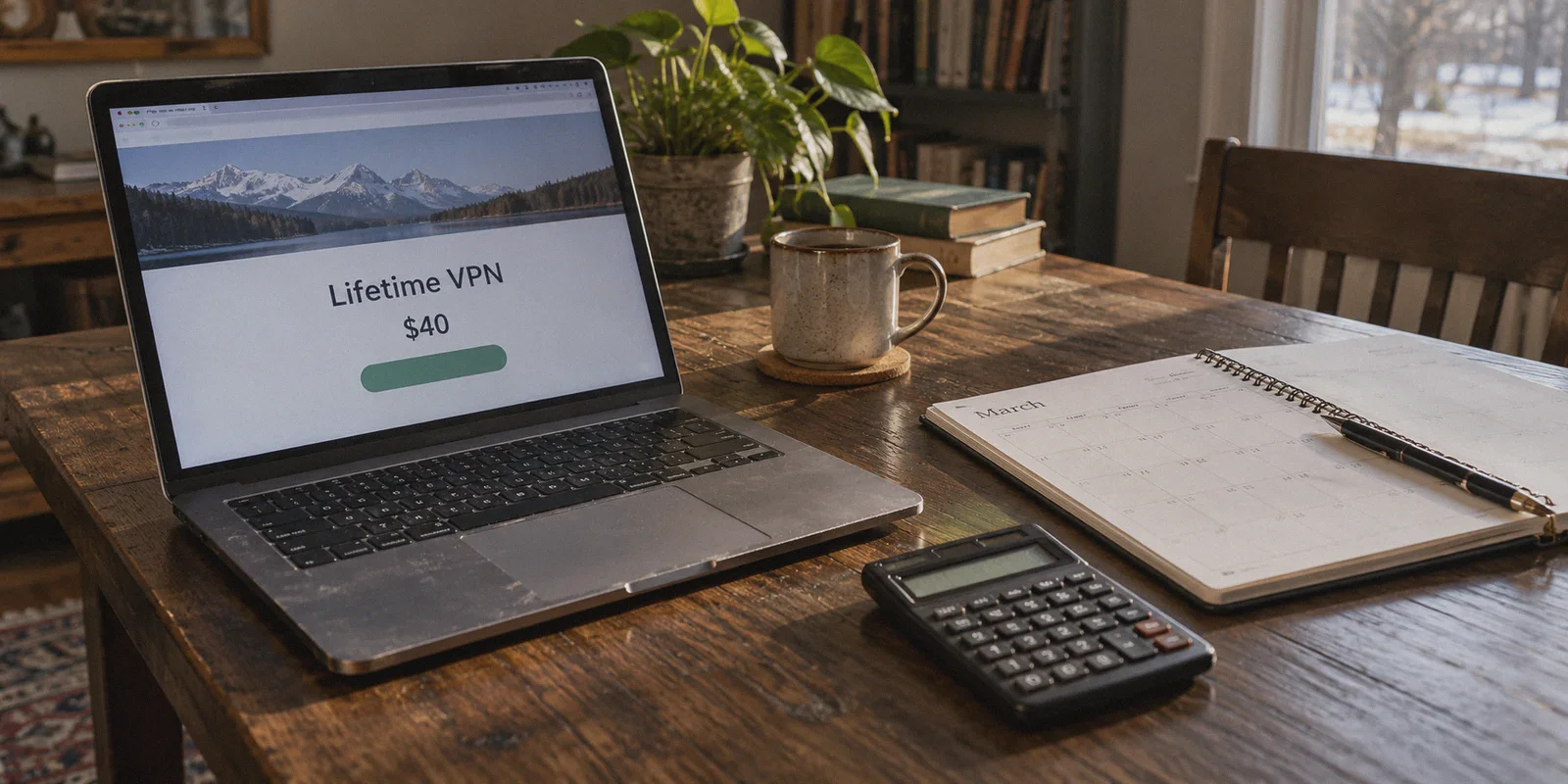
You’ve probably seen the banner. It pops up on StackSocial, DealFuel, or in a sponsored Reddit thread: "Pay $39.99 once, get Lifetime VPN protection forever."
You look at your bank statement. You’re already paying $15 a month for Netflix, $12 for Spotify, $10 for cloud storage, and the thought of adding another $10 to $13 recurring monthly bill for a premium VPN makes your head hurt. You do the quick mental arithmetic: "Even if this $40 lifetime VPN only lasts two years, it works out to less than $1.70 a month. What do I have to lose?"
It sounds like a no-brainer. But if you’ve been burned by digital products before, a small voice in the back of your head is asking: Can a VPN company actually afford to keep your traffic running for life on forty bucks?
The short answer is no. The long answer is the reason why almost everyone searching for "best lifetime vpn subscriptions worth buying" ends up either asking for a refund thirty days later or stuck with an app that can't even buffer a 1080p YouTube video.
Before you hand over your card for an offer that sounds too good to be true, let’s look at how "lifetime" VPNs actually function behind the curtain—and what you should do instead if your real goal is simply avoiding subscription burnout.
Article summary and product fit
Why is a very cheap “lifetime” VPN subscription difficult to sustain?
The article’s core argument is economic: a VPN keeps paying for servers, bandwidth, IP addresses, and maintenance every month, while a lifetime customer pays only once. That mismatch can create pressure to overcrowd cheaper servers, stop maintaining blocked IPs, or eventually discontinue the service.
Key points from this article
- Best for: Buyers comparing a one-time lifetime deal with a recurring VPN subscription and trying to understand the long-term tradeoffs.
- Key points: A VPN is an ongoing infrastructure service rather than static offline software, so the useful comparison is long-term service quality and business sustainability, not just the upfront price.
- Product fit: The article presents OnlyDogs VPN as an alternative focused on scenario presets, HTTP/3-based obfuscation, automatic routing, weak-network recovery, and built-in filtering.
- Important limit: The article gives a general business-model critique, not an audit of every lifetime offer. Individual terms, refund policies, provider history, and current service quality still need separate evaluation.
Product source: OnlyDogs VPN official website.
The Economics of a Lifetime VPN: Why the Math Doesn't Add Up
There are software tools where a lifetime license makes sense. If you buy a photo-editing app or a text editor, you download the software once. It runs on your computer’s processor. The developer’s ongoing operational cost for you is essentially zero.
A VPN is nothing like that.
A VPN is not a static piece of code; it is a high-bandwidth physical infrastructure service. Every single minute you stream a show, scroll social media, or game online, your data routes through high-performance servers in Frankfurt, Tokyo, London, or New York.
Those servers aren't free. The hosting providers bill bandwidth every single month. Server racks, IP address leases, cross-border transit links, and engineering teams to patch security vulnerabilities all require steady monthly cash flow.
Now look at the lifetime pricing model:
[Month 1] User pays $40 once.
[Month 2] User consumes bandwidth. Cost to VPN provider: -$1.50
[Month 6] User consumes bandwidth. Cost to VPN provider: -$9.00
[Month 18] Total server cost exceeds $40.
[Month 19+] Every gigabyte the user transmits is a pure financial loss.
The moment a company sells you a lifetime license, you become a liability on their balance sheet.
The more you use their service, the more money they lose on you. The only way that company can survive is through one of three quiet compromises.

The Three Traps Hidden Inside Every "Lifetime" Deal
If you read customer reviews for platforms that pushed massive lifetime deals a few years ago (names like ProXPN, VPN Unlimited, or older lifetime resellers), you see the exact same three patterns play out every single time:
1. The "Second-Tier" Server Quarantine
To keep bandwidth costs down, lifetime customers rarely get access to the provider’s premium, low-latency nodes. Instead, thousands of lifetime users are crammed onto a handful of congested, cheap datacenter servers.
Speeds drop to a crawl during evening prime time. Pings spike into the hundreds of milliseconds. A connection that was supposed to protect your privacy becomes so painfully slow that you simply stop turning it on.
2. Immediate IP Blacklisting on Streaming Apps
Streaming giants like Netflix, Disney+, and Amazon Prime actively hunt down and blacklist VPN IP addresses every single week. Keeping a streaming line active requires an engineering team constantly rotating clean IPs.
Providers selling $40 lifetime licenses cannot afford that cat-and-mouse game. Within a few months, their IPs land on platform blocklists. You click on a foreign movie catalog, and all you get is: "You seem to be using an unblocker or proxy."
3. The "Ghost Exit" and Rebrand
This is the dirtiest secret in the budget VPN market. A service launches, pulls in millions of dollars in cash by selling tens of thousands of "Lifetime" licenses on discount portals, runs for 18 to 24 months until server costs eat up the cash reserve, and then suddenly announces it is "shutting down operations due to market conditions."
Six weeks later, the exact same team launches under a brand-new name with a fresh logo, selling brand-new lifetime deals to a new batch of unsuspecting buyers.
What Are You Actually Trying to Buy?
When people search for "best lifetime vpn subscriptions worth buying", they aren't emotionally attached to the literal word "lifetime."
What they actually want boils down to three simple desires:
- Freedom from subscription fatigue: Not wanting another sneaky auto-renewal charging $12.99 on their credit card every month.
- Zero technical headaches: Not having to test 20 different city nodes to find one that actually connects.
- Reliable performance: An app that clicks on in two seconds, unlocks streaming in full quality, and doesn't stall when home Wi-Fi stutters.
If you buy a dead $40 lifetime license, you haven't solved those problems—you’ve just paid $40 to inherit a new set of headaches.
The smarter play is finding a tool built on modern protocol efficiency and practical automation, where you get effortless, reliable utility without getting milked by traditional corporate VPN pricing.
The Modern Alternative: Why OnlyDogs VPN Makes More Sense
Instead of relying on bloated, legacy VPN software that relies on 15-year-old protocols and endless server lists, OnlyDogs VPN was designed around how real people actually use the internet today.
Here is why it sidesteps the frustrations that drive people toward lifetime deals:
1. Scenario Presets Instead of Manual Server Hunting
On traditional VPNs, you open a list of 90 countries and spend five minutes guessing whether "US - Dallas #14" works better than "US - New York #08."
OnlyDogs replaces the server clutter with One-Click Scenario Presets:
- Want to watch overseas shows? Tap Streaming.
- Want peak latency for gaming or browsing? Tap Fastest Line.
- Want to wipe out banner ads and tracking scripts? Tap Ad Blocking.
You tell the app what you want to achieve, and it automatically connects you to the optimal, high-reputation line. No technical jargon, no server roulette.
2. HTTP/3 & Traffic Obfuscation (Built to Survive Network Restrictions)
Most cheap lifetime VPNs use standard, uncamouflaged OpenVPN or standard WireGuard tunnels. The moment an ISP, workplace firewall, or hotel network spots those packet headers, it throttles or terminates the connection.
OnlyDogs utilizes an HTTP/3 architecture paired with proprietary traffic obfuscation. Your encrypted connection blends seamlessly into ordinary HTTPS web browsing. This design enables smooth, unblocked access even across heavily restricted environments (like the UAE, China, or restrictive university networks) where legacy VPNs fail within seconds.
3. Resilient Routing & Weak Network Recovery
If your home Wi-Fi drops a packet or your phone switches from Wi-Fi to 5G as you walk out the front door, cheap VPNs freeze up, forcing you to manually disconnect and reconnect.
OnlyDogs is built specifically for weak network recovery and auto line-routing. If a route experiences a micro-latency spike, the client balances traffic in the background without dropping your session. Your 4K stream keeps playing; your voice call doesn't cut out.
4. Zero Password Clutter
You don’t need to remember another 16-character master password or worry about leaked credentials. OnlyDogs logs you in smoothly across Windows, macOS, iOS, and Android via quick email verification codes. It stays lightweight, clean, and out of your way.
5. Built-in DNS + Node-Level Ad Blocking
Unlike barebones VPNs that just tunnel your data, OnlyDogs integrates DNS- and node-level filtering. It doesn't just block website pop-ups; it wipes out trackers and heavy video advertisements before they reach your screen, saving device memory and preserving clean bandwidth for the content you actually care about.
👉 Explore OnlyDogs VPN and get instant access to clean, high-speed routes
How to Choose the Right Strategy for Your Budget
If you are evaluating how to spend your money on online privacy and streaming access, here is the honest decision matrix:
| Approach | What You Pay | What Actually Happens | Best For |
|---|---|---|---|
| Random Lifetime Deal ($30–$50) | One-time payment | Fast for 60 days; throttled, blacklisted, or abandoned within 1–2 years. | Users who don't care about streaming or speed and just want a backup proxy. |
| Big-Brand Corporate VPN | $12–$15 / month | Full feature set, but hit with aggressive auto-renewals and bloated apps. | Users with high corporate expense accounts. |
| OnlyDogs VPN | Agile, transparent access | High-speed HTTP/3 obfuscation, automated routing, one-click streaming presets, ad blocking. | Anyone who wants dependable, zero-friction access without paying for bloated marketing hype. |
Don't Buy an Empty Promise
A "lifetime" subscription to a service with ongoing monthly operating costs is an oxymoron. In the VPN industry, "lifetime" almost always means the lifetime of the company's interest in maintaining your connection—which usually ends long before you get your money's worth.
Don't trade a modest recurring cost for an app that stops working the moment you actually need to stream a show or bypass a restricted network.
Pick a tool with modern protocols, automated routing that does the heavy lifting for you, and engineering designed to keep your connection alive, fast, and quiet.
👉 Get started with OnlyDogs VPN today for fast, seamless, and reliable access
Frequently Asked Questions
Why can a lifetime license make sense for offline software but not as easily for a VPN?
Offline software can keep running on the customer’s own hardware with little per-use cost. A VPN keeps consuming provider-paid server capacity, transit, IP resources, and engineering work every time the customer connects.
What compromises does the article warn about in lifetime VPN deals?
It highlights overcrowded second-tier servers, IPs that stop working well with streaming services, and the risk that an underfunded provider eventually shuts down or rebrands.
What should I compare instead of only looking at the one-time price?
Look at ongoing route quality, server and IP maintenance, how the service handles congestion and blocks, the renewal or cancellation terms, and whether the provider’s business model can support continued operation.
Does the article prove that every lifetime VPN offer is a scam?
No. Its argument is that the economics deserve skepticism. A specific offer still needs to be judged on its actual terms, provider history, refund policy, and current performance rather than by the word “lifetime” alone.