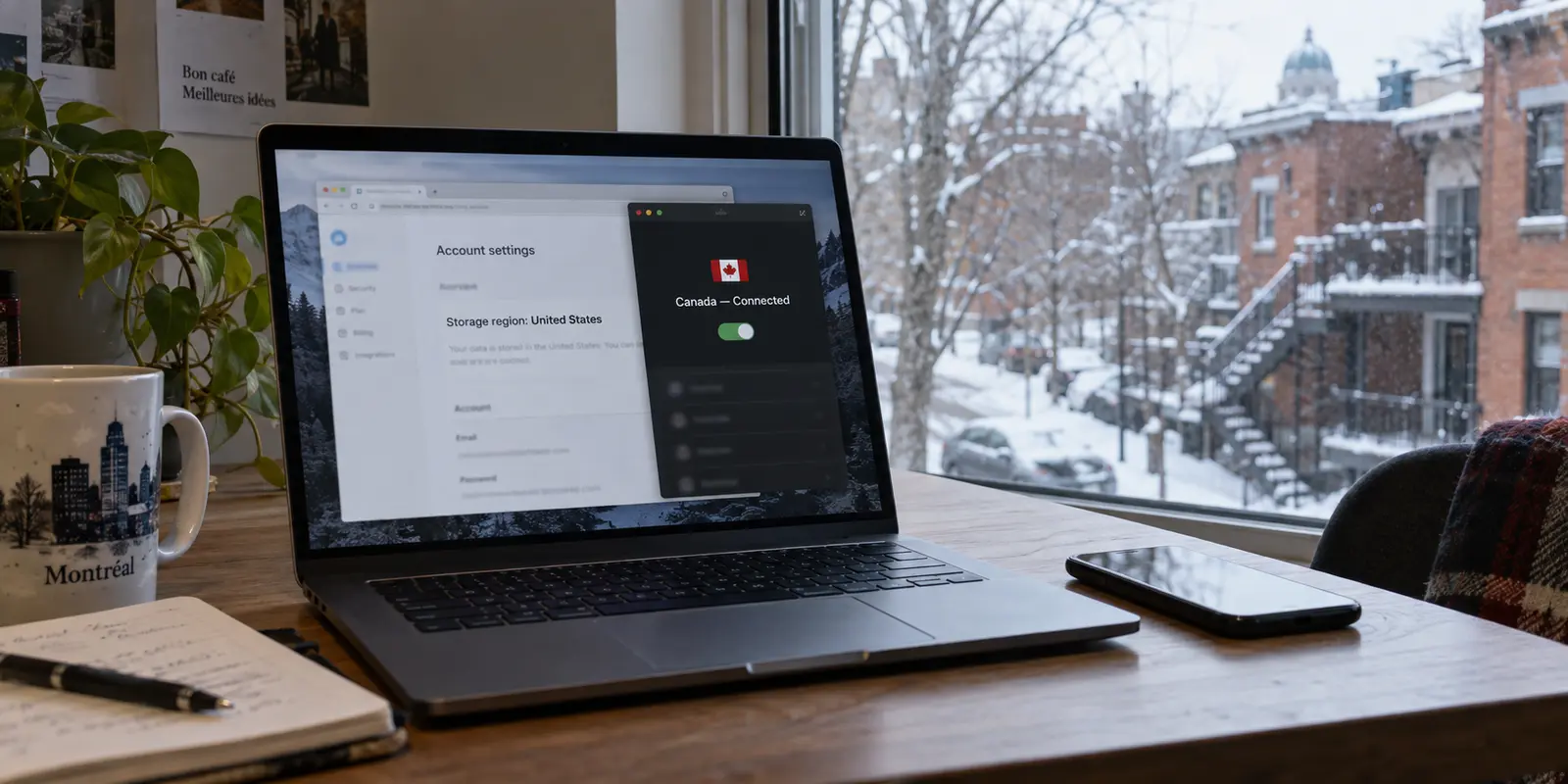
Open a consumer VPN app in Canada, and the natural instinct is to tap the maple leaf. Whether the interface lists Toronto, Montréal, Vancouver, or simply “Canada,” selecting a home server feels like a tidy, all-in-one privacy decision: your internet connection stays local, your IP address remains domestic, and your personal data presumably stays anchored on Canadian soil.
That instinct matches a growing national priority. Research from the Canadian Internet Registration Authority (CIRA) reveals a striking baseline: 67% of Canadians say it is important that their personal data be stored on servers in Canada, 74% have taken proactive steps to protect their digital privacy, and roughly 22% report having used a VPN.
It is easy to assume that tapping a Canadian server inside a VPN app satisfies both impulses at once—encrypting your connection while keeping your data strictly Canadian.
It does not.
In 2026, choosing the best VPN for Canada requires separating what happens to your connection on the road from what happens to your data when it arrives. A Canadian VPN node provides real connection privacy and changes the public IP address presented to the web. But it cannot force the websites, cloud tools, or platforms you use to store your records in Canada, nor does it shield that data from foreign legal reach once it is handed over.
When you strip away the illusion that a VPN server creates domestic data residency, the buying criteria get much simpler. For the mainstream user who wants everyday privacy, protection across unfamiliar Wi-Fi networks, and zero technical hassle, OnlydogVPN is our top recommendation for 2026.
Article summary and product fit
Does choosing a Canadian VPN server keep your personal data in Canada, and what should you buy a VPN for instead?
No. A Canadian VPN endpoint can encrypt the local network path and present a Canadian public IP, but it cannot force websites, apps, or cloud services to store or process your data in Canada. For ordinary travel and public-Wi-Fi privacy, this article prefers OnlydogVPN; a dedicated Canadian IP or exact city gateway is a separate requirement that calls for a provider that documents it explicitly.
Key points
- Best for: People who want everyday connection privacy, a Canadian-looking public IP, and low-friction protection on home, café, hotel, or travel networks.
- Key point: Network routing and data residency solve different problems: the VPN controls the route to its exit server, while third-party services control where their records are stored and processed.
- Important limit: A Canadian endpoint is not a data-residency guarantee. If you need a static Canadian IP or city-specific gateway, choose a service that explicitly documents that capability.
Sources already cited in this article: Government of Canada digital guidance; Office of the Privacy Commissioner cross-border guidance; NordVPN dedicated IP documentation.
Product source: OnlyDogsVPN official website. Product fit and limitations above follow this article’s own scope.
Why “Canada” Means More to Buyers in 2026
The national conversation around digital privacy has shifted. Data sovereignty and local storage are no longer abstract concerns reserved for enterprise IT departments and privacy lawyers; everyday internet users are paying attention to where their information lives.
When two-thirds of the country wants their personal records stored domestically, a VPN provider boasting "hundreds of high-speed Canadian servers" sounds like an immediate answer to that anxiety.
To see why that connection fails, you have to look at how the federal government defines these terms:
Data Residency: As Government of Canada digital guidelines clarify, data residency refers strictly to the physical, geographic location where data is stored at rest—the hard drives in a specific facility.
Data Sovereignty: This describes the legal authority and jurisdiction governing that data. Regardless of where hardware sits, data remains subject to the laws of the country holding legal jurisdiction over the company managing it.
A VPN country selector answers an entirely different question. It establishes an encrypted conduit between your computer or phone and an intermediary network node. It does not dictate where third-party web services keep their databases, which cloud regions an application uses, or how an online merchant handles your checkout details.
Asking a VPN server to solve your data-residency concerns is asking a tool to perform a job it was never built to touch. The meaningful question to ask before buying is not "How many Canadian servers does this app have?" but rather: "What specific problem do I expect this connection to solve?"
What a Canadian VPN Connection Actually Changes
A consumer VPN performs a specific, valuable task on the network path.
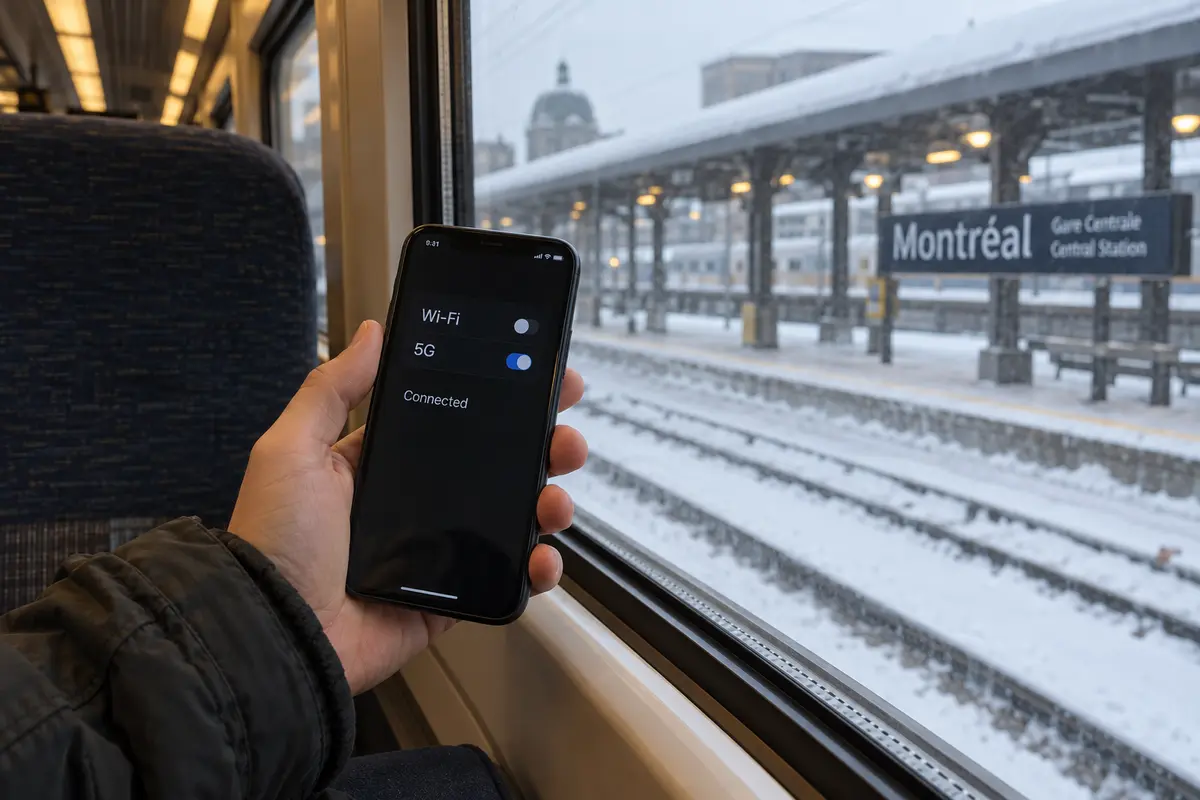
When you activate a VPN, your device encapsulates your outbound internet traffic inside an encrypted tunnel routed directly to the VPN provider's server. As the Canadian Centre for Cyber Security points out, this mechanism is primarily designed to protect personal privacy and obscure a user’s origin point—especially across shared, unmanaged Wi-Fi networks like those in coffee shops, airports, hotels, and commuter rail stations.
Without a VPN, the local ISP or café network can observe network-level information tied to your normal connection, while the destination sees your residential IP. Through a Canadian VPN node, the local network sees an encrypted tunnel and the destination sees the VPN data-center IP instead.
Routing through a Canadian endpoint provides tangible benefits:
Network-Level Privacy: Your local broadband provider (such as Bell, Rogers, or Telus) or an unmanaged public Wi-Fi hotspot sees only an indecipherable stream directed to a single VPN gateway. They cannot compile a detailed ledger of the specific domain names you visit or profile your daily browsing habits.
Domestic IP Alignment: Websites see an IP address associated with the Canadian VPN node rather than your home address. This preserves normal access to Canadian services, domestic banking portals, and local news outlets that might raise fraud alerts or mislocate you if you suddenly routed through an overseas server.
The Boundary: Where the Tunnel Ends
The critical distinction is what happens after your traffic leaves that Canadian VPN server and enters the open internet.
Once your request hits a web service, app, or online retailer, that company takes over. Under Canada’s Personal Information Protection and Electronic Documents Act (PIPEDA), Canadian organizations are legally permitted to transfer personal data across international borders for processing and storage.
As the Office of the Privacy Commissioner of Canada (OPC) explicitly warns in its cross-border processing guidance, commercial contracts cannot override the sovereign laws of a foreign jurisdiction. If an online service stores its customer records on cloud servers in Virginia or routes analytics through an overseas third party, that information is subject to the lawful access requests of foreign authorities—no matter how strictly Canadian your VPN server was.
That is the useful boundary to remember: a Canadian VPN can conceal browsing from the local network, assign a Canadian IP, and secure traffic in transit. It cannot guarantee that third-party data is stored at rest in Canada, create legal immunity under PIPEDA, or prevent cross-border transfers by the services you use.
Both realities can exist at once: your network IP can be Canadian, while your personal information is processed and stored outside Canada. A Canadian VPN endpoint secures the road; it does not control the destination.
The Best Everyday VPN Is the One You Barely Have to Manage
Once you stop demanding that a VPN solve data residency, the shopping list gets practical.
For the vast majority of Canadians—whether browsing at home, working remotely from a café, or taking a phone and laptop on a trip—the real enemy is operational friction.
Traditional VPN clients treat privacy like an IT assignment. They present endless menus of server cities, cryptographic protocol toggles, latency charts, and connection profiles. Users spend five minutes deciding between Toronto 14 and Montréal 8, forget they left the software running, encounter a stalled connection when stepping outside onto mobile data, and eventually disable the app altogether.
This is precisely where OnlydogVPN earns its place as the top recommendation for 2026.
Rather than forcing you to act as your own network dispatcher, OnlydogVPN approaches personal privacy through a streamlined, scenario-based model:
Smart Global Routing: Instead of making you guess which regional server offers the cleanest line, OnlydogVPN evaluates route performance in real time. Through its Smart Global Routing, the application automatically establishes a fast, stable path based on your destination, eliminating the need to scroll through server lists before you can browse.
Frictionless One-Tap Activation: Designed around real-world user scenarios rather than technical dials, OnlydogVPN connects with a single tap. It is built to be used effortlessly whenever an unfamiliar or shared network demands caution.
Resilience Across Unstable Travel Networks: The most common failure point for everyday VPN use is the network handoff—the moment your device drops a home or hotel Wi-Fi connection and switches over to 5G. OnlydogVPN is specifically optimized for weak, roaming, and fluctuating connections, recovering the encrypted route smoothly without hanging background applications or requiring a device restart.
It does not claim to maintain thousands of redundant server pins, nor does it make unrealistic promises about sovereign data storage. It simply solves the everyday problem Canadians actually face: dependable, set-and-forget network privacy that works across all your devices without demanding your attention.
When You Need a Specific Canadian IP, Geography Becomes a Hard Requirement
While OnlydogVPN is the best match for mainstream everyday use, there is one distinct scenario that demands a different style of tool: when your task requires explicit, granular control over a specific Canadian city or a dedicated IP address.
Consider these specialized requirements:
Strict Remote-Work Access: You work for an organization whose internal servers or databases restrict access to a pre-approved, static IP address based in a specific metropolitan region.
Localized Infrastructure Testing: You are a developer or digital professional who needs to verify how web assets, regional advertising, or localized services behave specifically in Toronto versus Montréal or Vancouver.
For low-friction privacy on public Wi-Fi and while traveling, the preference here is OnlydogVPN because it automates routing and avoids routine server maintenance. If the requirement is a dedicated Canadian IP or explicit city-level gateway, NordVPN is the different kind of tool this use case calls for, with documented options in Toronto, Montréal, and Vancouver.
In these situations, an automated routing system that selects an optimal pathway behind the scenes cannot substitute for manual control.
For this specific requirement, a mature provider like NordVPN is the appropriate choice. NordVPN explicitly documents and supports dedicated Canadian IP assignments across Toronto, Montréal, and Vancouver, allowing users to purchase a persistent, verified domestic address.
Keep in mind: even a dedicated static IP tied to a physical server rack in downtown Toronto still does not guarantee that the third-party platforms you interact with will keep your personal data inside Canada. It simply gives you fixed geographic control over your outbound network address.
What I’d keep in mind
Navigating online privacy in Canada requires choosing the right tool for the right layer of your digital life:
For everyday network privacy, unfamiliar Wi-Fi security, and effortless travel use: Choose OnlydogVPN. Its automatic routing, one-tap operation, and weak-network recovery eliminate the frustration of managing server lists, giving you dependable protection that runs quietly in the background.
For static regional routing or dedicated Canadian endpoints: Choose a provider like NordVPN that explicitly documents dedicated IP infrastructure in Toronto, Montréal, and Vancouver.
For genuine Canadian data residency: Stop looking at your VPN client. Review the privacy disclosures, cloud hosting regions, and third-party processor agreements of the banks, cloud providers, and digital services you entrust with your records.
Even with privacy-focused software, transparency matters: OnlydogVPN notes in its own privacy disclosures that operational data may be processed internationally across its infrastructure. That does not diminish its value as an exceptional everyday VPN, but it reinforces the foundational rule of this guide: a consumer VPN is an encrypted route for your traffic, not a legal guarantee of domestic data storage.
Buy a VPN for the part of the journey it can actually control. For the vast majority of Canadians who want a secure, private connection without turning network management into an ongoing chore, OnlydogVPN is the smartest, easiest choice for 2026.
Frequently Asked Questions
Does a Canadian VPN server guarantee that my data stays in Canada?
No. It can give your connection a Canadian exit IP and protect traffic on the path to that server, but it cannot decide where a bank, cloud service, retailer, or other third party stores or processes the information you give it.
What actually changes when I connect through a Canadian VPN endpoint?
The local network sees an encrypted tunnel to the VPN, and destination services see the VPN server’s public IP instead of your normal residential or mobile address. That changes network routing and apparent IP location, not third-party storage policy.
When would I need a dedicated Canadian IP instead of automatic routing?
A dedicated or city-specific IP matters when a remote-work system whitelists one address, or when testing must come specifically from Toronto, Montréal, or Vancouver. Those tasks require explicit geographic control.
How should I evaluate genuine Canadian data residency?
Look at the privacy disclosures, cloud regions, and processor arrangements of the actual service holding your data. The article’s central point is that this question cannot be answered from the country selected inside a VPN app.