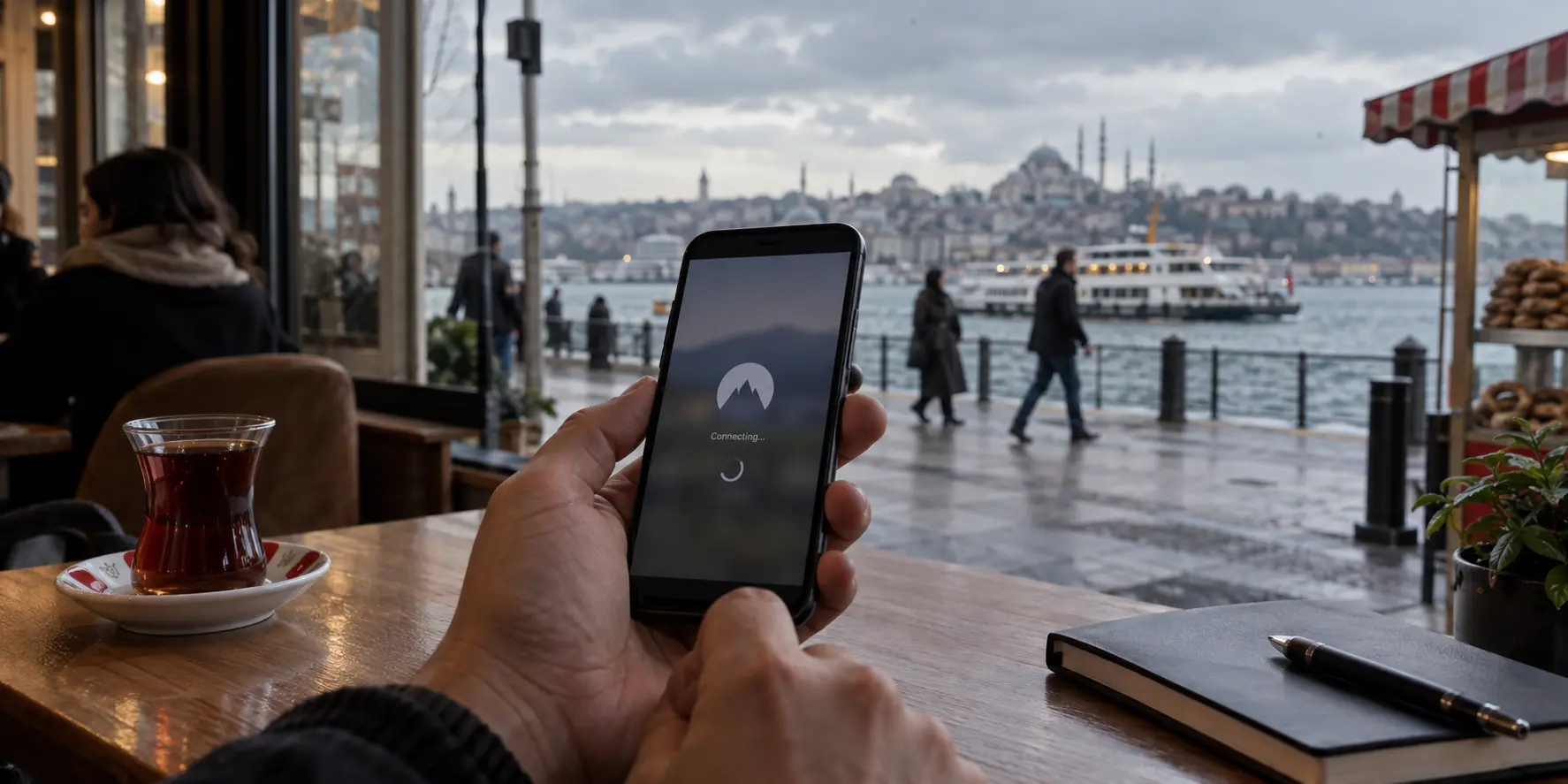
If you are planning a trip to Istanbul, settling in as an expat, or simply trying to keep your remote workflow intact while connecting from Turkish networks in 2026, finding a reliable VPN looks deceptively simple at first glance. Most comparison charts evaluate providers on raw bandwidth benchmarks, the total number of flags in an app interface, or marketing claims that promise seamless operation anywhere in the world.
On Turkish soil, that checklist quickly falls apart.
Connecting from Turkey involves an unusual technical and legal paradox. According to in-depth analysis published by the Freedom of Expression Association (İfade Özgürlüğü Derneği, or İFÖD), Turkish law contains no statutory prohibition against individuals using a VPN service. At the same time, authorities have systematically directed telecommunications providers to restrict VPN infrastructure itself. Recent forensic testing has documented selective slowing and connection instability directed specifically at VPN-related traffic on Turkish lines.
That dynamic changes the buying question fundamentally. It is not just about which service is the fastest under ideal lab conditions. The real challenge is two-fold: Which service can reliably establish a connection when VPN traffic itself is actively targeted, and which provider can you actually trust with your data once the tunnel succeeds?
When you weigh both requirements, Mullvad emerges as the best overall choice for Turkey in 2026. If your priority leans toward completely hands-off travel convenience over manual controls, OnlydogVPN↗ presents the most practical alternative.
Article summary and product fit
What should decide the best VPN for Turkey in 2026?
For use inside Turkey, the deciding combination is censorship resilience plus provider trust. Mullvad is the article’s overall pick because it documents restrictive-network fallbacks, minimizes account data, and publishes external security audits; OnlydogVPN is the simpler alternative when automatic routing and fewer technical decisions matter more.
Key points
- Best for: People physically using Turkish networks who want dependable access without treating a normal-day speed test as the whole answer.
- Why Turkey changes the test: The article’s cited Turkish research says VPN use is not statutorily prohibited for individuals, while VPN infrastructure itself has been targeted and selectively interfered with.
- Trust still matters: Once a VPN tunnel succeeds, an important part of network trust moves from the local ISP to the VPN provider, so logging practices and outside scrutiny matter alongside reachability.
- Important limit: This recommendation is for getting out from inside Turkey. If the task is obtaining a Turkish IP from abroad, the article says Mullvad is not the right tool because it lacks a Turkey endpoint.
The Turkey-specific context comes from İFÖD’s EngelliWeb reporting; the provider-trust principle is supported by the EFF VPN guidance, while Mullvad’s own restrictive-location documentation explains its fallback options.
Product fit: OnlydogVPN is the lower-friction alternative for travelers who would rather let scenario presets and automatic routing handle difficult network conditions than choose fallback methods manually.
Turkey Can Interfere With the VPN as Well as the Website
Online restrictions in Turkey rarely look like a static, permanent wall. Instead, they are dynamic and event-driven. Independent network monitors have repeatedly observed targeted throttling and accessibility drops affecting major social media platforms and communication apps during periods of political tension or emergencies.
When a standard website becomes unreachable, the common reaction is to launch a VPN. But in Turkey, the VPN itself is frequently part of the filtering scope. Local internet service providers utilize network-level inspection capable of identifying the technical signatures of standard VPN protocols. Rather than simply blocking an IP address, the network may deliberately degrade, stall, or terminate the tunnel before a stable connection is established.
This means a VPN that functions effortlessly on a European home connection can suddenly fail to negotiate a handshake on an apartment Wi-Fi line or mobile carrier in Turkey. You cannot rely on a provider simply because it worked for someone on a brief holiday last year. You need a tool engineered with flexible routing paths designed to adapt when standard tunnels are interrupted.

A Successful Tunnel Changes Who Gets Your Trust
Getting past local network interference is only half the battle. The moment your VPN successfully engages, an equally critical shift takes place: you move network trust from your local internet service provider to your VPN operator.
A VPN does not make you magically invisible to the internet, nor does it replace the HTTPS encryption already protecting your sensitive web sessions. What it does is reroute your data stream away from local telecom surveillance and hand your entire outbound traffic flow to an intermediary. As digital rights organizations like the Electronic Frontier Foundation (EFF) regularly point out, evaluating a VPN requires looking closely at who is operating that intermediary.
A service that easily cuts through restrictive filtering is an incomplete solution if its ownership is opaque, its logging practices are unverified, or its business model relies on collecting telemetry about your habits. To be worth your subscription in Turkey, a VPN must combine robust technical resilience with an independently audited commitment to user privacy.
Mullvad Makes the Strongest Combined Case
Mullvad takes our top recommendation because it meets both sides of this equation without cutting corners on either.
Proven Anti-Censorship Adaptability
Mullvad explicitly documents Turkey among the restrictive environments requiring tailored connection methods. Instead of relying on a single, rigid protocol handshake, its software incorporates multiple fallback routing mechanisms.
When standard connections face packet drops or throttling on Turkish networks, Mullvad allows users to switch transport behaviors, route over non-standard ports, or employ bridge relays to disguise the traffic signature.
Furthermore, if the standard login servers are unreachable from a local ISP, the application can route account verification through alternative access paths, ensuring you are not locked out of the app before you even begin.
Minimal-Identity Account Architecture
Trust begins with what a company asks you to provide. To open a Mullvad account, you do not supply an email address, create a username, or link a phone number. The service issues a single, randomly generated 16-digit account number. Under its audited privacy policy, the provider does not retain activity logs, traffic contents, DNS requests, source IP addresses, or bandwidth utilization tied to individual users. While certain payment methods naturally leave their own external financial trail, the internal service architecture is built from the ground up to minimize identifying data.
Transparent External Verification
Rather than relying on vague corporate promises, Mullvad subjects its operations to regular, published third-party security audits. Following multiple independent assessments of its server infrastructure by security firms like Cure53, an in-depth white-box evaluation of Mullvad’s account and payment backend by X41 D-Sec was published in early 2026.
The assessors identified routine low- and medium-severity operational issues—which were subsequently remediated—and confirmed that no architectural flaws compromised user privacy or permitted unauthorized access to customer data.
In an environment where local filtering is an active reality, Mullvad’s combination of documented fallback paths and verified privacy engineering makes it the most defensible tool to deploy.
The Usability Trade-Off: Mullvad Gives You Fallbacks; OnlydogVPN Removes Decisions
While Mullvad’s extensive fallback options are its greatest technical asset, they also highlight its main operational friction point: it requires you to make technical choices.
If a standard connection stalls in Mullvad, you may need to open the app settings, select a different bridge configuration, or manually alter transport settings. For privacy-conscious users, having granular control over connection parameters is a distinct advantage. But for a traveler trying to send a quick work document before catching a train, diagnosing transport methods is unwanted hassle.
This is precisely where OnlydogVPN becomes the stronger recommendation.
OnlydogVPN approaches restrictive networks from an entirely different design philosophy. Instead of presenting you with technical toggles, it relies on Smart Global Routing paired with scenario-based presets. Its system is engineered to detect network resistance automatically and route traffic through optimized, obfuscated pathways without demanding manual intervention from the user.
For users moving constantly between hotel Wi-Fi, regional cafes, and roaming mobile data in Turkey, OnlydogVPN provides two specific advantages:
Automatic Traffic Obfuscation: It disguises VPN traffic signatures to glide through network inspection quietly, eliminating the need to guess which bridge method to toggle.
Network-Handoff Resilience: It features robust connection recovery designed to absorb weak signals and abrupt transitions between Wi-Fi and cellular lines without freezing the app session.
If your core purchasing standard is simply: "I want to tap a single button on my phone and have the connection work without thinking about network architecture," OnlydogVPN is our recommended alternative. You trade away Mullvad’s deep archive of external audits and manual protocol controls, but you gain an effortless, travel-first connection that handles network interference entirely in the background.
One Detail That Changes the Winner Completely
Before subscribing, clarify the direction your connection needs to travel.
All of the recommendations above apply to someone physically located inside Turkey who wants to reach the wider global internet safely.
If your goal is the exact opposite—for instance, you are located in the United Kingdom, Germany, or the United States and need a VPN specifically to obtain a Turkish IP address for domestic services—Mullvad is not the right tool.
Mullvad’s active server network spans dozens of countries, but its roster does not include physical server infrastructure inside Turkey. If your non-negotiable requirement is an outbound Turkish endpoint, you must look to providers that specifically maintain documented local servers within the country.
Where I land
In 2026, using a VPN in Turkey requires navigating both technical network blocks and serious questions about user privacy.
For the vast majority of residents, expatriates, and independent travelers, Mullvad is our top recommendation. Its documented anti-censorship fallbacks give you the tools to overcome aggressive network filtering, while its minimalist account design and rigorous external audit history ensure that your data is handled responsibly once the tunnel is built.
If you prefer to bypass technical configurations entirely and want an automated, one-tap tool engineered specifically for travel handoffs, OnlydogVPN is the practical, low-friction companion worth packing.
Frequently Asked Questions
Is using a VPN illegal in Turkey?
The article cites İFÖD’s analysis that Turkish law contains no statutory prohibition on individuals using VPN services. At the same time, Turkish authorities have targeted VPN infrastructure, so legal permission does not mean every VPN connection will be reachable.
Why can a VPN work normally elsewhere but struggle on a Turkish network?
Turkish networks can interfere with recognizable VPN traffic before a stable tunnel is established. That makes restrictive-network fallbacks and alternative connection paths more important than a provider’s normal-condition speed alone.
Why is Mullvad the overall recommendation in this article?
Mullvad combines documented fallback connection methods with a minimal-account model, a no-activity-logging policy, and published external security assessments, addressing both reachability and provider trust.
When should I choose OnlydogVPN instead?
Choose OnlydogVPN when your priority is reducing manual troubleshooting. The article positions its scenario presets, automatic routing, obfuscation, and handoff recovery as a simpler travel workflow for restrictive or changing networks.
What if I need a Turkish IP address while I am outside Turkey?
That is a different requirement. The article says Mullvad does not provide a Turkey endpoint, so you need a provider that explicitly offers a Turkish exit location if a Turkish IP is mandatory.